

The Baltic Defense Line: Military Necessity and Civilian Protection on NATO’s Eastern Flank
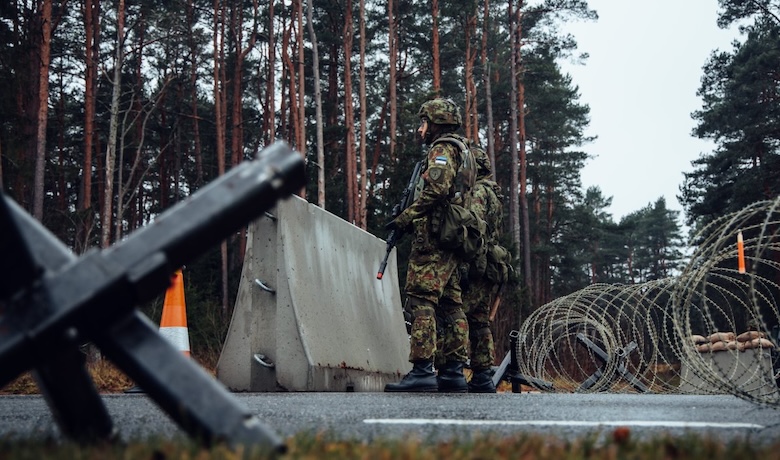
Europe’s easternmost flank is undergoing one of the most strategically calibrated defensive preparations since the Cold War. Estonia, Latvia, and Lithuania are coordinating the construction of the Baltic Defense Line, a sophisticated network of trenches, bunkers, observation posts, anti-armor obstacles, and surveillance systems stretching along their borders with Russia and Belarus. The initiative is designed to delay and channel any potential Russian advance, to buy time for the deployment of reinforcements under Article 5 of the North Atlantic Treaty, and to impose operational costs on the attacker.
While the military rationale is clear, a key question is how these measures align with the law of armed conflict (LOAC). The issue is not whether the construction is lawful, but whether it advances LOAC’s core purpose of civilian protection in practice. That inquiry hinges on how the fortifications balance interlinked legal principles of military necessity (para. 2.2.3) and the precautionary obligations under Article 58 of Additional Protocol I (AP I). Worth particular scrutiny is the requirement to take measures to distance civilians and civilian objects from military objectives, and to avoid locating such objectives in or near densely populated areas.
Strategic Shaping Operation
The Baltic States present the Baltic Defense Line (BDL) as a system of layered defensive positions designed to channel and delay an adversary’s advance, rather than a static barrier to be held at all costs (see statements from Estonia, Latvia, and Lithuania). This framing underscores the BDL’s intended interoperability with NATO’s regional defense plans and its integration into broader multinational operational concepts.
The system is being constructed in three principal layers. Along the most likely avenues of approach, identified through joint NATO-Baltic operational planning, are engineered obstacles and anti-vehicle barriers paired with pre-surveyed firing positions for anti-armor weapons. Hardened infantry bunkers, trench systems, and command posts form interlocking fields of fire while providing shelter from artillery and aerial attacks. Observation towers, ground sensors, and integrated drone reconnaissance assets feed real-time data into NATO and national command structures.
By slowing and canalizing attacking forces, the BDL aims to give NATO’s Very High Readiness Joint Task Force the time needed to cross from staging areas in Poland and Germany to the Baltic front. In the language of operations, BDL’s function is to shape the battlespace in favor of the defender, through to “deep operations.” From a military necessity perspective, forward positioning is integral. Estonia, the northernmost Baltic State, is less than 200 kilometers wide at some points; without effective forward resistance, Russian mechanized forces advancing from the border could threaten the capital city, Tallinn (p. 113).
Certain segments of the BDL are intended to be abandoned as the tactical situation develops, trading ground for time while preserving force integrity. Other components are designed for flexibility, enabling defenders to conduct a fighting withdrawal while maintaining the ability to delay, disrupt, and funnel advancing formations into engagement areas of the defender’s choosing. This mobility-minded approach allows the BDL to serve its purpose without locking defending forces into positions that could be bypassed or encircled, thereby preserving operational capability throughout successive defensive phases.
Legal Framework
There is no LOAC prohibition on a State constructing defensive fortifications in peacetime. The Hague Regulations of 1907, which codify much of the pre-First World War customary law on land warfare, regulate the conduct of hostilities but impose no ban on military works constructed before a conflict begins. Similarly, the Geneva Conventions and their Additional Protocols address the protection of persons and property during armed conflict, not the legitimacy of building defenses in anticipation of such conflict.
The legality of fortifications in peacetime rests on the basic premise of sovereign rights. States may take measures to ensure their defense so long as those measures do not themselves breach other obligations such as arms control treaties, environmental conventions, or specific bilateral agreements (e.g., S.S. Lotus, p. 19).
Given the geography of the Baltic region, enemy forces might reach capital cities before NATO’s rapid reaction forces can deploy, absent forward fortifications. Constructing such defenses is thus militarily necessary to shape the battlespace and reinforce the credibility of the alliance’s defensive guarantee, aligning with NATO’s concept of “forward defense.” However, necessity does not override the requirement to take precautions to protect civilians. This is where the “maximum extent feasible” standard in Article 58 of AP I becomes critical. Even when military necessity demands placing fortifications in certain locations, defenders must still evaluate whether civilian exposure can be reduced without compromising the core military advantage.
Feasible Precautions
Article 58 of AP I requires that parties to a conflict:
(a) … remove the civilian population, individual civilians and civilian objects under their control from the vicinity of military objectives;
(b) avoid locating military objectives within or near densely populated areas;
(c) take other necessary precautions to protect the civilian population … from the dangers resulting from military operations.
A widely cited operational-law definition of “feasibility” appears in Article 1(5) of Protocol III to the 1980 Convention on Certain Conventional Weapons (CCW). It describes “feasible precautions” as those measures that are “practicable or practically possible, taking into account all circumstances ruling at the time, including humanitarian and military considerations.”
State practice and negotiating history suggest that Article 58(a)-(b) of AP I has never been understood as imposing an absolute prohibition on locating military objectives near civilian areas. Rather, it is a qualified obligation applied “to the maximum extent feasible” and subject to national defense requirements (Official Records of the 1977 Diplomatic conference, Italy, p. 232; see also statements by the Federal Republic of Germany, United Kingdom, Netherlands, p. 214, Canada, p. 224, and Cameroon, p. 239). The Republic of Korea clarified that sub-paragraph (b) “does not constitute a restriction on a State’s military installations on its own territory” (p. 234-235). This interpretation is reflected in the U.S. Department of Defense Law of War Manual (§ 5.2.3.1). Importantly, the International Committee of the Red Cross (ICRC) Commentary to Article 58 stipulates that “a Party to the conflict cannot be expected to arrange its armed forces and installations in such a way as to make them conspicuous to the benefit of the adversary.”
Applied to the BDL, the feasibility test operates at two levels. Strategically, planners must consider whether fortifications can be sited to minimize civilian proximity without undermining their delay and channeling functions. Tactically, once hostilities begin, commanders must take practicable steps, such as advance evacuation of border settlements, reinforcing civilian shelters, or rerouting military supply lines, to reduce civilian risk without negating the BDL’s operational purpose (AP I, arts. 57-58; ICRC Customary International Humanitarian Law Study, rule 22). Russia’s documented pattern of disregarding civilian protections in Ukraine recalibrates the assessment of what is “realistically possible” in safeguarding civilians (see here, here, here, and here). In this case, the standard of “all feasible precautions” must be understood against concrete threat behavior, not in terms of idealized defensive geometry.
The Example of Mariupol in 2022
LOAC imposes parallel obligations on defenders and attackers. Even where defensive positions are located near civilian areas, the attacker remains bound by the principles of distinction and proportionality (AP I, arts. 48, 51) and must take all feasible precautions in attack (art. 57). The feasibility requirement for the attacker, as for the defender, is not absolute but assessed on a standard of reasonableness in light of the circumstances ruling at the time. However, Russia’s record in Ukraine means that the Baltic States must approach this assessment with heightened caution. The siege of Mariupol is a case in point.
When Russian forces surrounded Mariupol in late February 2022, the port city became the site of some of the most destructive urban combat in Europe since the Second World War. Within weeks, the siege cut electricity, water, heating, and communications. Civilians faced death from shelling, deprivation, and the inability to access medical care and Russian forces conducted attacks without regard for the principles of distinction or proportionality.
Ukrainian forces established defensive positions in the Azovstal steelworks, making them a legitimate military objective under Article 52(2), given the contribution to military action. However, the presence of military objectives within the city did not justify indiscriminate or disproportionate attacks. The Organization for Security and Cooperation in Europe (OSCE)’s Moscow Mechanism report documented repeated Russian shelling and airstrikes against civilian objects with no evident military presence. The most infamous example was the March 16, 2022 strike on the Mariupol Drama Theatre, which satellite imagery confirmed was marked with the word “children” in large Cyrillic letters visible from the air.
Russian officials made unsubstantiated allegations that Ukrainian forces were using civilians as “human shields” to justify repeated strikes on populated areas. Under Article 51(7) of AP I, using the presence of civilians to shield military objectives is prohibited. However, the OSCE Office for Democratic Institutions and Human Rights found no evidence of a systematic policy of this kind (p. 35). In the context of the BDL, the takeaway is that compliance with precautions obligations under Article 58 may reduce legal risk for the defender but does not ensure reciprocal compliance by an adversary. Civilian protection must therefore be built into defensive planning on the assumption that the attacker may disregard its obligations.
The purpose of this post is not to fault Ukraine’s passive precautions. Rather, it is to use the example of Ukraine to highlight a hard reality: even full compliance with Article 58 does not guarantee the attacker plays by the rules. In the Baltic context, if the BDL slows, channels, and bleeds a Russian advance, the likely response from Russia is harsher and less discriminating in means and methods. That never relaxes the defender’s duties under LOAC; it sharpens them. Passive protection measures under Article 58 must be built in from the outset and kept continuous, adaptive, and dynamic throughout the operation as the threat evolves.
Concluding Remarks
The BDL is a time-distance factor in the most literal operational sense. Forward obstacles and prepared positions create the temporal depth needed for NATO’s rapid reaction forces to deploy, which is the strategic hinge on which the credibility of collective defense turns. In this respect, its “time-buying” function is inseparable from the defender’s obligations under Article 58 of AP I. The BDL aims to provide the operational space for national authorities to execute evacuation plans, move civilians out of the vicinity of military objectives, reinforce shelters, and re-route essential services.
Its design also serves other military objectives: forcing the attacker into predictable avenues of approach; stretching their logistics; and increasing the operational cost of every kilometer gained. By funneling advancing formations into engagement areas suited to the modest numbers of initial defending forces, the BDL helps maximize the combat effect of those forces before NATO reinforcements arrive.
In a security environment shaped by an adversary with a documented record of disregarding its own LOAC obligations, designing the BDL with integrated civilian-protection measures is not only legally prudent, but also operationally sound. It anticipates that compliance by the defender may not be met with reciprocity, and it turns the BDL from a purely military construct into a bridge between strategic deterrence, operational necessity, and the humanitarian imperatives embedded in LOAC.
***
Davit Khachatryan is an international law expert and researcher with a focus on operational law, international criminal law, alternative dispute resolution, and the intersection of various legal disciplines.
The views expressed are those of the author, and do not necessarily reflect the official position of the United States Military Academy, Department of the Army, or Department of Defense.
Articles of War is a forum for professionals to share opinions and cultivate ideas. Articles of War does not screen articles to fit a particular editorial agenda, nor endorse or advocate material that is published. Authorship does not indicate affiliation with Articles of War, the Lieber Institute, or the United States Military Academy West Point.
Photo credit: Estonian Defence Forces
