

Military Animals in Armed Conflict
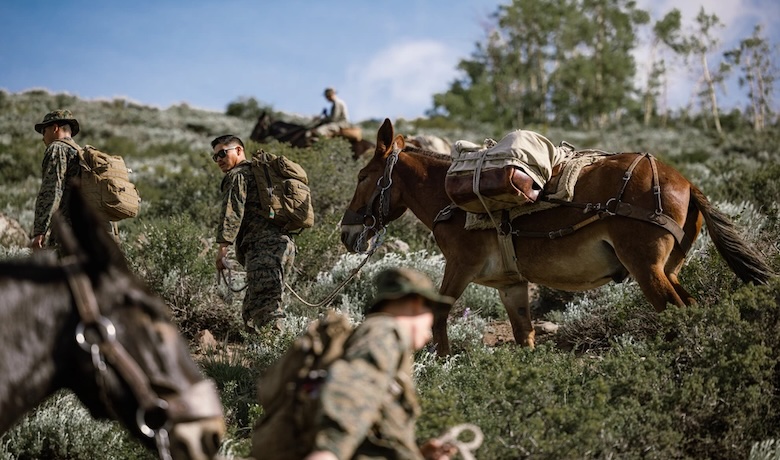
For much of human history, armies have relied on military animals to prosecute wars. Horses have served as means of transportation and tactical maneuver since ancient times. Mules, donkeys, camels, and other pack animals have been critical to supplying armies in the field. Other animals have performed more specialized functions, including explosives detection (dogs), message delivery (pigeons), poison gas detection (canaries), and mine clearing (dolphins and sea lions). Hannibal even employed elephants in his struggle against Rome during the Second Punic War.
Technology has generally reduced the reliance on animals on the modern battlefield, but military animals can and do continue to play a role in armed conflict. In Ukraine, reports have indicated that Russian forces are using horses and donkeys to carry troops and supplies to the front lines. In some cases, these animals are being used to replace vehicles, which are in short supply. In other cases, the use of animals appears intended to improve survivability and the delivery of supplies in the otherwise high-tech war. Because the animals are less conspicuous than motorized vehicles, they are less likely to be targeted by enemy drones operating at or near the front. The animals are also capable of carrying greater loads than the delivery drones that have become common in the conflict.
Despite these apparent advantages, it is unclear whether Russia’s renewed interest in military animals is the beginning of a trend in the war. The conflict has featured a surprising mix of old and new technologies—from caltrops and makeshift “cope cages” to autonomous drones and invisibility cloaks—and it is difficult to predict how each, either individually or in combination, might affect military operations. Nevertheless, because military animals have been reported on the battlefield, it is worth reviewing how the law applies to them in armed conflict.
This post examines the law applicable to military animals rather than animals in general. Accordingly, some categories of animals, including livestock and wild animals, are not the focus.
Military Animals as Objects of Attack
Under the law of targeting, only combatants and military objectives may be made the object of attack. This requirement derives from the principle of distinction, which requires that parties to an armed conflict distinguish between civilians and combatants and between civilian objects and military objectives and that they direct operations only against military objectives (Additional Protocol I (AP I), art. 48; U.S. Department of Defense (DoD) Law of War Manual, § 2.5). Military objectives are objects which “by their nature, location, purpose or use make an effective contribution to military action and whose total or partial destruction, capture or neutralization, in the circumstances ruling at the time, offers a definite military advantage” (AP I, art. 52(2)). Traditionally, military animals have been regarded as objects and military objectives by use or purpose, although some scholars believe this approach is ripe for reconsideration.
Outside the targeting context, the law of armed conflict also permits the seizure or destruction of enemy property for reasons of imperative military necessity (Hague Convention IV, Regulations, art. 23(g)). Various law of war treaties refer to animals as objects and property. For example, the Hague Regulations and the Third Geneva Convention explicitly mention horses among the property that may be lawfully confiscated from prisoners of war. An International Committee of the Red Cross (ICRC) 2020 Commentary to Article 18 of the Third Geneva Convention observes, “Horses are still included in this provision, even though they had already widely fallen out of use at the time of drafting and feature even less in contemporary armed conflicts.” Meanwhile, Article 54(2) of Additional Protocol I cites livestock among other examples of “objects indispensable to the survival of the civilian population.”
In the United States, military animals are formally recognized as property but are also treated differently than other property. For example, a U.S. armed forces instruction on military working dogs describes the acceptance of dogs as “Government property” but also requires that they be treated “with dignity and respect throughout their lives.” U.S. statutory law further mandates that all military animals must be made available for transfer or adoption under certain circumstances, including when they are no longer needed by the military. Although these provisions exceed what is ordinarily required of property, military animals nevertheless remain property under the existing law of armed conflict. The status of animals as property, however, is the subject of ongoing debate.
As objects and property, military animals are subject to the same rules as other military equipment in armed conflict. That means they can be attacked as military objectives under the law of targeting. They can also be seized as war booty or destroyed under the law applicable to military operations short of attack. Additionally, when employed exclusively for medical transportation, military animals are entitled to protection as medical transports, a term which an ICRC Commentary to Additional Protocol I explains should be understood expansively to include any means of transportation, “from the oxdrawn cart to the supersonic jet” (see Geneva Convention (GC) I, art. 35; GC IV, art. 21; AP I, art. 21; AP II, art. 11).
Military Animals as Weapons
The use of military animals has not been limited to hauling, transportation, and the performance of specialized tasks in armed conflict. Military animals have also served as weapons of war. In Shakespeare’s Julius Caesar, Mark Antony speaks of letting “slip the dogs of war,” an apparent reference to the release of war dogs onto the battlefield. Evidence that war dogs were actually employed as fighters in the front rank of battle can be found in Pliny the Elder’s Natural History. Other animals, including pigs, elephants, pigeons, bats, and even insects, have also been weaponized for use in war, with varying success. For example, during the Chremonidean War, the Megarians directed war pigs smeared with pitch and set afire against Macedonian war elephants, and during the Second World War, the United States planned to attack Japanese cities with bat bombs—weaponized bats strapped with small incendiary bombs.
When employed as weapons, animals are subject to the same laws governing other weapons in war, yet States regularly overlook applicable legal rules with respect to military animals. Among these is the obligation to review weapons for compliance with international law. Article 36 of Additional Protocol I requires State parties to conduct formal reviews of new weapons and means and methods of warfare. Whether such reviews are also required as a matter of customary international law is open to debate. Regardless, weapons reviews have been described as a “best practice for the implementation of customary and treaty law relating to weapons, means, and methods of warfare.” Among other things, weapons reviews ensure new weapons are not indiscriminate or of a nature to cause superfluous injury or unnecessary suffering. (Incidentally, a footnote in the U.S. Law of War Manual cites bat bombs as a rare example of an inherently indiscriminate weapon.)
Despite examples of their use as weapons, no State has formally acknowledged that military animals could qualify as weapons or means or methods of warfare. Unsurprisingly, then, no State has confirmed performing weapons reviews of military animals either. In “Animals as War Weapons,” Chris Jenks argues,
If [international humanitarian law] insists on treating animals as objects then states should be held to account for when those ‘objects’ constitute weapons. Ideally increased public scrutiny of animals as weapons could lead to states disavowing their use and even signing a declaration to that effect. But at a minimum, states using animals as weapons should have to own their actions and perform the required legal review. (p. 163).
Professor Jenks further suggests that the treatment of animals as weapons could help inform the ongoing debate regarding lethal autonomous weapon systems (LAWS) which, like animals, have no agency, cannot assume legal obligations, and are considered objects under the law of armed conflict.
Concluding Thoughts
A reliance on animals in contemporary conflict might seem like an anachronism, but in truth, militaries have always maintained an interest in animals’ capabilities in war. Although there is growing interest in providing animals with greater protection in wartime, the lex lata of armed conflict regards animals as objects and property. Accordingly, military animals may be treated like other military objects, and when employed as weapons, they should be subject to the same regulations as other weapons of war.
***
Ronald Alcala is a Colonel in the United States Army. He is an Academy Professor of Law and Associate Dean for Strategy & Initiatives at the United States Military Academy, West Point, N.Y. He also serves as Executive Editor of Articles of War and Executive Editor of the West Point Press.
The views expressed are those of the author, and do not necessarily reflect the official position of the United States Military Academy, Department of the Army, or Department of Defense.
Articles of War is a forum for professionals to share opinions and cultivate ideas. Articles of War does not screen articles to fit a particular editorial agenda, nor endorse or advocate material that is published.
Photo credit: Lance Cpl. Justin J. Marty, U.S. Marine Corps
