

Putting the Canadian in IHL: The Canadian Handbook on International Humanitarian Law
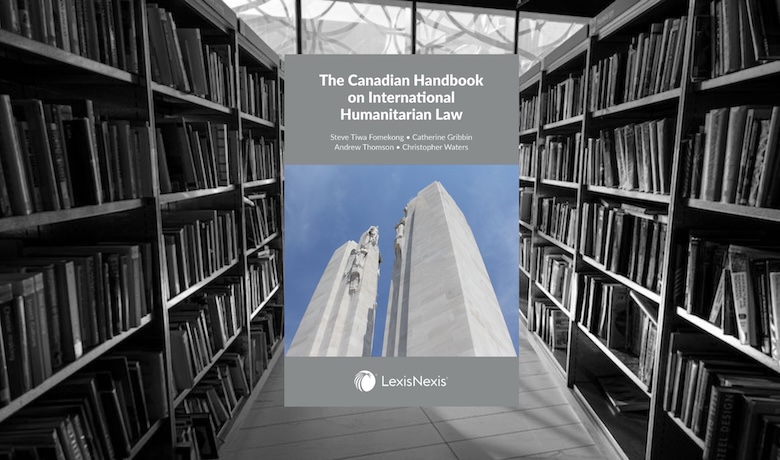
The International Committee of the Red Cross observes that “[t]he rules of war are universal.” Few would dispute that as a general statement, particularly considering the universal ratification of the Geneva Conventions. However, as we move from general propositions towards specific interpretations and applications of these rules, variance emerges within and between States. The differences have fueled academic debates and posed challenges at the doctrinal, strategic, and tactical levels of governments and their militaries as they reconcile their own legal interpretations with those of allies and opponents. As a result, international humanitarian law (IHL) practitioners, both inside and outside government, devote considerable time and effort to identifying and understanding these differences, operationalizing them, and assessing compliance.
A New Handbook
Against this backdrop, the project that became The Canadian Handbook of International Humanitarian Law (hereinafter, the “Handbook”) examines how Canada interprets and applies IHL. Three considerations motivated the project. First, there is comparably limited publicly available information on Canada’s approach to IHL. Snippets can be found in judicial rulings, submissions to international bodies, publicly available Canadian Armed Forces doctrine, and occasional public statements. However, there is no recent analogue to the United States’ Department of Defense Law of War Manual that sets out national positions in detail.
The Canadian Law of Armed Conflict (LOAC) Manual dates back to 2001, predating, among other operations, Canada’s engagement in Afghanistan from 2001 to 2014. While it remains a valuable guide, it is a summary in nature and somewhat outdated. Canada’s recently released The Soldier’s Handbook on the Law of Armed Conflict Applicable to Land Warfare, though significant in its purpose and clarity, does not provide much further insight into Canada’s specific legal interpretations. Except for cyber operations, there have historically been few instances in which the government has publicly articulated its IHL positions in sustained and detailed form.
Second, Canada has developed a distinctive approach to IHL. This approach is anchored in the country’s evolution as a middle power, and contemporary foreign and defence policy that emphasizes international institutions, alliances, multilateralism, and coalition operations. In many respects, Canada’s IHL policies and practices have prioritised interoperability and civilian protection.
Thirdly, there is a distinctive community of IHL practice in Canada, among government, civil society, and academic lawyers. Relationships among these actors are both established and ad hoc, including, for example, through the Canadian National Committee on Humanitarian Law, which issued a useful Voluntary Report on the Implementation of IHL at the Domestic Level in 2024. Although broader public engagement with IHL remains low, the authors of the Handbook reflect the small but closely connected IHL community in Canada, coming as we do from various military, governmental, humanitarian, and academic perspectives (while writing only in our individual capacities).
This first consideration—the fragmentation and limited accessibility of Canadian IHL doctrine—warrants further elaboration, as it has shaped our approach to the Handbook. Academically, the dispersion of Canadian positions across sources constrains the development of a visible Canadian contribution to comparative debates in IHL. Practically, it complicates interoperability, legal risk assessment, and accountability in coalition environments where interpretive differences may have strategic and tactical implications.
Fostering Legal Interoperability
To be clear, Canada’s established alliances have achieved, by necessity, legal interoperability in part through collaboration between IHL practitioners to achieve workable, practical operating approaches. The most prominent and enduring day-to-day collaboration is with the United States in the North American Aerospace Defense Command (NORAD). In the context of the North Atlantic Treaty Organization (NATO), NATO’s Rules of Engagement also provide a basis for working towards interoperability in its missions.
Nonetheless, emerging conflicts and new technologies will continue to place demands on time and resources for States to maintain legal interoperability. While institutions such as the Lieber Institute and the Naval War College Stockton Center play essential roles in fostering this collaboration, broader and more systematic expositions of States’ specific approaches to IHL remain necessary. This Handbook is intended as a contribution to that effort.
As States continue to plan for possible future conflicts alongside allies whose legal positions may diverge, the absence of easily accessible doctrinal sources becomes more than a scholarly inconvenience. Our response was to synthesize what exists, collating judicial reasoning, government submissions, diplomatic statements, military practice, and the insights of practitioners across sectors, from both English- and French-language sources. The effort was to make visible a Canadian approach that has remained largely dispersed, inaccessible, and unarticulated. The Handbook thus attempts to consolidate and clarify publicly articulated positions, while identifying areas where Canadian publicly available legal interpretation, including doctrine, remains underdeveloped or ambiguous. In doing so, it seeks to contribute both to domestic understanding and to Canadians’ engagement in national and global IHL discourse.
Recent Developments in the Canadian IHL Landscape
Perhaps the more interesting question now is not why we published the book just over one year ago, but what has developed since. Canada’s defence posture is evolving. Increasingly, the focus is on preparing for large-scale combat operations (LSCOs). Launched with little public fanfare in 2025, the Soldier’s Handbook, referenced above, signals a new type of IHL lawyering and practice in the Canadian Armed Forces.
When conducting land warfare, Canadian Armed Forces (CAF) members may not always have immediate access to legal advisors, particularly in the context of large-scale land warfare against a peer or near-peer State military.
The aim of the Soldier’s Handbook on the Law of Armed Conflict Applicable to Land Warfare is to provide CAF members with a clear and concise summary of the Law of Armed Conflict (LOAC) rules that apply, and, when necessary, empower them to make LOAC-compliant decisions without the benefit of real-time legal support (p. 3).
Recent developments beyond the Soldier’s Handbook also suggest an ongoing evolution in Canadian IHL practice. The Voluntary Report on the Implementation of IHL at the Domestic Level, mentioned earlier, marked a parallel step toward consolidating dispersed practice. Similarly, the modernization of weapons review processes, together with clearer public acknowledgements of these reviews, suggests a cautious normalization of transparency in areas traditionally characterized by operational sensitivity. These developments do not yet amount to a comprehensive and formalized Canadian IHL doctrine, but they nonetheless may reflect a discernible shift in approach that warrants attention.
Canada’s defence and security relationships have come under increasing and deep public examination over the past year in response to perceptions of geopolitical changes, including those involving its most significant strategic defence partner, the United States. As Canada’s Prime Minister put it in a widely covered speech at Davos in January, there has been a “rupture in the world order.” U.S. military involvement in Venezuela, for example, and its threatened annexation of Greenland, among other actions, have caused unease in Canada and heightened concerns of legal risk posed by interoperability. Obviously, military cooperation with the United States—including in the context of NATO and NORAD—remains a central plank of Canada’s defence policy, but it will come as little surprise to readers of Articles of War that questions around legal risk and sovereign decision-making have recently emerged publicly in policy debates and defence analyses. This is leaving aside the broader sovereignty concerns that have surfaced in the bilateral relationship, where recent political rhetoric has raised unprecedented questions about the nature and limits of allied pressure on Canadian decision-making autonomy.
Conclusion
The legal risks in interoperability extend beyond the Americas. Among other things, some European NATO allies have withdrawn from global humanitarian treaties dealing with anti-personnel landmines and cluster munitions to which Canada remains committed. The “principled but pragmatic” approach that Canada has signalled in its foreign and defence policy has implications for how it will engage with like-minded and non-like-minded States alike, including in the legal sphere. A second edition of the Handbook? We’ve started writing.
***
Christopher Waters is a Professor at the Faculty of Law, University of Windsor. In 2025, he was the inaugural Scholar-in-Residence at the Office of the Judge Advocate General of the Canadian Armed Forces.
Steve Tiwa Fomekong is an Assistant Professor at the Faculty of Law of Université Laval.
Catherine Gribbin is the Senior Legal Advisor and Senior Director of IHL with the Canadian Red Cross.
The views expressed are those of the authors, and do not necessarily reflect the official position of the United States Military Academy, Department of the Army, or Department of Defense.
Articles of War is a forum for professionals to share opinions and cultivate ideas. Articles of War does not screen articles to fit a particular editorial agenda, nor endorse or advocate material that is published. Authorship does not indicate affiliation with Articles of War, the Lieber Institute, or the United States Military Academy West Point.
Photo credit: Pexels, LexisNexis
