

Targeting in the Swiss Army
Many members of the press and media are generally uninformed, dismissive, and even sneer at matters related to international humanitarian law (IHL). These conditions apply equally with respect to most issues of public international law. Reality concerning the weight and impact of international law, however, is different. The truth is that many armies deploy significant efforts to render IHL highly operational in their ranks.
In my position as a member of the High Command IHL section of the Swiss Army, I am well placed to witness developments in that context. In the important area of targeting and precautions—the rules found in 1977 Additional Protocol I (AP I), Articles 51, 52, and 57—significant efforts have been made of late. This post provides a short overview of these efforts in Switzerland. The mentioned documents are not yet published; I have obtained them (and authorization to quote them) by virtue of my membership in the IHL section of the Swiss Army. My conviction is that they are, and should be, of general interest.
Targeting Chart
The Swiss Army has developed a detailed targeting chart to guide application of IHL during military operations. The legal advisor to a commander must complete the chart during all operations that involve planned targeting. Commentary that elaborates on the concepts and requirements of the chart is available to consulting legal advisors as well. Both the chart and select commentary appear as follows (translated from German to English). For ease of reading, the editors of Articles of War have broken the chart into segments and have appended a relevant section of commentary immediately below each with added punctuation and formatting.
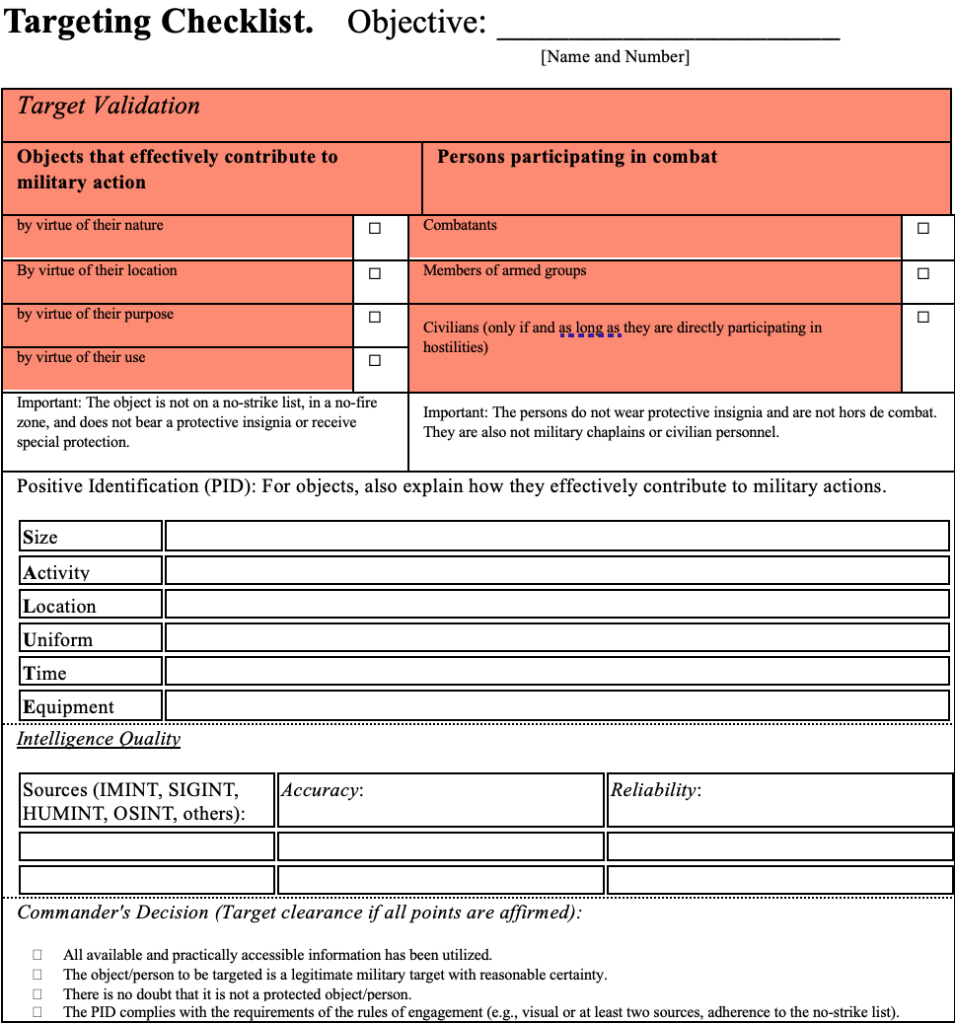
Concerning observation and reporting of potential targets for intelligence purposes, the following explanation is provided.
The SALUTE model serves to achieve reasonable certainty regarding the legitimacy of the military target and to identify the target (positive identification/PID). All available and practically accessible information is to be used regarding:
– Size: Number of persons, vehicles, or resources observed.
– Activity: Actions and behavior of the observed unit or, in the case of an object, how it is used by the enemy.
– Location: Precise geographical coordinates and, in the case of an object, how the location contributes to enemy military actions.
– Unit: Identification of the unit to which the observed target belongs (friendly, enemy actors, or civilians).
– Time: Date and time of the observation.
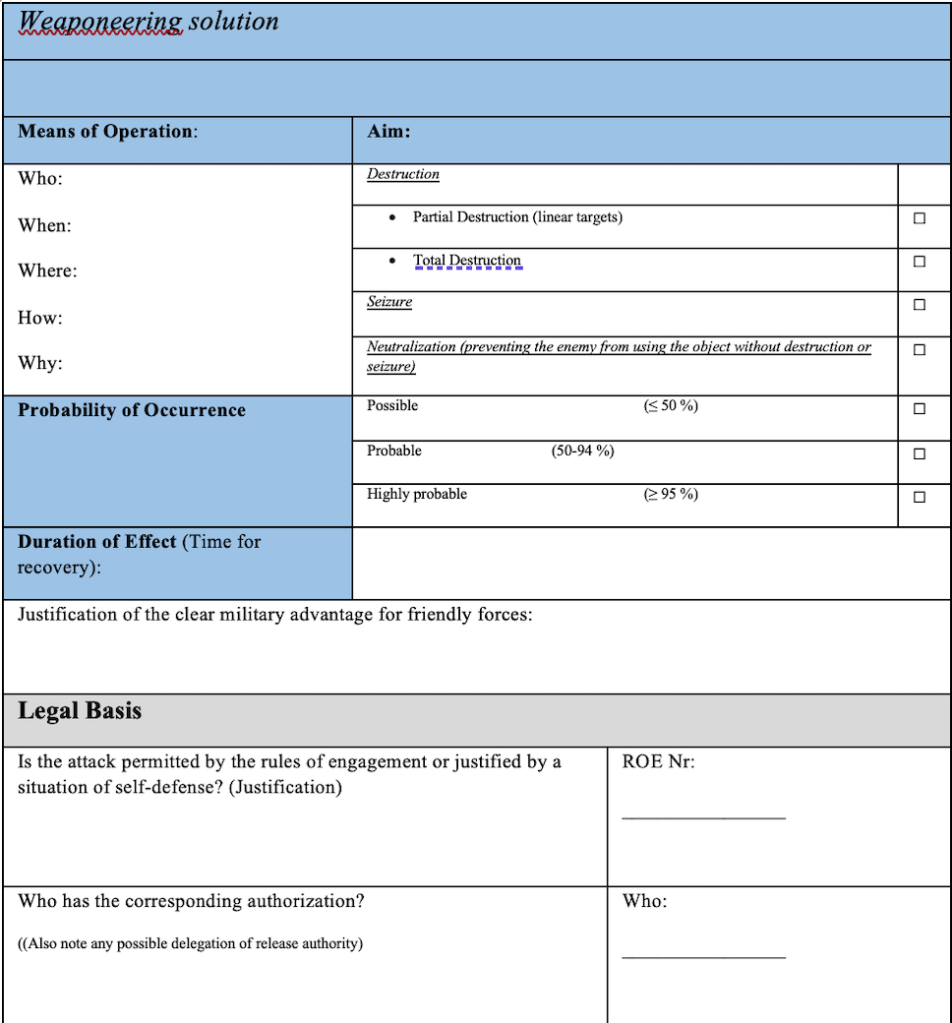
No commentary accompanies the Weaponeering and Legal Basis sections of the chart.
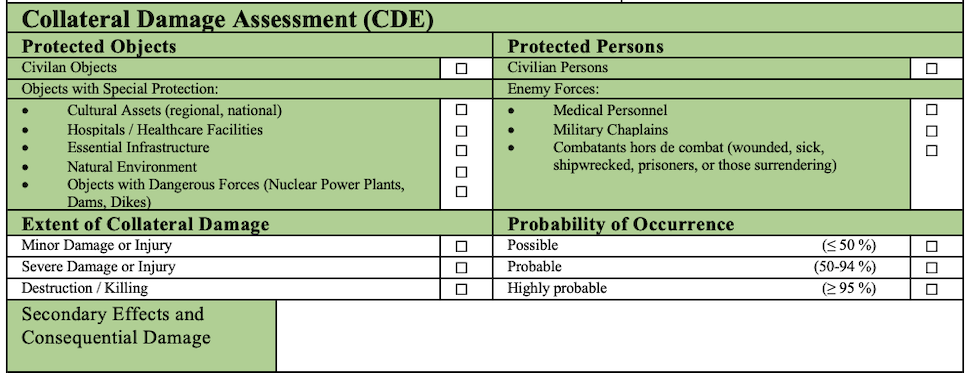
Concerning estimations of collateral damage, commentary offers the following.
In military operations, it is essential to ensure that collateral damage is avoided, particularly that the civilian population, civilians, and civilian objects are spared. The following procedure is recommended for determining expected collateral damage:
a. Defining the danger zone: Mark the danger zone around the target on the map. This zone should be large enough to encompass all possible hits (including known dispersion). Everything within this zone is considered potentially at risk.
b. Identifying protected persons and objects: For each danger zone, record the following information:
– Name and type of protected objects (e.g., apartment building, school, hospital);
– Estimated number of people within them;
– Estimated distance of protected persons/objects from the center of the target (in meters);
– Probability that hits will affect protected persons/objects.
c. Assessing the extent of the damage: Determine the probability of occurrence and the extent of direct collateral damage. This includes at least:
– Minor damage to property / minor injury to persons;
– Serious damage to property / serious injury to persons;
– Destruction of property / killing of persons.
d. Analysis of expected consequential damage: assess potential consequential damage that may affect property, persons, or institutions not located in the immediate vicinity of the target (e.g., a power or water outage could impact hospitals, schools, or other civilian facilities in the area).
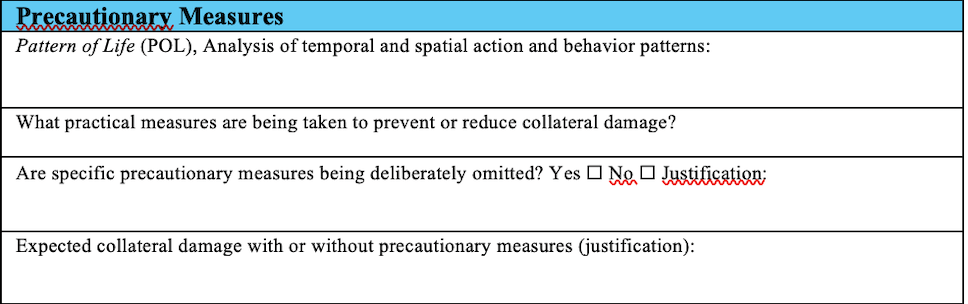
Concerning the issue of precautions, commentary provides as follows.
In connection with attacks, precautionary measures must be taken to minimize the expected collateral damage. Pattern-of-life (POL) analysis serves to identify spatial and temporal patterns of action and behavior among the civilian population. Based on this analysis, practically feasible precautionary measures can be examined, such as:
a. Changing the target point;
b. Adjusting the angle of attack (e.g., when using artillery or mortars);
c. Using different ammunition (e.g., more precise ammunition, smaller charge);
d. Using a different fuse;
e. Using different weapons, means, or methods;
f. Warning or evacuating the civilian population;
g. Changing the time of the attack
In attacks that could affect the civilian population, an effective warning must precede the attack, unless the circumstances do not permit this (AP I, art. 57 (2)(c)). The protection of specially protected objects and persons ends only after a mandatory warning has been issued with a reasonable notice period. This includes:
– Medical units, medical facilities, and mobile medical formations when used by the enemy for purposes other than humanitarian ones to harm us (Geneva Convention (GC) I, art. 21, AP I, art. 13);
– Civil defense organizations, their personnel, buildings, shelters, and equipment, if they commit or are used to commit harmful acts (AP I, art. 65);
– Prisoners of war who escape or attempt to escape (GC II [sic; recte: III] art. 42).

On proportionality, commentary provides as follows.
If a choice exists between several military objectives to achieve a comparable military advantage, the objective to be chosen is the one whose pursuit is likely to pose the least risk to civilians and civilian objects (AP I, art. 57(3)). Furthermore, any attack must be abandoned, or any ongoing attack must be temporarily or permanently halted, if the expected collateral damage is likely to be disproportionate to the expected concrete and immediate military advantage (AP I, art. 57(2)(a) and (b)). Consequently, military actions must be continuously monitored and documented. Upon receiving new information, the legality of the attack must be re-examined.
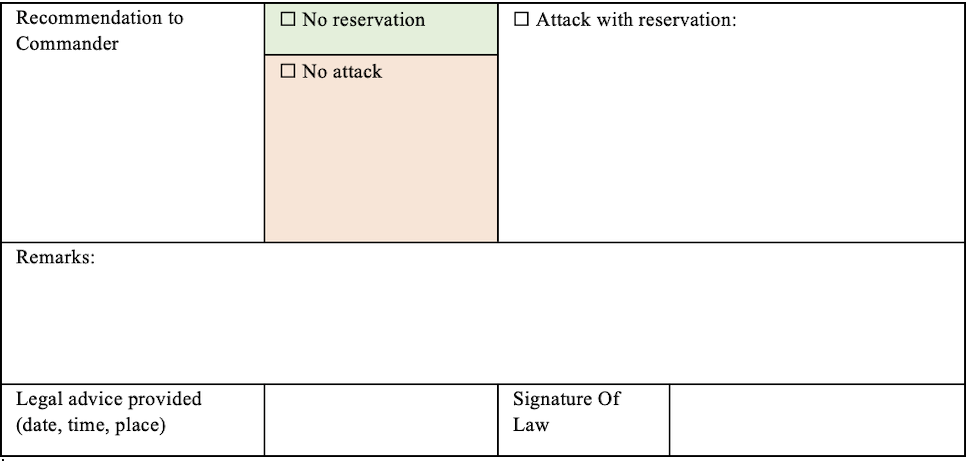
Finally, as to the advice given to the commander, the commentary provides as follows.
Legal advice should be clear, understandable, and timely to provide tangible added value for the commander and staff. The Legal Officer can, if necessary, identify concrete, legally sound alternative solutions. However, the role of a “worrier,” “watchdog,” or “decision-maker” is not desired. Statements such as “it depends” should also be avoided. The Legal Officer provides the commander with a legal recommendation as to whether the planned attack is lawful with or without reservations, or whether the attack should be rejected. The recommendation must be legally justified and documented. The Legal Officer can also support the commander in ensuring that the International Covenant on Civil and Political Rights (ICCPR) is observed by subordinate units. This is achieved, in particular, by integrating ICCPR into all command and control instruments.
Here are some possible measures that can be mentioned under “Remarks”:
– Review orders, rules of engagement, authorization procedures, and concepts for all areas of command and control;
– Actively participate in targeting and other planning processes;
– Actively participate in training, exercises, rehearsals, wargaming, and inspections to review the practical application of the COD and the operational documentation of subordinate units;
– Participate in briefings, feedback processes, and investigations to ensure that violations are identified, addressed, and future procedures are improved;
– Promote a culture of lawful conduct and open communication.
Exercises for Officers of the Army
To give more practical effect to the chart and its commentaries and to illustrate the sorts of exercises and training referred to in the preceding comment, three exercise examples for higher ranks of the Army follow. Commanders are expected to answer the following questions for each proposed target:
1) Is this a legitimate military target?
2) Calculate the specific expected collateral damage from the planned artillery fire.
3) State the criteria and procedure for calculating the expected collateral damage.
Exercise 1
– Destination: Port of Elbonia.
– Location: 12 km north of the border.
– Description: Southernmost port on the Rimmat River.
– Military Use: Resupply of all supply classes and diamond exports.
– Civil Use: Import fuel, food, medical supplies, equipment; Export: diamonds.
– Further reconnaissance: a civilian-flagged vessel is about to enter the Port of Elbonia; multiple sources confirm that weapons for the Army of Elbonia are on board; the ship will arrive in 36 hours; the cargo will be temporarily stored in a warehouse; the port also accepts all essential goods (food and medicine) for the population of South Elbonia via the same unloading infrastructure; the ship is carrying only civilians (pictures omitted).
Exercise 2
– Target Name: HQ of the 2nd Mech Brigade “Lion”.
– Location: 9 km north of the border.
– Description: The target is the HQ of the 2nd Mech Brigade.
– Military Use: Forward military position supporting tactical operations of the subordinate large unit.
– Civilian Use: None.
– Further reconnaissance: the target has storage facilities in well-protected bunkers and maintenance facilities; the target is protected by a security company and an anti-aircraft platoon; multiple sources report that the command and control element of the 2nd Mech Brigade operates from this HQ; there is a medical area and a prisoner-of-war camp; this location is the command and control center of the 2nd Mech Brigade; multiple sources report that 80% of the 12 Mech Infantry Battalions are at the target (pictures omitted).
Exercise 3:
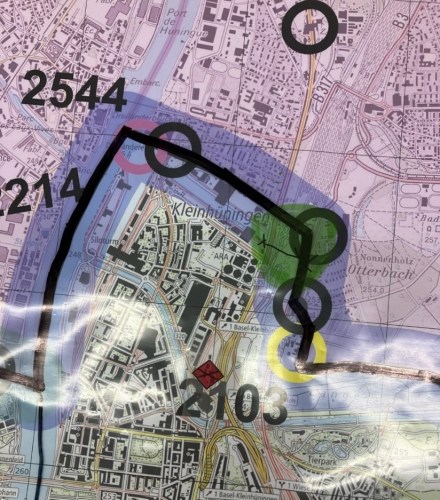
Elbon forces, after successfully repelling an attack, are attempting another thrust towards Basel. The commander of the Territorial Division intends to delay an enemy attack for one hour with an artillery barrage in the narrow passage near Kleinhüningen (Basel). The expected destruction radius is marked in green (see the map). Based on the recent fighting, it is estimated that approximately 20-30 wounded enemy soldiers remain in the narrow passage.
Conclusion
Contrary to popular conceptions, many armies, including the Swiss Army, prepare actively to apply IHL in war. Recent and past geopolitical situations have triggered many negative impressions of international relations and specifically international law, also some positive ones. In the latter category falls the propensity of many armies to devote meticulous attention to preparing, understanding, internalizing, and applying the rules of warfare.
It is hoped that this post, and others like it, will nourish appreciation of State practice on such issues, practice which is moreover made available to the public.
***
Robert Kolb is a Professor of Public International Law at the University of Geneva and former legal staff member of the ICRC. Prof Kolb is also a member of the legal section of the Swiss military high command (IHL section).
The views expressed are those of the author, and do not necessarily reflect the official position of the United States Military Academy, Department of the Army, or Department of Defense.
Articles of War is a forum for professionals to share opinions and cultivate ideas. Articles of War does not screen articles to fit a particular editorial agenda, nor endorse or advocate material that is published. Authorship does not indicate affiliation with Articles of War, the Lieber Institute, or the United States Military Academy West Point.
Photo credit: U.S. Army, Sgt. Yesenia Cadavid
