

Ukraine’s Attacks on Oil Infrastructure and the “War-Sustaining” Debate
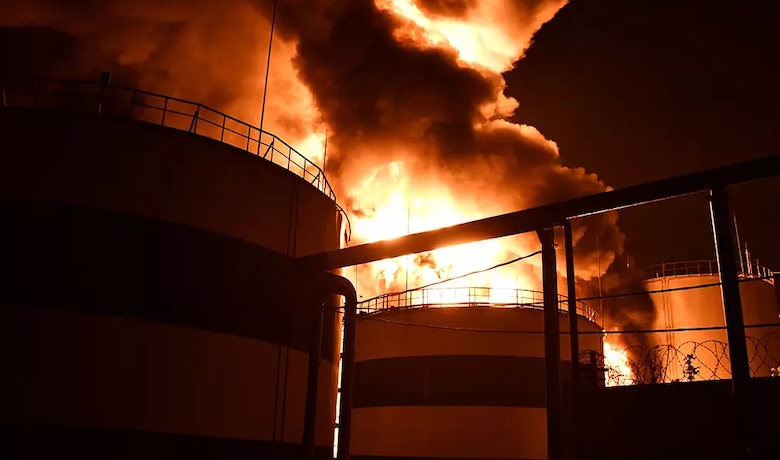
On 16 June, Ukraine launched a drone strike on Russia’s Gazprom Neft Moscow Refinery, an oil processing facility that sources a third of the fuel supply for the Russian capital and its surrounding region. Two days later, Ukraine struck the refinery again with one of its largest drone attacks of the war, targeting the facility’s backup infrastructure. The strike engulfed portions of the refinery in flames, sending acrid smoke across the capital’s outskirts and forcing the temporary closure of four nearby airports. Damage assessments indicate that the attacks destroyed a combined oil-processing unit and four vertical storage tanks with a total capacity of nearly 18 million gallons. Analysts doubt the refinery will resume operations before the end of the year.
Unrelenting, Ukraine followed up the strikes two days later with attacks on an oil depot in occupied Crimea and oil transportation infrastructure spanning the Kerch Strait. In response, Russian officials suspended fuel sales to individuals and businesses in occupied Crimea, with the Russia-backed governor announcing that “fuel will only be supplied to government agencies that ensure the functioning and security of the peninsula.” In a similar move, Moscow imposed a temporary ban on aviation fuel exports through 30 November and has reportedly begun importing gasoline from Asia by sea to offset growing domestic shortages.
The drone strikes are but the latest in a sustained campaign against Russia’s energy sector to degrade its war-making capacity. At least 40 strikes targeting similar oil infrastructure have been reported since the beginning of the year. In early June, for example, Ukrainian drones struck two oil facilities in the Black Sea port of Novorossiysk, a major hub for exports to China, India, and Turkey, as well as the Grushevaya oil storage and transshipment facility in Krasnodar and the Krasny Yar pumping station in Volgograd. On Russia Day (12 June), Ukraine carried out long-range strikes on the Taneco and Taif-NK refineries in Tatarstan, among the largest refining facilities in the country. Similar attacks in May damaged oil depots located in Taganrog and Armavir.
The cumulative impact has been substantial. As of January, drone attacks on the Baltic Sea ports of Primorsk and Ust-Luga, closure of the Druzhba pipeline, and sanctions enforcement actions against Russia’s “shadow fleet” had reportedly degraded as much as 40 percent of Moscow’s oil-exporting capacity. Its oil production has now dropped for six consecutive months, falling to 9.009 million barrels per day (bpd) in May—nearly 690,000 bpd below its OPEC+ quota. The latest attacks on the Moscow Refinery removed an additional 600,000 barrels per day of refining capacity from an energy sector already operating at its lowest level in more than two decades. Nevertheless, whether Ukraine’s campaign will ultimately prove successful remains to be seen.
Aside from its strategic efficacy, the question arises whether all of the oil infrastructure targeted by Ukraine satisfies the widely accepted criteria for lawful military objectives under the law of armed conflict. Following the attacks on the Moscow Refinery, for example, an official from the UN Office for the Coordination of Humanitarian Affairs insinuated in a brief to the UN Security Council that the facility was a civilian object protected from attack. More specifically, Ukraine’s campaign revives the long-running debate over whether so-called “war-sustaining” objects may be attacked based solely on their financial contributions to an adversary’s overall capacity to wage war (see, e.g., Goodman, Watkin, Padeanu, Dunlap). Although there is little doubt that facilities that produce or service oil for military consumption are military objectives, the legal controversy is most acute with respect to infrastructure associated with the production, transportation, and storage of oil destined for export or commercial markets.
In this post, I outline the relevant framework for assessing the lawfulness of Ukraine’s attacks with special emphasis on the war-sustaining debate. It begins with an overview of the principle of distinction and its implementing targeting criteria as they apply to attacks on oil infrastructure. It then briefly summarizes the war-sustaining debate and how it may apply in the context of Ukraine’s campaign, drawing upon my recent examination of the controversy in International Law Studies. It is limited to the question of when oil infrastructure qualifies as a military objective under the law of armed conflict; it does not address other aspects of the targeting process, such as whether Ukraine’s attacks complied with the obligations to take feasible precautions in the attack and to refrain from disproportionate attacks.
Before proceeding with that discussion, it is important to note that it is often challenging to draw affirmative conclusions as to the lawfulness of an attack based on information gleaned from media and other publicly available reports. Seldom do commentaries have access to all the pertinent information available to or considered by a party throughout an attack. The analysis in this post is therefore largely confined to laying out the appropriate framework for assessing the Ukrainian operations, rather than reaching firm conclusions based on incomplete evidence.
Military Objectives
It is well settled that the law of armed conflict requires belligerents to discriminate in their attacks between civilian objects and military objectives. In modern treaty form, the rule that civilian objects are protected from direct attack is set forth in Article 52 of the 1977 Additional Protocol I to the 1949 Geneva Conventions. In relevant part, it provides that only military objectives, defined as “those objects which by their nature, location, purpose or use make an effective contribution to military action and whose total or partial destruction, capture or neutralization, in the circumstances ruling at the time, offers a definite military advantage,” may lawfully be made the object of attack (art. 52(2)). Though Ukraine and Russia are both bound by the definition as parties to that instrument, there is little question that it accurately reflects universally binding customary international law applicable to both international and non-international armed conflicts (see International Committee of the Red Cross (ICRC), Customary International Humanitarian Law (CIHL), practice relating to rule 8).
Nature, Purpose, or Use
An object qualifies as a military objective by nature if it possesses “some inherent attribute which eo ipso makes an effective contribution to military action” (Dinstein, para. 361; see also Tallinn Manual 2.0, commentary to rule 100, para. 16). As military objectives per se, these objects qualify regardless of their actual present use. While this is undoubtedly the case with military vehicles, equipment, and installations, there is some debate whether oil infrastructure qualifies under this criterion due to the high degree of dependency on oil for military operations and the relative ease with which it may be converted to military use. The late Yoram Dinstein, for instance, maintained that
[o]il is so vital today to modern warfare that military objectives by nature include not only military dumps of refined oil (for aircraft, warships, tanks, trucks, etc.), oil refinery facilities and petro-chemical plants, but also crude oil fields and pipelines. Indeed, “oil installations of every kind are in fact legitimate military objectives open to destruction by any belligerent” (para. 404, quoting Leslie Green; see also para. 362).
If his interpretation is correct, there is a compelling argument that at least a majority of the Ukrainian attacks are lawful.
The prevailing view, however, is that oil infrastructure does not qualify as a military objective by its nature; rather, it may qualify contingent on its use or purpose. Although the Additional Protocol does not further define the two terms, there is general agreement that use refers to an object’s current use, whereas purpose refers to its intended or expected future use (see UK, Manual of the Law of Armed Conflict, para. 5.4.4; France, Manual of the Law of Military Operations, para. 3.2.3; O’Connor). While identifying an object’s current use is often straightforward, reliably determining when an object is subject to future use presents greater challenges (see Alcala & Nasu). In this regard, the Tallinn Manual 2.0 offers a particularly useful explanation for how the purpose criterion operates in practice.
Difficulty often arises in determining the enemy’s intentions. The law of armed conflict provides no particular standard of likelihood for concluding that a civilian object will be converted to military use, nor does it set forth the requisite degree of reliability with respect to the information on which such a determination is made. Instead, the law generally requires the attacker to act as a reasonable party would in the same or similar circumstances. In other words, the legal question to be asked is whether a reasonable attacker in the circumstances would determine that the reasonably available information is reliable enough to conclude that the civilian object is going to be converted to military use (commentary to rule 100, para. 14).
Accordingly, oil infrastructure not currently employed for military purposes may nevertheless qualify as a military objective when an attacking party reasonably anticipates its future military use by the enemy. Illustrating the flexibility with which this standard applies in practice using concrete examples in analogous contexts, the U.S. Navy’s Annotated Supplement to the Commander’s Handbook on the Law of Naval Operations provides,
[R]unways at a civilian airport could qualify as military objectives because they may be subject to immediate military use in the event that runways at military air bases have been rendered unserviceable or inoperable. Similarly, the likelihood that bridges or tunnels would be used in the adversary’s military operations in the future because of attacks on other bridges could lead to them satisfying the purpose factor (p. 8-7).
As the foregoing analysis implies, oil infrastructure’s so-called “dual use” by civilians and the military is irrelevant to whether it qualifies as a military objective. Legally speaking, an object is either military or civilian in character, never both. Irrespective of an oil facility’s civilian use, the decisive factor at the target identification stage is whether the object’s present or future use makes an “effective contribution to military action” and whether targeting it would, under the circumstances, provide a “definite military advantage.”
Effectiveness and Definiteness
The threshold for “effective contribution” is relatively low. There is broad agreement that military objectives may include logistical infrastructure, such as railroads, airfields, and ports, as well as so-called “industries of fundamental importance” to the war effort, so long as they, in fact, support military action (Bothe et al., p. 365; ICRC, Commentary to AP I, art. 52, n. 3). As for the “definite military advantage” prong, attacking parties may assess definite military advantage in light of the broader context in which an attack occurs (Dinstein, ¶ 346; U.S. Department of Defense (DoD), Law of War Manual, § 5.6.7.3). The advantage gained may manifest at the operational or strategic levels of war, or even incrementally, so long as that expectation is “definite,” i.e., reasonable and not speculative.
Whether one adopts Professor Dinstein’s view or applies the use or purpose criteria, it is likely that many of the facilities struck by Ukraine qualify as lawful military objectives. As I have observed elsewhere in the context of the international armed conflict between the United States-Israel and Iran, attacks on oil infrastructure are undoubtedly lawful if the facilities are used by the enemy for its military fuel needs. There is little doubt that at least some of facilities in Russia, presumably those located in Russian-occupied regions of Ukraine or near zones of military operations, would likewise qualify as military objectives on that same ground.
Indeed, Ukraine’s Permanent Representative to the UN confirmed as much in remarks before the UN Security Council following the attack on the Moscow Refinery, emphasizing that, “An oil refinery that produces fuel for Russian tanks, combat aircraft and missile carriers is not a civilian object in the sense that the Russian delegation and some colleagues are trying to impose.” The Ukrainian General Staff has similarly reported that the Poltavska oil depot was targeted because it supplied oil to Russian forces in occupied Ukraine. The same is apparently the case for two refineries in the Ryazan and Samara regions, which supplied jet and other fuel for Russia’s forces, and the 400km long Koltsevoy pipeline. If the reports are true, there is little reason to doubt those facilities legitimately qualified as military objectives. And considering Russia’s finite number of interconnected facilities are plagued by strategic bottlenecks, the case for treating others not currently used to supply Russian forces as military objectives by purpose grows progressively stronger as Ukraine’s campaign continues to diminish those that do.
The analysis is more challenging, however, for infrastructure associated with oil bound not for the battlefield, but for sale in domestic or foreign commercial markets.
The “War-Sustaining” Debate
Economic objects, including oil exports, are not specially protected from attack under the law of armed conflict. Instead, as with any military objective, the critical issue is the extent to which they satisfy Article 52(2)’s widely accepted criteria. Nevertheless, the debate over the lawfulness of attacking oil exports and their supporting infrastructure is often framed in relation to the U.S. position, according to which the term military action conceptually includes an enemy’s “war-sustaining” capabilities (DoD, Law of War Manual, § 5.6.6.2). While there is no authoritative definition for the term war-sustaining in this context, critics of the U.S. position often allege it refers to objects that contribute to an enemy’s capacity to wage war, rather than its active means of doing so. To them, “The connection between military action and exports required to finance the war effort is too remote, as almost every civilian activity might be construed by the enemy as indirectly sustaining the war effort.”
To be sure, just because oil exports may contribute to an adversary’s overall pool of resources available for military expenditure does not mean one may presume they make an effective contribution to military action or that any military advantage to be gained from their attack would be definite. A contrary interpretation would be inconsistent with the rule’s object and purpose, if not its text. It would also surely serve as a proverbial exception that swallows the rule. “After all,” as two senior U.S. military legal advisors have observed, “taken to an extreme, virtually all economic activity within a society could arguably be found to support that society’s ability to make war.”
The United States does not dispute these concerns. In its view, revenue-generating objects, as such, are not military objectives per se. Nor does the United States believe that an object’s remoteness to military operations is irrelevant. As a former DoD General Counsel has explained in the context of attacks on oil infrastructure and cash holdings, “Although each target must be assessed based on its facts and circumstances, all else being equal, each additional link in a causal chain between an object and its contribution to military action will generally make the military advantage to be gained from its destruction less certain, and more remote, and therefore less likely to qualify as ‘definite.’”
At the same time, it would be equally unreasonable to presume that oil and similar exports can never satisfy Article 52(2)’s criteria. The critical inquiry is whether a discernible and traceable link exists between an object and the military operations it indirectly supports. As my article argues in the context of revenue-generating exports,
The mere fact that an object is converted into revenue does not mean that one cannot reliably “follow the money” to military action downstream. To conclude otherwise would effectively carve out a de facto special protection for exports and other revenue-generating activities that the law of armed conflict does not otherwise prescribe. In the final analysis, either an object does, in fact, effectively contribute to military action or it does not. Equally so, a military advantage is either definite or it is not (p. 210).
Thus, the United States and likeminded States do not rely upon overbroad generalizations or categorial presumptions regarding Article 52(2)’s criteria. Instead, as with any target, they evaluate each target on a case-by-case basis to determine if that object meets them.
With respect to Ukraine’s attacks on facilities primarily devoted to oil exports, it is again difficult to reach affirmative conclusions. For one, it is unclear whether Ukraine targeted those facilities due to their financial contribution to Russia’s overall war effort or on some other basis. Given the limited redundancy in Russia’s Soviet-era oil infrastructure, some export facilities may also process or transport fuel destined for military consumption. Moreover, as explained, as the number of operational refineries and related facilities capable of supplying Russian forces declines, infrastructure previously devoted to commercial purposes may increasingly qualify as military objectives by purpose because it can be readily converted to military use.
Even assuming Ukraine deliberately targeted export facilities to deny Moscow oil revenue, the lawfulness of those attacks cannot be assessed confidently based on the information available. If the facilities were attacked solely because of their macroeconomic importance to Russia’s overall economy, the strikes would likely fall outside the accepted definition of a military objective. But one should not readily foreclose the possibility that Ukraine can articulate a causal link between individual export facilities and Russia’s military operations.
Consider Russia’s heavy dependence on oil revenues to finance its war effort. In my view, the more an adversary relies on a particular revenue stream to sustain its military operations, the more likely it is that at least some of the objects generating that revenue will bear an identifiable nexus to those operations. Note, this is not because dependence automatically converts objects into military objectives as a matter of law. Rather, it is simply a matter of evidentiary proof and common sense; the greater the dependence on a particular source of funding, the more likely it is that at least some of the infrastructure generating that funding can be shown to contribute effectively to military action and that attacks thereon would provide a definite miliary advantage.
According to the head of the Security Service of Ukraine, “oil extraction and refining make up around 90 percent of Russia’s defense budget,” with “55 percent [deriving from] foreign exchange earnings from the export of oil products.” Two of Russia’s Baltic Sea ports, Ust-Luga and Primorsk, were reportedly used for nearly half of those exports. If true, it is not inconceivable that Ukrainian forces reliably determined that the facilities were causally related to Russian military operations. The extensive financial sanctions imposed on Russia—including restricting its access to Western financial transaction systems (SWIFT) and other measures targeting its oil trade—may further strengthen that evidentiary showing by exposing the pathways through which its revenues contribute to its military expenditures. While this is admittedly speculation on my part, the critical point is that these and similar considerations are relevant to the fact-intensive inquiries that war-sustaining calculations demand.
Much of Russia’s oil infrastructure was almost certainly a lawful object of attack. Yet, while one cannot easily rule out that Ukraine struck certain facilities solely to deny Moscow war-revenue in individual cases, one should not jump to conclusions quickly. Absent more information of what Ukrainian forces actually considered, assessments of those attacks are likely too close to call.
Conclusion
Ukraine’s campaign demonstrates why the debate over so-called “war-sustaining” objects should not be resolved through categorical assertions. Much of the oil infrastructure almost certainly qualified as military objectives due to its direct support to Russian military operations. As Ukraine’s campaign further degrades Russia’s refining and distribution network, other facilities once devoted to non-military use may become reasonably expected to support military operations.
Still others raise more difficult questions that cannot be answered confidently based on currently reported information. The better view is neither to presume that revenue-generating infrastructure is categorically immune from attack, nor to conclude that it becomes a military objective merely because it contributes to an adversary’s economy. Rather, Article 52(2) requires a fact-intensive inquiry into whether a particular object makes an effective contribution to military action and whether its destruction offers a definite military advantage. Whether particular facilities satisfy that standard depends not on their economic value alone, but on the extent to which they bear an identifiable nexus to military operations.
***
Lieutenant Colonel W. Casey Biggerstaff is an Assistant Professor in the Department of Law and Philosophy at the U.S. Military Academy at West Point.
The views expressed are those of the author, and do not necessarily reflect the views or official position of the United States Military Academy, Department of the Army, Department of Defense or its components.
Articles of War is a forum for professionals to share opinions and cultivate ideas. Articles of War does not screen articles to fit a particular editorial agenda, nor endorse or advocate material that is published.
Photo credit: State Emergency Service of Ukraine
