

Air Warfare and International Humanitarian Law
In 1949, the U.S. Army’s International Law Branch Chief, Major William G. Downey, provided remarks (in his personal capacity) to the American Society of International Law. He asserted,
The person who first drafts an acceptable code of rules for use in aerial warfare will receive the thanks of the peoples of all nations and he will become the Francis Lieber of the 20th Century.
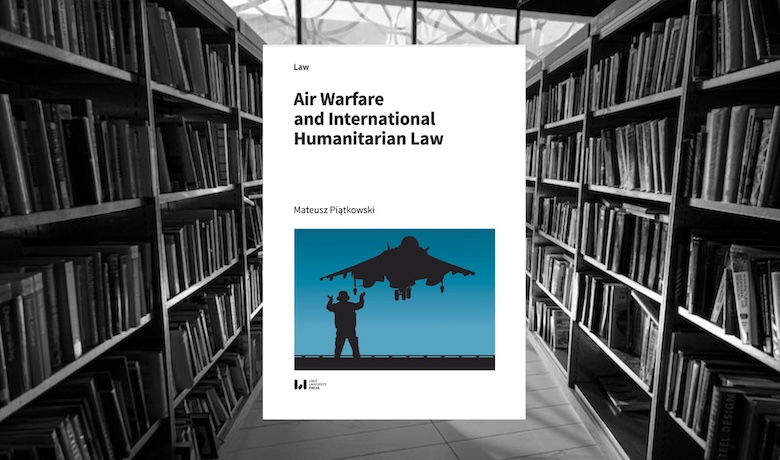
Seventy-five years later, the dream of this American lawyer remains unfulfilled. Air warfare still lacks comprehensive regulation. My new open-access monograph, Air Warfare and International Humanitarian Law, is a modest attempt to explain why this happened and what this leaves the international community (especially belligerents) with.
Air Bombardment
Aviation in the modern era may well be the most important means of conducting armed combat. Examples of air campaigns over the last three decades indicate that this form of warfare will be a decisive factor in determining success in future armed conflicts. In the early 20th century, aviation had an advantage over naval and land warfare due to its capacity to strike targets situated deep behind the frontline. This element is no longer a unique characteristic of air warfare, as the development of missiles and the introduction of cyber warfare have broken the “exclusivity” of air warfare in conducting operations beyond the frontline. However, air power has never lost its role as a means of massive force projection.
The effectiveness of air warfare was, from a military perspective, a blessing. It was, however, a curse from the viewpoint civilian populations seeking protection. While technology progressed rapidly, States quickly adopted treaties and regulations for civil aviation, establishing an effective international law regime of mutual cooperation. This was not the case with the law concerning air warfare, which progressed slowly and modestly, when it progressed at all.
In 1899, States adopted a temporary prohibition on air bombardment, a radical solution that soon faded away due to rapid technological developments. In 1907, States combined the regimes of land bombardment and air bombardment in the wording of Article 25 of the Hague Regulations of 1907. It reads, “The attack or bombardment, by whatever means, of towns, villages, dwellings, or buildings which are undefended is prohibited.”
Special chapters of the book are devoted to the consequences of this decision. The practical applicability of Article 25 of the Hague Regulations of 1907 was already questioned during the First World War. Scholars and belligerents soon advanced different interpretations of the meaning of the term “undefended.” However, in the context of air operations the term’s actual meaning remained ambiguous.
In 1923, the delegates that drafted the Hague Rules of Air Warfare, abandoned the requirement that a target be an undefended locality and instead adopted the doctrine of military objectives. This achievement, which (after modifications) today constitutes a cornerstone of targeting law, was not devoid of controversy. Nevertheless, it represented undeniable progress when compared to the impractical rules governing land bombardment as applied to air operations.
The Legal Review of the Second World War Air Bombardment
Ultimately, States did not ratify the 1923 Hague Rules. The book examines whether those rules nonetheless became part of customary international law prior to the Second World War. In doing so, the book analyses military manuals, diplomatic correspondence, and official State positions, including those reflected in the not-so-well-known cases from countries such as Poland, Italy, and Japan. These State positions are contrasted with examples of large-scale indiscriminate air campaigns conducted first by the German Air Force between 1939 and 1941 and later by the Allies from 1942 onwards.
In the book, I advance the view that, although one may debate the extent to which the Hague Rules of Air Warfare became part of customary international law, any legal restrictions on the conduct of air operations effectively collapsed under the pressure of total war, particularly during its final stages. If one adds to this equation the fact that neither the Nuremberg nor the Tokyo Trials addressed, for obvious reasons, the legal aspects of aerial bombardment, the broader picture of a legal vacuum becomes complete.
Other Areas of the Law of Air Warfare
The book recognizes that the law governing aerial bombardment is generally regarded as the most important and controversial part of the law of air warfare, but it is by no means the only one. My book includes chapters examining the practical aspects of air operations, including the legal status of pilots and people parachuting from aircraft, the issue of military markings on aircraft, and the types of weaponry that may be employed by aircraft.
The book ends with a glimpse towards the future of air warfare, namely, unmanned and autonomous air operations. Here, I provide the reader with a gentle warning: just as the unregulated nature of air warfare contributed to the humanitarian catastrophe of the Second World War and subsequent conflicts, unregulated autonomous aerial operations have the potential to be equally dangerous.
Conclusions
The conflicts in Ukraine, Gaza, and Iran have brought contemporary air operations back to the center of legal scrutiny, from the classification of military objectives to the protection of civilian aircraft, crews, and the legality of the weapons being deployed by the aircrafts. While the law is far more precise in comparison with the legal architecture that existed prior to 1977, continuous technological development and increasingly intense security competition create a constant challenge for the applicability of the law of air warfare.
***
Mateusz Piątkowski is an Assistant Professor in the Faculty of Law and Administration at the University of Łódź, Poland.
The views expressed are those of the author, and do not necessarily reflect the official position of the United States Military Academy, Department of the Army, or Department of Defense.
Articles of War is a forum for professionals to share opinions and cultivate ideas. Articles of War does not screen articles to fit a particular editorial agenda, nor endorse or advocate material that is published. Authorship does not indicate affiliation with Articles of War, the Lieber Institute, or the United States Military Academy West Point.
Photo credit: Pexels, Lodz University Press
