

Compliance by Design I: LOAC in U.S. Autonomous Combat Platforms
Editors’ note: This is the sixth post in a series dedicated to Lethal Autonomous Weapons Systems (LAWS) and the questions of human oversight and legal accountability under international humanitarian law. Previous posts have focused on LAWS, China, Russia, the United States, and Europe. This post begins a five-part examination of defense industry practices. It analyzes how hardware developers, software providers, and manufacturers approach the integration of law of armed conflict requirements into autonomous combat systems in the United States, China, Europe, and Israel.
In April 2026, the establishment of the SOUTHCOM Autonomous Warfare Command, a sub-unified command under U.S. Southern Command, was announced, underscoring the acceleration of a deliberate strategic transition in which the United States seeks to establish and maintain global leadership in the development and integration of unmanned aerial systems.
Much like the space domain, where relatively new private companies such as SpaceX rapidly became the backbone of U.S. national security launch and satellite capabilities, the U.S. Air Force’s Collaborative Combat Aircraft (CCA) program now draws heavily on agile, non-traditional hardware developers rather than solely on legacy prime contractors to advance the next generation of unmanned combat systems. These developments reflect the early stages of a broader U.S. and global transition in which major powers are accelerating the integration of autonomous and unmanned systems into combat aviation.
To illustrate how leading private developers are addressing these requirements in practice, this post focuses on Anduril’s Lattice integration with the Fury CCA and Shield AI’s Hivemind. These systems represent the most prominent and publicly documented implementations of mission autonomy in the CCA program to date, while parallel efforts, such as Collins Aerospace’s Sidekick autonomy software on General Atomics’ YFQ-42A, provide important comparative context. Private-sector design choices of this kind, such as human-on-the-loop architectures, explainable interfaces, runtime assurance mechanisms, and auditable testing protocols, may help reduce some of the legal and operational difficulties associated with Article 36-equivalent reviews, described in detail below. Nevertheless, it is crucial to underscore that consistent compliance cannot be assumed; among the prerequisites are sustained verification, robust operator training, and careful operational integration, all of which help reduce the risk of error, misinterpretation, and unlawful use.
Compliance by Design: Embedding LOAC from the Outset
The principles of distinction, proportionality, and precautions apply to autonomous systems in the same way they apply to any other weapon or method of warfare. Attacks must be directed only against military objectives, all feasible precautions must be taken to avoid or minimize incidental civilian harm, and expected civilian harm must not be excessive in relation to the anticipated military advantage.
Article 36 of Additional Protocol I requires States to assess whether new weapons, means, or methods of warfare would be prohibited under international law in some or all circumstances. For autonomous platforms, meaningful review depends on whether the system’s behavior can be reasonably predicted, explained, and traced. Where these qualities are absent, it becomes difficult for legal reviewers to determine whether the platform will operate lawfully once deployed.
“Compliance by design” means incorporating these legal obligations from the earliest stages of development, rather than treating them as something to be managed later through operator judgment. In concrete terms, this involves conducting a legal review before the system enters service, translating IHL rules into technical safeguards (such as discrimination logic, geofencing, or abort mechanisms), and ensuring the development process itself is auditable so that reviewers can see how legal considerations influenced design decisions.
This differs from an approach that relies primarily on human oversight at the point of use. While meaningful human control remains important, it cannot fully compensate for systems whose design makes it difficult or impossible to apply distinction and proportionality in a reliable way. Developers therefore have a practical role in reducing legal risk by building human-on-the-loop safeguards, runtime assurance functions, and documented testing processes during design. Although the United States is not a party to Additional Protocol I, it maintains a comparable policy requiring new means and methods of warfare to be reviewed for consistency with the law of armed conflict.
Anduril’s Lattice AI and Fury CCA: Sensor Fusion with Supervised Autonomy
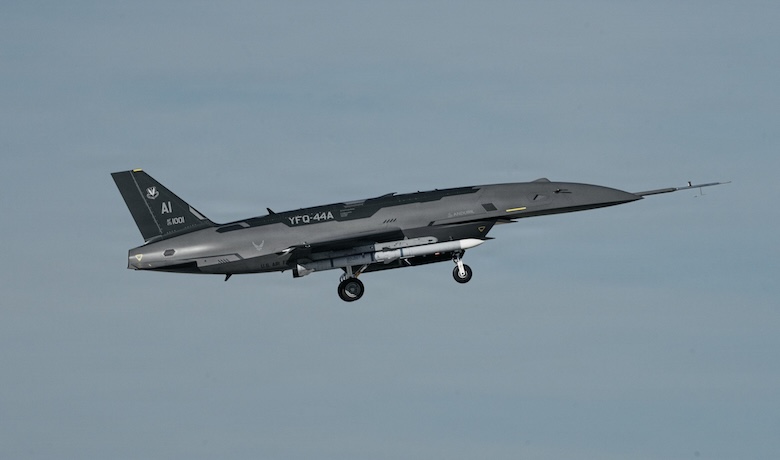
Anduril’s Lattice for Mission Autonomy functions as an AI-powered operating system that enables teams of unmanned systems to collaborate dynamically across domains under the direction of a single human operator. When integrated with the YFQ-44A Fury CCA, which went into production in March, Lattice provides real-time sensor fusion, intent-to-task decomposition, and collaborative swarming. The platform can conduct semi-autonomous flight, threat classification, and mission prioritization while remaining under supervisory control. The system’s human-on-the-loop architecture illustrates one practical approach to preserving commander accountability. Lattice breaks high-level operator intent into discrete tasks for the unmanned team, but the AI only proposes actions; it does not independently authorize or execute lethal force. This design supports the commander’s ability to apply distinction between military objectives and civilians and to assess proportionality in real time.
Explainability features receive equal emphasis. Lattice’s interface presents complex fused sensor data as clear, actionable insights on a single pane of glass, allowing operators to understand and verify AI recommendations quickly. Such transparency helps address the black box problem often associated with autonomous systems. It enables commanders to confirm target identification and evaluate expected incidental harm before approving engagement, thereby satisfying the precautions in attack requirement.
Testing and validation protocols further enhance legal reviewability. Anduril relies on extensive software-in-the-loop and hardware-in-the-loop simulations, which are then validated in live-virtual-constructive flight demonstrations. In the February 2026 interoperability test, which provides one of the more accessible illustrations of how private developers have sought to embed features intended to support legal reviewability, the YFQ-44A Fury switched mid-mission between Shield AI’s Hivemind and Anduril’s Lattice autonomy stacks without landing and completed identical combat-representative mission points under both systems. Additional trials with the Air Force’s Experimental Operations Unit at Edwards Air Force Base confirmed operator-led launch, recovery, and dynamic tasking procedures.
These auditable development and integration processes generate traceable performance data that directly assists Article 36-equivalent weapons reviews by demonstrating system predictability in some or all circumstances. Lattice and the Fury CCA thus offer one example of how private developers are attempting to embed features that could support rather than undermine core LOAC obligations.
Shield AI’s Hivemind: Autonomy and Runtime Assurance
Shield AI’s Hivemind functions as a platform-agnostic AI pilot software designed for read-and-react swarming and dynamic mission execution in collaborative unmanned operations. It has been integrated into the CCA program and demonstrated its capabilities during the same February 2026 test series as Anduril’s Lattice.
The system employs a human-on-the-loop architecture that keeps the commander in supervisory control. High-level intent is set by the operator, who retains real-time intervention authority, while the AI proposes courses of action but does not independently authorize lethal force, an arrangement that illustrates one method of preserving the commander’s ability to exercise meaningful human judgment over distinction and proportionality decisions.
A central technical feature is Hivemind’s Multi-Monitor Runtime Assurance framework, aligned with ASTM F3269-21 standards. Independent safety monitors continuously bound AI behavior in real time, enforcing predefined safe operational envelopes even under degraded conditions or unexpected threats, and the resulting auditable logs and software artifacts supply the traceability that legal reviewers require for Article 36-equivalent assessments. These runtime bounds promise to improve predictability, enabling commanders to better evaluate whether expected incidental civilian harm remains proportionate and whether feasible precautions have been taken.
Explainability and verification receive comparable attention. Hivemind generates traceable decision outputs and performance metrics that operators can readily interpret. Like Lattice, this approach helps mitigate the opacity problems that frequently hinder meaningful review of autonomous systems. Verification and validation rest on high-fidelity simulation, automated testing suites, and live-virtual-constructive demonstrations, which together produce the data needed to assess whether the system will behave reliably in some or all circumstances. The company’s verification and validation processes rely on high-fidelity simulation, automated testing suites, and live-virtual-constructive demonstrations. These protocols produce the detailed data packages needed to demonstrate that the system will behave reliably “in some or all circumstances.”
Recent CCA program milestones illustrate the practical application of this approach. Hivemind’s adherence to the Autonomy Government Reference Architecture supports mid-flight handoffs with other autonomy stacks while maintaining full traceability; in this manner, Shield AI’s design choices form part of a wider industry effort to embed features intended to facilitate LOAC compliance. Parallel efforts demonstrate that this approach is not limited to any single vendor. Collins Aerospace’s Sidekick mission autonomy software, integrated with General Atomics Aeronautical Systems’ YFQ-42A, completed a successful four-hour semi-autonomous flight test in February 2026 under human operator control via the Autonomy Government Reference Architecture (A-GRA). Like the Lattice–Hivemind demonstration, Sidekick operates in a human-on-the-loop configuration in which the operator retains supervisory authority and issues commands that the autonomy software executes, providing one example of ongoing industry efforts to incorporate design features relevant to Article 36-equivalent legal reviews.
Conclusion
The February 2026 interoperability flight of the YFQ-44A Fury demonstrated in concrete terms how private developers can embed features that support rather than undermine LOAC compliance. Through human-on-the-loop architectures, explainable interfaces, runtime assurance mechanisms, and auditable testing protocols, Anduril’s Lattice, Shield AI’s Hivemind, and parallel efforts illustrate one approach to what has been termed “compliance by design,” while also raising important questions about how effectively commander accountability can be preserved amid the increased speed and scale that collaborative combat aircraft are designed to deliver. However, these innovations do not eliminate the substantial challenges that remain, including the persistent risk of automation bias, the difficulty of fully validating proprietary algorithms in contested electromagnetic environments, the demands of sustained operator training, and potential limitations on transparency during legal reviews.
For the United States and its allies, private-sector innovation represents one possible path toward maintaining legal reviewability of autonomous platforms under Article 36-equivalent processes. In the end, the law of armed conflict does not change with new technology. What does change is the ease with which States can demonstrate that their means and methods of warfare remain consistent with distinction, proportionality, and precautions. Ultimately, industry design decisions today will determine how credibly that demonstration can be made on tomorrow’s battlefields.
***
Dr Gerald Mako is a Research Affiliate at the Cambridge Central Asia Forum at Cambridge University.
The views expressed are those of the author, and do not necessarily reflect the official position of the United States Military Academy, Department of the Army, or Department of Defense.
Articles of War is a forum for professionals to share opinions and cultivate ideas. Articles of War does not screen articles to fit a particular editorial agenda, nor endorse or advocate material that is published. Authorship does not indicate affiliation with Articles of War, the Lieber Institute, or the United States Military Academy West Point.
Photo credit: Secretary of the Air Force Public Affairs
