

The Double Qualification of a Single Act of Belligerence
In the complex web of armed conflict classification, a problem has emerged in recent years linked to transnational armed conflicts that are breaking out and spilling into our troubled world. What is a transnational armed conflict?
Let us first note that it is not a category of positive law. The current law of armed conflict only recognizes international armed conflicts and non-international armed conflicts, to which partially different rules apply. However, it goes without saying that a specific conflict can be mixed, having aspects to which the law of international armed conflicts applies and other aspects to which the law of non-international armed conflicts applies.
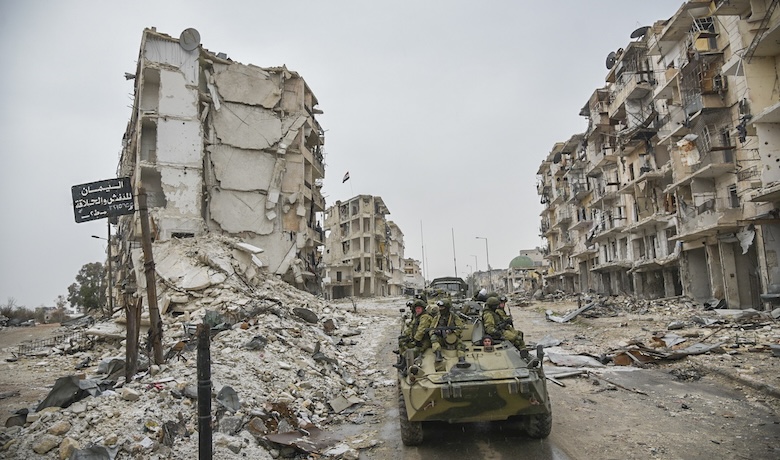
Transnational armed conflict is therefore for the moment only a descriptive category, although some propose, de lege ferenda, to provide its own legal regime. Transnational armed conflict concerns situations in which a State fights an armed group through actions located beyond its borders, that is, on the territory of a third State (often a neighboring State). This has been the case with the actions of the United States of America or Russia against Daesh in Syria, or the cross-border actions between Rwanda (also Uganda) and the Democratic Republic of Congo.
Factual Permutations and the Classical Approach
According to the classical approach, it is necessary to distinguish between cases in which the State on whose territory the armed action takes place (the territorial State) consents or does not consent to the foreign armed action. One must also distinguish cases in which the territorial State exercises control over the armed group.
If the territorial State consents to the foreign action, as Mali did in relation to France’s operations in recent years, the military encounter between the intervening State and the armed group remains a non-international armed conflict. The only question that will arise is whether conventional provisions such as Common Article 3 of the 1949 Geneva Conventions and Additional Protocol II of 1977 (AP II) apply extraterritorially. Conversely, if the territorial State controls the armed group (criterion of overall control), this group acts as an agent of the State concerned and its military engagement against the intervening State will be legally classified as an international armed conflict, that is, as an encounter, longa manu, between the intervening State and the territorial State.
What happens if the territorial State does not give its consent to the intervention (which is very frequently the case) and does not control the armed group in a comprehensive manner (which is also the rule)? Here again, according to the traditional way of seeing things, the criterion ratione personarum prevails. Because it is a relationship between a State and an armed group, the law of non-international armed conflicts must be applied. An international armed conflict could obviously be added to this conflict if the intervening State commits a separate act directed against the territorial State, likely to trigger an armed conflict between them. This was the case in Lebanon in 2006. Israel’s intervention against Hezbollah forces constituted non-international armed conflict (if these forces were not controlled by a State), and it is indeed to this law that Israel oriented itself.
But by separately declaring a blockade of Lebanon, an international armed conflict against that State was triggered in parallel. It will be noted that the two legal regimes are juxtaposed but do not overlap: the law of non-international armed conflicts applies to Israel/Hezbollah relations; the law of international armed conflicts applies to Israel/Lebanon relations; and each of these bodies of law applies in relation to different acts, the conduct of hostilities on the one hand and the blockade on the other.
However, in the most frequent case, there is a single act, for example an attack by artillery or air forces against a given rebel position in the territorial State and no separate act specifically directed against the latter. Many situations of this kind exist, for example, in the Great Lakes region around the Democratic Republic of Congo. It goes without saying that these strikes are directed exclusively against the armed group. But they inevitably affect the territory of the State where the intervention takes place and may have collateral effects on its civilian population.
Given that the territorial State has not, by hypothesis, consented to these strikes, should we consider that there is a double armed conflict in relation to the same act, one in the relations between the intervening State and the armed group and the other in the relations between the intervening State and the territorial State?
Double Classification
It must be emphasized that in this case there is not a juxtaposition of the applicable law, but rather a superposition. Two bodies of law do not apply in parallel to two different acts, but two bodies of law apply simultaneously to the same act of belligerence. In recent years, this view has indeed become popular. It has found support in doctrine and has been adopted, in particular, by the International Committee of the Red Cross. In a new commentary to Geneva Convention I, we read the following,
[I]t is useful to recall that the population and public property of the territorial State may also be present in areas where the armed group is present and some group members may also be residents or citizens of the territorial State, such that attacks against the armed group will concomitantly affect the local population and the State’s infrastructure. For these reasons and others, it better corresponds to the factual reality to conclude that an international armed conflict arises between the territorial State and the intervening State when force is used on the former’s territory without its consent (para. 262).
However, the issue remains controversial, and it is worth briefly examining it more closely.
Various arguments have been presented against this division of the legal situation by double classification, in favor of the classic classification as only a non-international armed conflict. First, it is argued that this traditional classification follows the only recognized criterion in the matter, namely the identity of the parties or the personal criterion (States / armed groups); this criterion guarantees a certain simplification, legal certainty as well as adherence to the facts on the ground. The most appropriate law to govern belligerent relations between a State and an armed group is the law of non-international armed conflict. To impose, even partially, the application of the law of international armed conflicts on this belligerent relationship would amount to applying an inappropriate law.
Second, there is the complexity of the double classification, which could have unwelcome effects. Thus, if there is an international armed conflict between the intervening State and the territorial State, the question arises of the measures that, for example, the territorial State could take against civilians of the intervening State, who would now be enemy civilians. Moreover, on legal policy, it is inappropriate to further complicate the applicable law for military personnel on the ground. Too much complexity renders the law of armed conflict inoperative.
Third, the extensive versions of the double qualification (i.e., those that consider any attack on foreign territory to be an international armed conflict) derive the application of the law of armed conflict from a violation of the sovereignty of the territorial State. This is underlined by the criterion of the absence of the latter’s consent. In doing so, these positions confuse jus ad bellum and jus in bello, which must be kept separate.
Fourth, the States concerned, for example during the armed conflict in Syria, in their fight against the Islamic State, applied the law of non-international armed conflict. In other words, practice seems to reject the double qualification. On the contrary, the arguments in favor of dual classification generally boil down to the search for better protection for civilians potentially affected by attacks, especially with regard to collateral damage. Given the relative proximity of the rules on targeting in the two types of armed conflict, however, the gain in protection seems limited, if not hypothetical. Practice also shows that States do not target according to different rules in the context of their transnational conflicts.
Assessing the Double Classification Approach
What should we think of the double classification involving an overlapping of the legal regime applicable to the same act? For fairly marginal advantages this doctrine risks opening a Pandora’s box. If the primary aim is to protect civilians and civilian objects against the effects of attacks, the rules on targeting in non-international armed conflicts are sufficient, perhaps provided that the rules of AP II are interpreted in light of customary law. We cannot see any other reasonable application—other than targeting and special protection of objects—for the rules of the law of international armed conflict. Applying a double classification just for one set of rules, while opening the door to a series of other rules that are not really appropriate, seems odd. Indeed, a whole series of questions then arise.
The first question which might arise is what should happen if the rules of international and non-international armed conflicts are not identical or even seem to contradict themselves. If both must apply to the same act, which one of these rules should prevail? This type of difficulty is more apparent than real. It could indeed be argued that in such a situation, the more protective rule, i.e. the one requiring a more exacting restraint, should prevail. If under the law of non-international armed conflict the protection of the environment in case of attack is lower than it is during an international armed conflict, and if the attack triggers both an international and a non-international armed conflict, the more protective rules governing international armed conflicts should apply. There seems to be hardly any real situation in which one of the rules could not prevail over the other under this lens. However, a significantly trickier question is whether the choice of the more generous rule is always advisable from the perspective of policy. This depends on what situations the double qualification doctrine is extended.
Other issues are even thornier. Will the international armed conflict be reduced to the belligerent operation in question (for example, the bombing of a rebel camp) and end immediately thereafter? This is not certain because several strikes will normally be launched against the armed group. Will there in such cases be a continuous international armed conflict or a repeated, one-off, international armed conflict? Consequently, delicate problems of temporal application arise. If the armed conflict is considered to be continuous as long as the isolated strikes last, this leads to overclassification. Indeed, this approach brings into the armed conflict and its permissive law (more permissive than human rights and the law of peace) situations that should not be found there.
This is the case in several instances including: the power to take restrictive measures against civilians of the intervening State (or vice versa); their internment not being subject to ordinary habeas corpus (we see here the derogatory function of the law of armed conflict); to take prisoners of war and detain them up to the “end of hostilities,” a moment not clearly determined in the case of action such as described (and if the armed conflict begins and disappears with each attack, i.e. a kind of revolving door, will it be necessary to repatriate every opposing prisoner with each beat?); to practice some belligerent “license to kill”; to suspend treaties in view of armed conflict; to operate maritime or territorial “blockades” as a measure of war, etc.
If the armed conflict is not international, but remains non-international, there is in principle no reason to detain the military personnel of the intervening State, at least from the point of view of the law of armed conflict (that is to say, outside of criminal proceedings for violation of the sovereignty of the territorial State). This means that for a series of persons, the qualification of superimposed international armed conflict entails a worsening of their legal situation. Several people, both civilian and military, are deprived of the greater protections applicable in peacetime.
Unfortunate effects may also exist in the jus ad bellum. Given that there is an international armed conflict between the intervening State and the territorial State, the latter can use violence against the former as a measure of war. Must it comply with the requirements of self-defense? In response to the initial act of attack, it seems that self-defense is paramount. But beyond, this is not certain. If there is an ongoing situation of armed conflict, the violence can, in principle, be used without the constraints of self-defense, in particular without any new acts of attack / aggression; moreover, the attacks taken one by one may not have reached the necessary threshold of gravity of an “armed attack” (in French: aggression) to justify a military response, perhaps unless at a certain moment a cumulative effects doctrine is applied.
In any case, this offers to some extent a convenient escape to the territorial State to use violence beyond the restrictions of Article 51 of the UN Charter. This can be seen in the recent attacks by Isreal on the nuclear installations in Iran, one justificatory argument advanced having been that there is a state of war between the two States. However, it can also be credibly said that even in case of a qualification as mere non-international armed conflict, the situation would not greatly change. The first attack carried out without consent could give rise to self-defense action if the aggrieved State sees it as an attack on its territory, directed also against itself. If it does not respond, even if an international armed conflict has been triggered by the attack, nothing happens in the jus ad bellum. If it does respond, it must rely on self-defense and its requirements and in any case an international armed conflict will arise, and the further acts of violence will be governed essentially by the law of armed conflict. It is therefore not clear whether jus ad bellum difficulties really exist if the law is applied correctly. But that does not mean that the territorial State cannot try to rely on the double qualification-armed conflict to try to evade, at least to some extent, jus ad bellum constraints. This could be unwelcome.
Concluding Thoughts
Overall, it appears that the doctrine of double qualification is neither necessary nor balanced. It does not address a dangerous gap in international humanitarian law that we must perforce fill. Conversely, it opens some pitfalls with uncontrolled effects and adds an additional layer of sheer complexity to the already epically complicated law of qualification of conflicts. There seems little to gain and more to lose.
***
Robert Kolb is a Professor of Public International Law at the University of Geneva and former legal staff member of the ICRC. Prof Kolb is also a member of the legal section of the Swiss military high command (IHL section).
The views expressed are those of the author, and do not necessarily reflect the official position of the United States Military Academy, Department of the Army, or Department of Defense.
Articles of War is a forum for professionals to share opinions and cultivate ideas. Articles of War does not screen articles to fit a particular editorial agenda, nor endorse or advocate material that is published. Authorship does not indicate affiliation with Articles of War, the Lieber Institute, or the United States Military Academy West Point.
Photo credit: Mil.ru
