

Future of Warfare and Law Series – Introduction
Editors’ note: This post introduces a series featuring topics discussed during the Third Annual Future of Warfare and the Law Symposium.
This past May, a community of military legal scholars and technical experts met at the Third Annual Future of Warfare and the Law Symposium, co-hosted by the Army Futures Command (AFC) Office of the Staff Judge Advocate (OSJA), the Strauss Center for International Security and Law at the University of Texas at Austin, and the Lieber Institute for Law and Warfare at West Point.
The symposium served as a forum to address how emerging technologies will reshape the battlefield, how the law impacts the development and use of these future systems, and how these technologies might impact the development of the law. Through a scenario-based approach, scholars and experts were asked to explore the bounds of what is reasonably foreseeable in 2040 from legal and technical perspectives. To adequately address those issues, the legal community must understand the technology. And vice versa; the technical community must develop weapons that can comply with legal obligations. This mutual understanding is essential not only to inform doctrine and development but also to dispel common myths about what the law requires and what technology can truly achieve.
For the first time since its inception, the symposium was formally recognized as an Army Focused Warfighting Experiment. Warfighting experiments situate representative soldiers (lawyers and scientists in this case) into realistic operational environments through the application of constructive, virtual, and live simulation with a goal to inform decision makers about capabilities that the future force may employ. Army Focused Warfighting Experiments examine the military utility and burdens of new and existing technologies and support the development and refinement of warfighting concepts, future operational capabilities, and DOTMLPF–P (Doctrine, Organization, Training, Materiel, Leadership and Education, Personnel, Facilities, and Policy) needs.
The symposium began with an overview of the Future Operational Environment Threat Forecast for 2040, generated and presented by AFC’s Directorate of Intelligence and Security. This set the scene allowing participants to rigorously explore the implications of introducing new technologies on an already complicated battlefield. The symposium’s structure ultimately mirrored that of AFC’s premier modernization experiment, CAPSTONE experiment (PC-C5). By structuring discussions around plausible military scenarios, the symposium enabled a practical application for how emerging technologies might be used and regulated on future battlefields.
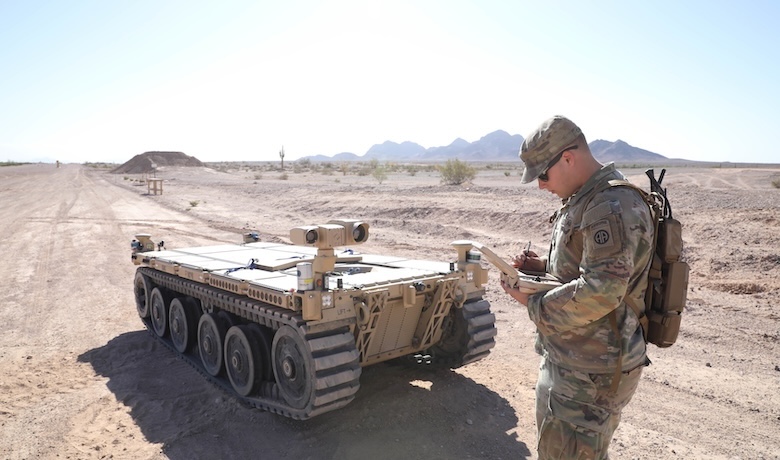
This year, the symposium emphasized the application of emerging technology to five key areas: directed energy weapons; military “grey space activities” in high-altitude airspace and in space; advanced cyber operations; artificial intelligence; and autonomous weapons systems. Discussions regarding each of these diverging technologies and domains exposed legal challenges. These ranged from matters related to testing and evaluation of models that incorporate machine learning to foreseeable collateral effects of weapon systems yet to be employed in warfare. They addressed: the employment of autonomous weapons systems within the framework of the principles of distinction and proportionality; the legal considerations when using these technologies in an urban environment; and whether weapons should be tested and/or subjected to weapons review after battlefield software updates.
The upcoming posts in this series will dive deeper into the insights that emerged from these sessions. Our discussion begins with “Addressing Uncertainty in the Use of Autonomous Weapons Systems” by Professor Charles Trumbull, which examines the risks of employment and offers options to mitigate. Next, we’ll turn to “Laws About LAWS” by MAJ Bryan Jack, arguing that existing law of armed conflict principles are sufficient to regulate the use of lethal autonomous weapons systems (LAWS) regardless of unresolved questions involving human control and accountability. Finally, with COL Andrew McKee, I consider the practical application of legal reviews in modern warfare in a post entitled “Adapting the Legal Review of Autonomous Weapons for the Tactical Edge,” focusing on how the Army’s weapons legal review process must evolve for both future and present conflicts.
Our goal is to continue the conversation by inviting thought leaders in law, defense, and technology to weigh in. Stay tuned for deeper dives into each of these critical areas.
More about the conference sponsors:
U.S. Army Futures Command exists to transform the Army to ensure war-winning future readiness. Headquartered in Austin, Texas, AFC has more than 17,000 personnel worldwide. It is the newest of the Army’s four major commands, established in 2018 to ensure the Army and its Soldiers remain at the forefront of technological innovation and warfighting ability. AFC currently focuses on two priorities: (1) Prioritize People; and (2) Drive Continuous Transformation. The command executes six essential functions in pursuit of these priorities with support from industry, academia, and Joint and multinational partners: (1) The Future Operational Environment, (2) Research, (3) Concepts, (4) Experimentation, (5) Requirements, and (6) Integration.
Strauss Center for International Security and Law, University of Texas, Austin
The Robert Strauss Center for International Security and Law integrates expertise from across the University of Texas at Austin, as well as from the private and public sectors, in pursuit of practical solutions to emerging international challenges. Towards that end, the Center sponsors a wide array of research programs and educational initiatives which vary from security and technology pursuits, to national security and regional challenges programs, and our broader outreach for students and the public.
The Lieber Institute for Law and Warfare, West Point
The Lieber Institute at West Point facilitates and contributes to the global dialogue on today’s most pressing and complex law of war issues. Through its research, publications, events and education, it strives to advance the understanding and maintain the value of law in today’s armed conflicts. The Lieber Institute seeks to bridge the divide between legal scholarship and battlefield experience in the study of the law. It engages in innovative research and collaboration on multiple topics of legal study including targeting, detention, artificial intelligence, emerging technologies and war crimes accountability.
***
LTC Christina Colclough is an assistant professor in the Department of Law and Philosophy at the United States Military Academy.
The views expressed are those of the author, and do not necessarily reflect the official position of the United States Military Academy, Department of the Army, or Department of Defense.
Articles of War is a forum for professionals to share opinions and cultivate ideas. Articles of War does not screen articles to fit a particular editorial agenda, nor endorse or advocate material that is published.
Photo credit: U.S. Army, Army Sgt. Marita Schwab
