

International Law, the Civil Law Tradition, and Sources of Law – Part I
Editors’ note: This is the first in a two-part post illustrating the impact of the civil law tradition on the formation of international law, specifically the sources of international law. This entry will focus on treaties and custom as sources of law, including in the law of war.
In the legal pluriverse, sources of law are elemental. They are the fundamental components of any legal system, including the international legal system. As Hugh Thirlway states, “the notion of sources … underlies any claim to a legal entitlement, and any complaint of a breach of international law.” A legal system’s sources of law can shape its physiognomy, determining the way it operates, structuring its methodology, contributing to the content of the law “at the most fundamental level,” and establishing how law “is made or identified.” It is around the concept of sources that “legal discourses and legal claims are built.” Samantha Besson and Jean d’Aspremont note, “It is not contested that speaking like an international lawyer entails, first and foremost, the ability to deploy the categories put in place by the sources of international law.”
On that score, it is generally accepted that the five sources of international law are set forth in Article 38 of the Statute of the International Court of Justice (ICJ). Of these, the three primary sources of international law are: (1) treaties between States; (2) customary international law derived from the practice of States; and (3) general principles of law. The two subsidiary sources of international law are: (4) judicial decisions; and (5) the writings of “the most highly qualified publicists.”
As with other aspects of international law, the sources of international law, including the law of war, can be elucidated through comparative legal analysis and a study of the continental civil law tradition. This is because they are derived from concepts that germinated and evolved in the context of that particular legal tradition. As John Henry Merryman remarks, “It is difficult to overstate the influence of the civil law tradition on the law of specific nations, the law of international organizations, and international law.” Accordingly, the study of the civil law tradition, and comparative legal analysis, can deepen our understanding of international law and its subsets.
Previous posts have demonstrated how an understanding of civil law systems, and comparative legal analysis, can assist in identifying, interpreting, and explaining various facets of international law. This two-part post will continue along that same intellectual pathway and bring specific focus to the sources of international law as articled in Article 38 of the ICJ Statute, providing context that can permit a more fulsome understanding of their operation and appropriate use. The discussion will include an analysis of the hierarchical nature of these sources of law and an examination of their normative gradation for the benefit of academics and practitioners alike.
Civil Law Influence Within the Advisory Committee of Jurists
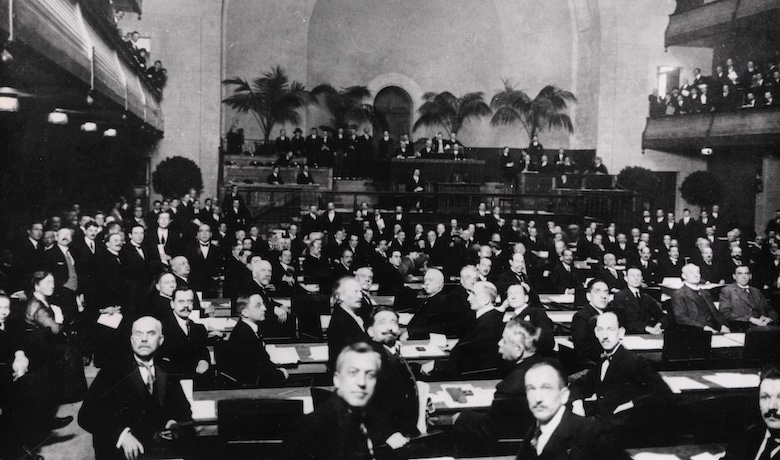
Nothing begins ex nihilo. The five sources of international law articulated in Article 38 have origins, both ancient and distinct, that long predate their crystallization in a multilateral convention. Their grouping and delineation as an authoritative list of sources dates only to the interwar period, specifically in February of 1920, when the Council of the League of Nations appointed a committee (the Advisory Committee of Jurists) to plan for the establishment of the Permanent Court of International Justice (PCJIJ) as Article 14 of the Covenant of the League of Nations required. Dr. Marija Đorđeska highlights that the committee was composed of ten independent jurists drawn from a range of disparate legal systems: Baron Édouard Eugène François Descamps, the President of the Committee (Belgium); Minneichiro Adatci (Japan); Rafael Altamira (Spain); Clovis Bevilaqua, who was later replaced by Raoul Fernandes (Brazil); Francis Hagerup (Norway); Albert de Lapradelle (France); Bernard Loder (Netherlands); Lord Walter George Frank Phillimore (England); Arturo Ricci-Busatti (Italy); and Elihu Root (United States). Notably, the U.S. representative, Elihu Root was a prominent American jurist who was awarded the Nobel Peace Prize in 1912 for his pioneering work in international arbitration, served as U.S. Secretary of State, and was also the 41st U.S. Secretary of War.
The vast majority of the members of the committee (eight out of ten) were jurists from civil law jurisdictions. This is unsurprising given that most legal systems globally are civil law systems based on legal concepts, categories, and rules derived from Roman law. Observers note that “[c]ivil law systems, also called continental or Romano-Germanic legal systems, are found on all continents and cover about 60% of the world.” The fact that so many members of the Advisory Committee of Jurists were steeped in the civil law tradition invariably influenced the substance of the committee’s work. As Dr. Đorđeska notes,
The members of the [committee] were national lawyers and jurists whose “conception of the content of international law would almost unavoidably have been coloured by national tendencies and traditions.” Indeed, Hammarskjöld’s reports speak of the stark difference of opinion between Descamps – a continental jurist – on the one hand, and Phillimore and Root – both common law jurists – on the other.
Adding to the influence of the civil law tradition on the substance of Article 38 is the fact that the members of the Advisory Committee of Jurists were already working in a milieu that, from its very outset, was influenced by the civil law tradition. As previous posts have noted, substance and concepts from the civil law tradition were incorporated into international law’s primordial structures by civil law jurists like Hugo Grotius, Francisco Vitoria and Emmerich de Vattel. International law, therefore, draws heavily from civil law systems at a fundamental level. This is not to say that the civil law tradition was the only influence on Article 38. The common law jurists on the committee obviously had an impact as well. (Clearly, having an eminent jurist of such significance as Elihu Root would ensure an indelible impression on any effort). Moreover, commentators have observed that Article 38 was “… derived, however, at least to a certain extent, from previous international practice and mirrors to a degree other international courts and tribunals, coming very close to that of the Prize Court.” As this post will demonstrate, however, the civil law tradition was the main epistemological wellspring for Article 38 and its expression of the sources of international law.
The Hierarchy of Sources of Law
Many contemporary jurists hold to the view that the sources of international law, “exist alongside each other in no particular order of pre-eminence, in a kind of decentralized and pluralistic arrangement where no source ranks higher than the others.” As Professor Mario Prost posits, “Article 38 does not establish a rigid hierarchy of sources, particularly when it comes to the relationship between customary law and treaties.” Other views, however, hold that the sources of international law are not coequals and that each occupies a distinct level in an ordered hierarchy of norms. Some scholars place treaties at the pinnacle of this pyramid, while others emphasize custom, etc. As Prost observes, advocates of all logically available positions exist regarding the hierarchical relationship among the various sources of international law.
An analysis of the civil law tradition’s influence on the sources of international law helps inform this discussion by illuminating a natural hierarchy that is encoded within the foundational fibers of international law. This hierarchy can be discerned, in part, through examination of various civil codes across civil law systems, codes that contain a normative order of “rules that have distinct marks and character, rules in form and those in substance, positive rules of law and those that are extra-positive.” Within this system, a “hierarchy prevails, with priority being given to the written law, the general rules dictated by the parliament or legislative power, with custom and general principles being subsidiary formal sources of law, and with the rest, including jurisprudence, being indirect extra-positive sources.”
The value given to these sources by divergent civil law jurisdictions, however, can vary. For instance, some law jurisdictions place general principles among the primary sources of law, while the civil codes of other civil law jurisdictions do not mention general principles at all. Civil law jurisdictions, after all, are not monolithic. Even so, despite these divergences, shared principles (and sources) can be ascertained. These commonalities are brought into relief through careful observation of the aetiological articles that exist in some codes—usually in the initial articles—detailing their sources of law and even discussing the normative force of each individual source. Consider the initial articles of the Spanish and Iraqi civil codes.
Spanish Civil Code
Article 1
1. The sources of the Spanish legal system are written laws, custom and general legal principles.
2. Any provision which contradicts another of higher rank shall be invalid.
3. Custom shall only apply in the absence of applicable written laws, provided that they are not contrary to morality or the public order, and that it is duly proven. Legal uses which are not merely for the construction of a declaration of will shall be deemed customs.
4. General legal principles shall apply in the absence of applicable written law or custom, without prejudice to the fact that they contribute to shape the legal system.
5. Legal provisions contained in international treaties shall have no direct application in Spain until they have become part of the domestic legal system by full publication thereof in the Official State Gazette.
6. Case Law shall complement the legal system by means of the opinion repeatedly handed down by the Supreme Court in its construction and application of written laws, customs and the general legal principles.
7. The Judges and Courts of Law shall have the inexcusable duty of resolving in any event on the issues brought before them, abiding by system of sources established.
Iraqi Civil Code
Article 1
The written provisions of the Civil Code are dominant. When the written law is silent on a certain topic, Iraqi courts will decide matters in accordance with normal custom and usage. Should there be no applicable custom or usage to which the court can turn, then an Iraqi court may look to Islamic Shari’a to decide the merits of an issue. Otherwise, courts may look to the principles of equity in making decisions. In all instances, Iraqi courts may be guided by Iraqi jurisprudence and the jurisprudence of other countries with legal systems which are similar to the Iraqi legal system.
One may perceive textual echoes of this codal language in the work of the Advisory Committee of Jurists. On December 16, 1920, the statute of the PCIJ was published, Article 38 of which provided as follows:
The Court shall apply:
1. International conventions, whether general or particular, establishing rules expressly recognized by the contesting States;
2. International custom, as evidence of a general practice accepted as law;
3. The general principles of law recognized by civilized nations;
4. Subject to the provisions of Article 59, judicial decisions and the teachings of the most highly qualified publicists of the various nations, as subsidiary means for the determination of rules of law. This provision shall not prejudice the power of the Court to decide a case ex aequo et bono, if the parties agree thereto.
The content—and even the structure—of Article 38 of the PCIJ Statute bore a striking resemblance to the aetiological articles of civil codes that exist within the civil law tradition. That substance and structure was retained in 1945, when Article 38 of the PCIJ Statute was transmuted into Article 38 of the ICJ Statute (which remains in force).
1. The Court, whose function is to decide in accordance with international law such disputes as are submitted to it, shall apply:
a. international conventions, whether general or particular, establishing rules expressly recognized by the contesting states;
b. international custom, as evidence of a general practice accepted as law;
c. the general principles of law recognized by civilized nations;
d. subject to the provisions of Article 59, judicial decisions and the teachings of the most highly qualified publicists of the various nations, as subsidiary means for the determination of rules of law.
2. This provision shall not prejudice the power of the Court to decide a case ex aequo et bono, if the parties agree thereto.
As noted, Article 38 of the ICJ Statute remains today the generally accepted expression of the sources of international law. An exploration of Article 38 and the alignment of its provisions to corollary concepts within the civil law tradition can provide insight as to how each source of international law operates, how each source of law was originally conceived, and its proper place in the glistening expanse of the international legal firmament.
Civil Law and its Influence on the Sources of Law
Article 38(1)(a): Treaties
The first primary source of law listed in Article 38 is that of international conventions (treaties), defined in the Vienna Convention of the Law of Treaties as international agreements concluded between States in written form and governed by international law.
A key question relating to treaties is their place in the hierarchy of international norms and whether they prevail over the other sources of international law. Some commentators posit that, in the drafting of Article 38, treaties were not given a place of priority over the other primary sources of international law and that the order in which the sources are listed carries no real legal relevance. This view is frequently based, in significant part, on fact that, in the drafting of Article 38 of the PCIJ Statute, language was stricken that would have expressly required that the various sources of law be examined successively. The elimination of these words (“dans l’ordre successif”or “en ordre successif”) is frequently cited as indicating an intention by the committee to eliminate any required hierarchy. Fabian O. Raimondo notes,
In addition, the [Advisory Committee of Jurists] considered whether there was a hierarchy among the sources of applicable law. Descamps’ proposal directed the PCIJ to apply conventional rules, international custom, and the “rules of international law as recognized by the legal conscience of civilized nations”, in that sequence. Ricci-Busatti and Hagerup disagreed on this point and requested the suppression of the words ‘dans l’ordre successif’. In their view, pursuant to the fundamental legal principle of lex specialis derogat legi generali, such reference would have been superfluous because conventional and customary rules are lex specialis and general principles of law, lex generalis. Moreover, the expression “dans l’ordre successif” failed to recognize that the PCIJ could apply simultaneously all the three sources. Ricci-Busatti’s argument prevailed and, as a result, Article 38 of the PCIJ Statute did not establish any hierarchy among the sources of applicable law.
In discussing the language of Article 38(1)(a), Michael Akehurst, notes that “it is not clear whether these words were intended to establish a definite hierarchy of sources, or whether (as Phillimore argued) they merely reflected the logical sequence in which the rules would occur to the judge’s mind.” He further remarks that “it is not clear whether the deletion was inspired by a feeling that the idea contained in the words was wrong, or that the idea was so obviously right as not to need stating.”
Even so, it is possible to discern from the procès-verbaux of the PCIJ Statute a degree of agreement among members of the committee that a “text” or “conventional rule” has more normative force than other sources. Although the words “dans l’ordre successif” were struck from the final draft of the progenitorial Article 38, the drafters did not seem to doubt—whatever their respective rationales—that conventional rules, when present, had at least some claim to primacy. A reading of the procès-verbaux could easily lead to the conclusion that the language was eliminated as superfluous only because it was already clear that treaties should be considered first and, therefore, had “natural precedence.” After all, the French member of the committee, Albert de Lapradelle, observed that “the order in which the sources should be consulted was already indicated in the enumeration.”
A review of the civil law systems in which most members of the committee were educated could help bring clarity to the question of the proper place of treaties in the international hierarchy of norms. In that regard, the closest domestic corollary to international treaties or “conventional rules” would be legislation because each—treaties and legislation—represents the written, defined expression of the principal actor of each respective legal plane. States are the primary makers of international law and, according to the civil law tradition, the legislature is the maker of domestic law (“Law is a solemn expression of legislative will”).
The primacy of legislation in civil law systems is a direct reflection of its Roman origins. Professor John Randall Trahan notes that Roman law “recognized legislation as the chief source of law with legal analysis focusing on exegesis (the interpretation of texts).” This dates back at least as far as 450 BC, when the Twelve Tables were published “at the insistence of the plebeians, who felt their legal rights were hampered by the fact that court judgments were rendered according to unwritten custom preserved only within a small group of learned patricians.” Reducing the law to writing and publishing it in the form of the Twelve Tables allowed the plebeians “both to become acquainted with the law and to protect themselves against patricians’ abuses of power.”
This facet of Roman law would be embraced in Europe during the nineteenth century when civil law jurists on the continent were drafting the first civil codes. This was a time marked by the ascending, positivist idea that law emanates from the modern, sovereign State. Civil law matured in an intellectual era that emphasized the strict separation of powers and maintained an insistence that only the legislature could make law. Continental civil law doctrine, therefore, cohered around the concept that legislation was the primary source of law in contrast to “secondary sources of law, such as jurisprudence, doctrine, conventional usages, and equity that may guide the court in reaching a decision in the absence of legislation and custom.” The written law that emanates from the principal lawgiver prevails over other sources and renders them subordinate.
A review of civil law sources of law, therefore, supports the idea that treaties occupy the highest rung on the international hierarchy of norms. This would tend to validate the “treaty primacy thesis” advanced by some international lawyers as well as observations that “the practice of international tribunals [is] to give precedence to treaty law.” Moreover, scholars highlight that, as a practical matter, treaties are now commonly considered the most significant of the primary sources. As Prost remarks, “To some scholars, the preeminence of treaties is such that international law-making can be usefully divided into ‘treaty law’ and ‘non treaty law’. Treaties on the one hand, everything else on the other.”
Article 38(1)(b): Custom
The second primary source of law listed in Article 38 is custom, defined in that same article as a general practice accepted by law. The notion of customary international law is as old as the very idea of international law. Hugo Grotius, the father of international law, “acknowledged custom as a legal source … and considered customary law as a form of unwritten law as it concerns the tacit consent of a country or a place.”
Custom is understood today as a source of international law that develops “from a general and consistent practice of States followed by them from a sense of legal obligation.” Its two consitutent elements are: (1) State practice; and (2) an understanding that the practice is legally required (opinio juris). In 1920, the issue of customary international law, however, was a matter of some debate among members of the Advisory Committee of Jurists. Some members of the Advisory Committee of Jurists (most notably Elihu Root, the American member of the committee) expressed concern that the notion of custom as a source of law was too vague and indeterminate to be included as a source of law. Ultimately, however, at the urging of other members of the committee (such as Baron Descamps) it was included in Article 38. Baron Descamps view of the matter is set forth with clarity in the procès-verbaux.
It is equally evident that, when a clearly defined custom exists or a rule established by the continual and general usage of nations, which has consequently obtained the force of law, it is also the duty of a judge to apply it. Custom has always played an important part in, and been especially applicable to the law of nations, because in the absence of legislation and in view of the limited development of conventional law between States, the development and establishment of the law of nations has taken this form. It is a very natural and extremely reliable method of development since it results entirely from the constant expression of the legal convictions and of the needs of the nations in their mutual intercourse. Not to recognise international custom as a principle which must be followed by the judge in the absence of expressed conventional law. would be misconstrue the true character and whole history of the law of nations.
Commentators note, however, that since its articulation in Article 38, the notion of custom as a source of international law has given rise to controversy due to a lack of understanding regarding its nature. Bart M.J. Szewczyk has framed the issue accordingly.
Indeed, Manley Hudson pointed out that the authors of the modern formulation of international custom as general practice accepted as law “had no very clear idea as to what constituted international custom.” In contrast to treaties, whose interpretation is governed by the Vienna Convention on the Law of Treaties, there is no authoritative statement delineating international custom beyond the laconic definition in the ICJ statute.
Here too, an exploration of civil law systems is instructive, for custom has been a primary source of law in such systems since the time of the Romans. One sees the nascent formulation in Justinian’s Digest, which stated, “Custom of long standing is rightly regarded as law.” After the fall of Rome, on the continent of Europe, the normative force of custom (and its formal recognition) persisted. As Gail Stephenson notes, “Most early Roman and European law in the Middle Ages was customary.” And in the nineteenth century, even as new nations emerged and new civil codes were promulgated, custom remained a source of law for civil law systems, though the way it was defined evolved. While medieval jurists believed that custom consisted of acts, repeated with some degree of frequency over some period of time by a community that engaged in these acts with tacitus consensus (tacit consent), nineteenth century jurists replaced the element of tacitus consensus with the requirement of opinio juris.
Although neither the French nor German civil codes defines custom (in fact, the revolutionary ethos of the time of the French code’s drafting was antithetical to the concept) custom remained a source of law in modern civil law systems. The great French jurist Marcel Planiol defined custom for purposes of civil law systems as, “law which has not been sanctioned by legislation. It consists of traditional rules established little by little in the course of time, and which are often difficult to ascertain.” A notably lucid definition of the concept appeared in Louisiana’s first Civil Code in 1808, Article 3 of which read, “Customs result from a long series of actions constantly repeated, which have by such repetition, and by uninterrupted acquiescence, acquired the force of a tacit and common consent.” The comments to Article 3 of the Louisiana Civil Code note, “According to civilian theory, the two elements of custom are a long practice (longa consuetudo) and the conviction that the practice has the force of law (opinio necessitatis or opinio juris).” The international legal definition of custom, therefore, clearly draws from the civil law tradition.
The inquiry then turns to custom’s place in the hierarchy of norms. In France, “custom is only a subsidiary source of law,” and French courts have declined to view custom as prevailing over legislation (custom contra legem). It, therefore, exists as a gap-filler or interpretive aid. French jurist Yvon Loussouarn states, “[T]he respective importance of legislation and of custom in a codified system of law reveals that legislation remains the primary source of law, for if there has been a revival of custom as an authoritative source of law it nevertheless remains a subsidiary one.” A similar view is echoed in the comments in the Louisiana Civil Code, reiterating that “[l]egislation and custom are primary sources of law,” but “legislation is the superior source of law in Louisiana.” A review of civil law sources of law, therefore, supports the idea that custom is an important source of law, but one that naturally occupies a lower rung on the international hierarchy of norms beneath treaty law.
Conclusion
This post has illustrated the impact of the civil law tradition on the sources of international law, highlighting the way in which a comparative analysis supports the notion of a hierarchy among these sources. Treaties were clearly viewed by the Advisory Committee of Jurists as the primary source of international law, consistent with the way written law in the domestic context (legislation) is viewed in the civil law tradition. Custom, in turn, has long been viewed as a primary source of law in international law, and is conceptualized in the same way that it exists within the civil law tradition, a general practice accepted as law, forming a primary source of law that is, nonetheless, secondary to written law.
A comparative analysis augments our understanding of these sources of law and, for a careful observer, “descries the outlines” of what could be considered an innate normative hierarchy. The next entry will further explore this topic with a focus on analyzing general principles of law, judicial decisions, and the teachings of the most highly qualified publicists (doctrine).
***
Dan E. Stigall is a policy advisor with the Office of the Secretary of War (Policy). He is also a Distinguished Professorial Lecturer in National Security Law at the George Washington University Law School where, among other subjects, he teaches a course on comparative law and talks to his students about the influence of civil law on international law. The author would like to thank Mr. Veselko “Veso” Brkić for his assistance with research for this post. Any opinion expressed is solely that of the author.
The views expressed are those of the author, and do not necessarily reflect the official position of the United States Military Academy, Department of the Army, or Department of Defense.
Articles of War is a forum for professionals to share opinions and cultivate ideas. Articles of War does not screen articles to fit a particular editorial agenda, nor endorse or advocate material that is published.
Photo credit: National Library of Norway, Frédéric Boissonnas
