

Jamming Enemy Weapon Systems and the Law of Targeting
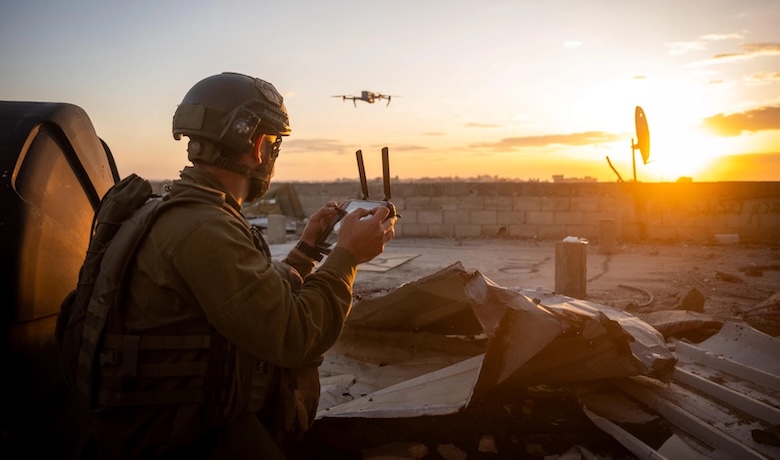
Throughout history, superior weaponry and tactics have always provided a decisive edge in warfare, driving continuous cycles of measures and countermeasures among adversaries. Today’s battlefields are no exception. In the Russo-Ukrainian war and the armed conflict involving the United States, Israel and Iran, drone warfare has emerged as one of the defining features, with increasingly autonomous unmanned systems providing unprecedented situational awareness to belligerents and playing a crucial role in target identification. In addition, large numbers of (one-way) attack drones are being deployed to strike targets.
However, as these systems proliferate, so too do the means designed to counter them. Electromagnetic warfare (EW) techniques, such as jamming and spoofing (p. 8-9), are developing rapidly and are increasingly employed to disrupt the communication and guidance systems of drones and GPS-guided missiles (Slusher, p. 6-7). The electromagnetic spectrum, indispensable to both military operations and civilian life, has thus become a highly contested operational environment.
Despite the prevalence of EW on contemporary battlefields, limited attention has been devoted to the question of how international humanitarian law (IHL) regulates such technologies (notable exceptions include posts by Coventry and Gigliotti and Lawless and Nasu on Articles of War). In a recent article in the Military Law and Law of War Review, I seek to address some of the complex legal questions that arise, including whether international telecommunications law remains applicable between belligerents and how the targeting rules must be applied to EW. In doing so, I examine jamming and spoofing of communications systems and of enemy weapon systems. In this post, I focus on the latter issue: how does the law of targeting apply when weapon systems are jammed?
Consider the following scenario, which appears far from hypothetical in light of contemporary armed conflicts: States Alpha and Beta are engaged in an international armed conflict (IAC). Beta fires several GPS-guided kamikaze drones at Alpha’s military headquarters. In response, Alpha launches a broad GPS jamming operation to disrupt the weapons’ navigation systems, aiming to cause at least some of them to veer off course and miss their intended target. However, one of the disrupted drones strikes a nearby apartment building, resulting in multiple civilian deaths and significant material damage.
How does IHL govern such scenarios? Has Beta violated the principle of distinction (art. 48, 1977 First Additional Protocol (AP I)) because one of its drones struck a civilian object? Or was it Alpha that by interfering with the enemy weapon system “attacked” civilians or conducted an indiscriminate attack? What are the obligations of a party that conducts an electromagnetic operation which foreseeably places civilians at risk, and must a party conducting a strike account for the possibility that the enemy interferes with its weapon systems?
Has Beta Violated the Principle of Distinction?
Let us first consider whether Beta has violated the principle of distinction. This principle prohibits belligerents from directing attacks against civilians and civilian objects (AP I, arts. 51(2) and 52(1)). Did Beta’s attack fall foul of this prohibition? The answer is negative. The object of Beta’s attack was the enemy’s military headquarters, which qualifies as a military objective by nature within the meaning of Article 52(2) of AP I. The fact that the drone failed to strike its intended target and instead hit a civilian object does not, in itself, constitute a violation of the principle of distinction. Compliance with the targeting rules is not assessed based on the outcome of an attack, but rather on the attacker’s ex ante assessment (See, for example, Corn & Watts; for a different view with respect to distinction, see Hill-Cawthorne). Before turning to the remaining obligations incumbent upon Beta, it is useful to examine the lawfulness of Alpha’s jamming operation.
Can Jamming Constitute an “Attack”?
Military operations such as jamming, hacking, or adversarial AI techniques that interfere with the enemy’s targeting system are, in principle, lawful defensive operations against military objectives (see also Boothby, p. 155) and may also qualify as ruses of war. However, that characterization is of rather limited legal significance, as all ruses must comply with the applicable rules of IHL.
To assess the lawfulness of Alpha’s jamming operation, the central question is whether it qualifies as an attack within the meaning of Article 49(1) of AP I, namely, an act of violence against the adversary, whether in offence or defence. If so, the operation would be subject to the full range of targeting rules, including the principle of proportionality (AP I, art. 51(5)(b)) and the “attack-specific” precautionary obligations (AP I, art. 57(2)). If not, the operation would be subject to a more limited set of rules, such as the constant care obligation (AP I, art. 57(1)) and the obligation to take precautions against the effects of attacks and other “military operations” (AP I, art. 58).
Although jamming is a non-kinetic operation that does not, as such, cause direct physical damage to the targeted system, it may under certain circumstances qualify as an attack (See also Lawless & Nasu). As has been clarified with regard to cyber operations, the notion of “attack” is interpreted broadly and encompasses at a minimum those operations that are intended or reasonably expected to cause death or injury to persons, or damage or destruction to objects (Tallinn Manual 2.0, rule 92, ). This is so, irrespective of the means by which those effects are brought about and irrespective of whether such harm is caused to the target of the attack or incidentally (Schmitt, p. 338). The notion of “violence” in the definition of attack thus at least refers to foreseeable physical harm.
In light of this definition, it is evident why some forms of jamming, such as the jamming of radio communications or TV broadcasts, have traditionally not been considered as constituting an attack, given the absence of foreseeable physical harm (Manual on International Law Applicable to Air and Missile Warfare, p. 10). By contrast, the jamming of kamikaze drones by Alpha, while not directly damaging the drones, is expected to cause at least some of them to crash, resulting in their destruction. There are therefore strong grounds to qualify such an operation as an attack, particularly in cases where it is also expected to cause incidental civilian harm.
Another position is advanced by Boothby with regard to so-called “parrying operations” in the cyber-context (p. 157). These are operations that interfere with an enemy weapon system to prevent it from striking its intended target. Such parrying operations are analogous to Alpha’s jamming activity, which disrupts the positioning systems of incoming drones with the aim of diverting them from their target, but without exercising directional control over where those drones ultimately impact. According to Boothby, such measures do not amount to an attack, as they redirect the adversary’s violence away from its intended object rather than directing force against a person or object selected by the acting party (see also: Oslo Manual, commentary to rule 45,). On this view, such situations must be distinguished from operations in which a party intentionally directs a weapon system against a target of its choosing.
However, this approach appears difficult to reconcile with the cognitive standard underpinning the notion of attack, namely, that it suffices that physical harm be “reasonably foreseeable” (see also Kwik, p. 751). While attacks are indeed defined as acts of violence “against the adversary,” the absence of control over the ultimate impact point does not, in itself, preclude the qualification of such conduct as an attack where harmful effects remain reasonably foreseeable. This is all the more so because the foreseeable physical harm resulting from the operation need not be inflicted on the intended target, but may also consist of reasonably foreseeable incidental harm (Tallinn Manual 2.0, commentary to rule 92; Schmitt, p. 338). Consequently, the more convincing approach is to consider Alpha’s jamming operation as an attack within the meaning of Article 49(1) of AP I, due to its foreseeable harmful effects.
Alpha’s Obligations Under the Law of Targeting
Having concluded that Alpha’s jamming operation must be considered an attack, it must comply with the full set of IHL targeting rules. Consequently, the first fundamental issue that arises is whether Alpha’s operation can be reconciled with the principle of distinction, given that it has caused one of the incoming drones to strike a civilian object. As noted above, the principle of distinction prohibits Alpha from making civilians or civilian objects the object of attack (AP I, arts. 51(2) and 52(1)).
But was this prohibition actually breached in the present scenario? Put differently, does the mere fact that Alpha foresaw the possibility of civilian harm resulting from the jamming operation mean that it thereby “directed” an attack against civilians or made them the “object” of attack? The answer is negative. “Directing an attack” or making a person or an object “the object of attack” refers to a decision-making process in which that person or object is purposefully selected as the target of the attack (See Van Benthem, p. 196. See also U.S. DoD Law of War Manual, § 5.4.1,). In the present scenario, Alpha’s operation was not directed against the apartment building, but against the enemy drones, which constitute military objectives by nature within the meaning of Article 52(2) of AP I. The civilian harm resulting from the impact of the deflected drone, even though foreseen by Alpha, is therefore more appropriately categorized as incidental harm or so-called “collateral damage,” as it constitutes the undesired consequence of an attack directed against a lawful military objective (See also Sari, p. 230).
The analysis would change, however, if Alpha had redirected Beta’s weapon system towards another target of its choosing. Had Alpha, for instance, spoofed the drones’ navigation systems in order to redirect them towards civilian objects on Beta’s territory, the operation would clearly violate the principle of distinction (See also Oslo Manual, rule 45).
Yet the analysis does not end there. Even if Alpha did not direct an attack against civilians or civilian objects, a further question arises: does the operation nevertheless fall foul of the prohibition of indiscriminate attacks under Article 51(4) of AP I? After all, the jamming operation is expected to cause at least some of the attack drones to crash at unpredictable locations. As it was established that the jamming operation was directed against Beta’s drones, it can be argued that Article 51(4)(a) and (b) of AP I do not come into play.
Of greater relevance is Article 51(4)(c), which prohibits attacks whose effects cannot be limited as required by the Protocol. One category of attacks that fall within the scope of this prohibition are disproportionate attacks. In this regard, the principle of proportionality precludes Alpha from conducting the jamming operation if it may be expected to cause incidental civilian harm that would be excessive in relation to the concrete and direct military advantage anticipated of fending off and neutralizing the incoming drones (AP I, art. 51(5)(b)).
Yet assessing proportionality in this context poses particular challenges. On the one hand, it may be difficult to predict where disrupted drones would crash and, consequently, whether they will cause civilian harm. Nevertheless, when jamming operations are carried out against such explosive weapon systems in or near densely populated areas, there is a heightened risk of civilian harm (See also International Committee of the Red Cross (ICRC), p. 98). In addition, there may be uncertainty as to what extent the jamming operation will achieve the anticipated military advantage, as this depends, inter alia, on whether the drones are equipped with alternative navigation systems which might not be known to the commander at the time of decision-making. Such uncertainty regarding the probability of obtaining the anticipated military advantage diminishes the concreteness of the advantage to be taken into consideration. Consequently, less expected incidental civilian harm will be tolerated in such cases (ICRC, p. 18).
Finally, Alpha’s attack must comply with the principle of precautions in attack (AP I, art. 57(2)) and particularly the obligation to take all feasible precautions in the choice of means and methods of warfare with a view to avoiding, and, in any event, minimizing incidental civilian harm (AP I, art. 57(2)(a)(ii)). Under this obligation, Alpha may be required to employ alternative means where these would be expected to cause less incidental civilian harm, provided that such means are available and their use is feasible in the circumstances ruling at the time. For instance, if Alpha’s military headquarters were located in a densely populated area, with a correspondingly high risk that disrupted drones could strike civilians or civilian objects, Alpha would be required to consider alternative defensive measures, such as traditional kinetic air defences or directed-energy weapons, where these would be expected to reduce collateral harm and are feasible in the circumstances.
Beta’s Obligations Under the Law of Targeting
Finally, we return to Beta’s obligations under the law of targeting. The question that arises here is whether Beta must account for Alpha’s interference with its weapon systems when planning and carrying out the attack against Alpha’s military headquarters.
With regard to the principle of proportionality (AP I, art. 51(5)(b)), which requires an ex ante evaluation of the anticipated direct and concrete military advantage and the expected incidental civilian harm, Beta must take into account Alpha’s jamming capabilities when assessing the military advantage if it knew or reasonably should have known of them. Such knowledge would bear directly on the expected effectiveness of the attack and may therefore reduce the anticipated military advantage. As a result, a lower level of incidental civilian harm would be justified.
Assessing the civilian harm side of the equation raises a more complex issue. Must Beta also take into account the risk that its drones may cause incidental civilian harm as a result of Alpha’s interference? It has been argued that civilian harm attributable to the conduct of a third party must not be included in the proportionality assessment, except when it results from the physical effects of the attack itself (Gillard, p. 15). However, as Alpha’s jamming operation can be considered an attack in itself, it logically follows that the risk of civilian harm arising from that operation need not be taken into account by Beta in its proportionality assessment. By analogy, if Alpha had neutralized the incoming drones with kinetic means, Beta would likewise not be required to factor in the risk of civilian harm resulting from falling debris caused by Alpha’s attack.
Finally, as has been argued in the context of cyber interference, the obligation to take constant care to spare the civilian population, civilians, and civilian objects (AP I, art. 57(1)) may entail that all feasible measures must be taken to ensure that weapon systems remain sufficiently robust against known forms of interference (Boothby, p. 154). This is an area where military effectiveness and humanitarian considerations clearly converge. Examples of such measures include, where feasible, the use of redundant navigation systems (such as combining GPS with alternative guidance methods). Such considerations should already form part of the legal review of the weapon system (AP I, art. 36) and must also be monitored during its employment, for example in the context of battle damage assessments. It may even be argued that, where Beta is aware of Alpha’s jamming capabilities yet fails to take feasible measures to ensure the robustness of its weapon systems, its conduct could itself raise issues under the prohibition of indiscriminate attacks, in particular under Article 54(4)(b) of AP I (See also, Kwik p. 747-748) .
Conclusion
Electromagnetic warfare, including jamming and spoofing techniques, is rapidly evolving. When deployed against weapon systems, such inexpensive technologies can significantly degrade the accuracy and effectiveness of sophisticated weaponry. At the same time, defensive interference operations raise complex questions under IHL, giving rise to interpretative difficulties that go to the core of some of the fundamental norms of the law of targeting and complicating the attribution of responsibility where civilians are harmed.
A party conducting a defensive jamming operation directed against enemy weapon systems can be considered to carry out an “attack” when it is reasonably expected to cause physical harm, thereby triggering the application of attack-specific targeting obligations. In addition, belligerents conducting targeting operations may not disregard an adversary’s electronic warfare capabilities. Rather, these must be taken into account, particularly in the assessment of proportionality and the obligation to take feasible precautions in attack. As EW capabilities continue to proliferate, both attackers and defenders will need to carefully calibrate their operations in light of their legal obligations, especially where such techniques introduce uncertainty as to where and how civilian harm may materialize.
***
Maxime Nijs is a PhD Researcher and Academic Assistant affiliated with the Ghent Rolin-Jaequemyns International Law Institute at Ghent University.
The views expressed are those of the author, and do not necessarily reflect the official position of the United States Military Academy, Department of the Army, or Department of Defense.
Articles of War is a forum for professionals to share opinions and cultivate ideas. Articles of War does not screen articles to fit a particular editorial agenda, nor endorse or advocate material that is published. Authorship does not indicate affiliation with Articles of War, the Lieber Institute, or the United States Military Academy West Point.
Photo credit: IDF Spokesperson’s Unit
