

Legal Interoperability Lessons from the Red Sea
The landscape of 21st century warfare is rapidly changing. After 20 years of fighting terrorism by non-State actors, great power competition and hybrid threats now dominate the security landscape, along with a return to large-scale kinetic war in Europe and the Middle East. Cyber, information, and legal warfare dominate the competition to conflict spectrum, and naval combat has re-emerged as a central element of modern warfare in both the Black Sea and the Red Sea. While significant in the current context, this is also the environment that will shape a future military engagement with China.
Recognizing the overlapping threats inherent to current and future wars, the United States and its allies and partners have focused substantial energy on improving military interoperability—the ability to seamlessly integrate multiple systems to maximize lethality across a multinational force. Although part of the military strategy discussion for years, the Russian invasion of Ukraine pushed this conversation to the forefront, as partners contributed weapons and ammunition to the defense of Ukraine and NATO considered its collective defense capability.
For warfighters, discussions of interoperability generally focus on the technical, procedural, and human dimensions—e.g., weapon systems, command and control, intelligence sharing—which track the doctrinal discussion of interoperability found in NATO Allied Joint Doctrine (AJP-01). Meanwhile, operational lawyers must focus on “legal interoperability”—a mutual understanding and predictable application of relevant laws—to ensure effective operations as national interpretations of the law evolve and domains overlap and intersect (e.g., cyber operations launched from international water or towards targets in space). Yet, while AJP-01 is the most significant source of military doctrine on interoperability, it only briefly acknowledges the role of the law, without any discussion of interdomain or joint legal interoperability. Within the U.S. military, the U.S. Army is so far the only service to have published a “Best Practices of Multinational Legal Interoperability,” but it is primarily focused on U.S. Army interoperability with partners and allies rather than multidomain/joint force operations.
In fact, joint legal interoperability has received very little attention in U.S. military legal training, particularly with respect to maritime operations. I recognized this firsthand as the Staff Judge Advocate (legal advisor, or “JAG”) to the Commander of the USS Dwight D. Eisenhower (IKE) Carrier Strike Group (IKECSG), as we deployed to the Red Sea in late 2023. Advising on what would become the most sustained period of combat for U.S. Navy warships since the Second World War, I quickly realized that my joint counterparts did not clearly understand the nuance of the law as applied in the maritime context and the grave implications of such in a multidomain, high-end fight where decisions have to be made at the speed of modern combat.
The Red Sea—An Incubator for Next Generation Naval Combat
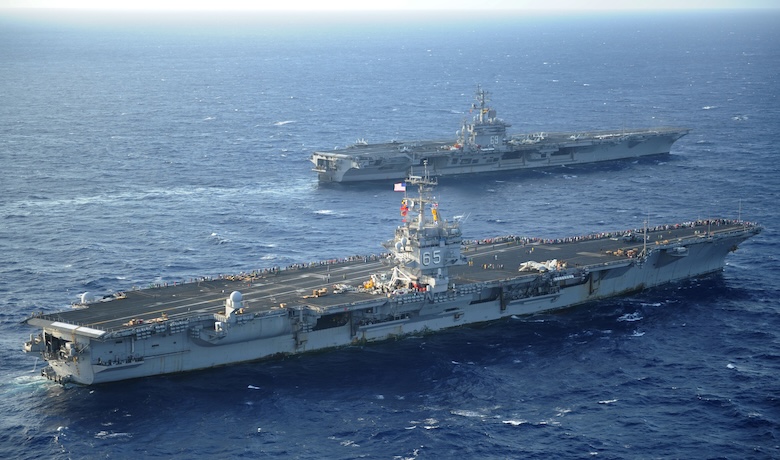
Five days after the IKE and her escorts departed Norfolk in October 2023, the Houthis launched their first salvo of missiles and drones up the Red Sea. Over the next nine months, the units of the IKECSG would deploy over 800 munitions in near constant naval battle against the Houthis. Following the IKECSG’s departure from the theater in June 2024, the U.S. Navy would deploy another five carrier strike groups (USSTheodore Roosevelt, USS Abraham Lincoln, USS Harry S. Truman, USS Carl Vinson, and USS Nimitz), as well as multiple independently deployed guided missile destroyers, to counter Houthi aggression and deter Iranian support to the rebels.
Operations by these forces ultimately engaged over 400 Houthi-launched missiles and drones while providing escort to scores of merchant vessels transiting the Bab-al-Mandeb Strait. For all this effort, including sustained strike operations from March to May 2025, the Houthis maintained the capability to target and sink merchant vessels attempting the transit and demonstrated the threat that 21st-century asymmetric warfare poses to maritime traffic through critical sea lines of communication.
Many warfighting lessons were learned from the experience of the American warships engaged in daily battle against the Houthis. Near constant defensive combat operations tested the mettle of the ships, their systems, and their crews. Operational tempo followed a daily pattern of encountering novel threats, developing and implementing solutions, and assessing the results for lessons learned. This was learning at the speed of combat, and as with all combat, as threats evolved, so did the legal questions.
The questions were simple at first: What is the threshold for the use of force in self-defense? Who can I defend in addition to myself? But then the questions got more complicated: How does the customary law as reflected in the UN Convention on the Law of the Sea apply during hostilities? At what point do we start applying the principles of the law of armed conflict in the maritime setting? What different factors affect our authorities? Do the Houthis qualify as pirates? How do unmanned aerial and surface systems demonstrate hostile intent?
Cross-Domain Legal Advice
Although described as sea combat, the Red Sea fight against the Houthis was actually a battle at the “seam” of land and sea. This became particularly important when it came to the application of relevant legal frameworks and authorities. In the military, authority flows through the command structure, meaning certain commanders are authorized to use force when others are not, depending on the nature of the mission in that specific location. This may seem like a simple command and control nuance, but in the Red Sea, questions concerning when and who would engage targets ashore caused confusion and led to unnecessary delays in action. Thankfully, those delays did not result in any military casualties in the Red Sea, but that may not be the case in the future.
As the IKECSG JAG, I trained all subordinate units on the authority to use force in self-defense under the UN Charter, the rules for the conduct of hostilities under the Geneva Conventions, the national application of these laws under the Standing Rules of Engagement for U.S. Forces (SROE), supplemental guidance from higher headquarters, and the IKECSG commander’s intent. The greatest focus during these trainings was on what “demonstrated hostile intent” and “imminent threat” look like, threshold questions legal advisors must equip operators to answer quickly.
Like any other legal practice, interpretation of operational law is informed by present circumstances, past experience, training, and formal education. This multi-factor analysis can frequently lead to debate, a challenge that is exacerbated in a joint environment, where experience, training, formal education, and even the mere use of the English language can differ significantly. Anyone who has served in the military understands that different services—and even different communities within the same service—frequently use similar terms to mean different things. The result: different understandings of the threshold question of imminence.
The assessment of whether something constitutes an imminent threat is shaped by intelligence (frequently service-specific), higher-level guidance, capabilities, platform integration, and personal experience. Even in the best intelligence-sharing environment, service culture and training can lead to cognitive bias that affects the analysis. What “demonstrated hostile intent” looks like to a naval operator may be very different than what it looks like to counterparts in the other services, who may be used to closer combat conditions with different levels of platform-to-platform integration.
Further, the U.S. SROE authorize and direct self-defense of an entire unit, but the interpretation of “unit” differs among services in practice. When conducting distributed maritime operations, naval vessels may be hundreds of miles apart and yet still be considered part of the same “unit.” In such a case, the best defense may not come from other ships but from a more proximate land or air asset, which requires a joint understanding of the threat—and agreement on the interpretation of relevant authorities—in real time.
A Naval Warfare Renaissance
While many Navy JAGs have advised for years on air and/or ground combat operations in Afghanistan, Iraq, and Syria, our counterparts in other services have not had the same breadth of exposure to maritime operations. Moreover, although Navy JAGs are generally trained in the Law of Naval Operations, this “dirt sailor” experience has made any understanding of naval warfare largely theoretical. Yet, examples from the Red Sea and other recent naval battles clearly show how maritime operations are re-emerging as a dominant domain of modern warfare, even against adversaries without traditional navies. Critical response time is wasted, and legal advisors do a disservice to their commanders operating across domains if they are not ready with relevant understanding.
The Red Sea battles identified some critical gaps in understanding between land and naval legal advisors regarding who can shoot at land-based targets and when – questions that identified challenges in applying existing legal frameworks to the joint targeting process. Fortunately, these questions were primarily focused on general principles derived from the jus ad bellum as applied through the rules of engagement (e.g., what constitutes “demonstrated hostile intent” in the maritime domain?). Even as the tactics of the Houthis, a non-State actor without a formal navy, evolved to incorporate the use of small armed boats, the use of force in response was largely controlled by basic legal principles.
By contrast, when considering a State adversary with greater maritime capability, the law of naval warfare factors much more prominently than it did in the Red Sea. Questions regarding lawful military objectives, distinction, and proportionality are all answered differently when it comes to targeting adversary ships, and naval warfare incorporates unique authorities like the almost forgotten concept of “prize law,” which some predict will play a meaningful role in a potential conflict with China. Moreover, the law of naval warfare does not only control responses by naval assets. Operators across the joint force (and their JAGs) must also have a working understanding of these concepts.
Unfortunately, joint legal interoperability is rarely taught in our schoolhouses or practiced in pre-deployment training. During the IKECSG workup (i.e., deployment training) cycle, my training to be the principal legal advisor for the entire strike group focused on collaborating with other Navy judge advocates up the chain of command and around the theater. It also included a very brief module focused on interoperability with NATO.
During our training evolutions, I consulted a colleague with very similar training to my own, who spoke the same “Navy language” as I did. Even in the context of working through complex NATO rules of engagement, we came at the training scenarios from the same perspective. With no disrespect to the capability of the training team, the exercise did not give any attention to questions of legal interoperability with our U.S. joint counterparts. To their credit, this particular training team later took my experience from the Red Sea and updated their next workup evolution, but the practice of training on operational law with joint counterparts remains far from a universal standard.
More “Joint” JAGs
This is not a criticism of my joint counterparts or any of our training programs, but a call to action. We need more “joint” JAGs. This is true regardless of whether there is joint or service-specific command and control (as we retained in the Red Sea). Even under a joint task force structure, time is wasted if JAGs don’t understand operations, threats, and authorities across all domains. As the joint force focuses on the three dimensions of military interoperability, it is imperative that it also consider joint legal interoperability. Like the operators we advise, JAGs should train with our service counterparts to better understand the considerations derived from service culture and operational capabilities, as well as the legal authorities unique to certain domains.
Updating training isn’t a particularly hard task. It could easily start with the integration of cross-service JAGs into workup cycles and deployments, providing firsthand experience. We currently do this within the Navy to expose and train junior judge advocates; it would provide equally good training to our joint counterparts. Beyond such “on-the-job” training, JAGs across all services would benefit from more exposure to joint concepts during initial and intermediate training courses at the service legal schoolhouses. These schoolhouses could also collaborate to create a new handbook for joint legal interoperability (or revise the Army’s handbook to cover joint and multinational operations), as a useful resource to JAGs across all services.
Preparing for Next Time
The Red Sea was an incubator for innovation in naval combat. Each day presented challenges that required collaboration with joint and multinational counterparts as we fought at the “seams” of peace and hostilities and maritime and land domains. We figured our way through the legal questions of joint operations in the Red Sea, but it won’t be as “simple” in a potential fight with China. We would certainly take the operational lessons learned in the Red Sea and apply them in such a conflict, but operational lawyers must also be prepared for a war that will trigger concepts of naval warfare that have not been considered in over 70 years.
True legal interoperability requires a mutual understanding and application of relevant law to ensure effective operations. The time to fill this gap is now with the lessons we have identified in the Red Sea. Not doing so will leave us vulnerable and cause us to waste response time we won’t have to discuss legal standards that could (and should) be aligned well in advance. Ultimately, it could cost lives.
***
Kathy Paradis is a Commander in the United States Navy Judge Advocate General’s Corps.
The views expressed are those of the author, and do not necessarily reflect the position of the United States Military Academy, Department of the Army, Department of the Navy, the Department of War, or the U.S. Government.
The public release clearance of this publication by the Department of the Navy does not imply Department of the Navy endorsement or factual accuracy of the material.
Articles of War is a forum for professionals to share opinions and cultivate ideas. Articles of War does not screen articles to fit a particular editorial agenda, nor endorse or advocate material that is published. Authorship does not indicate affiliation with Articles of War, the Lieber Institute, or the United States Military Academy West Point.
Photo credit: U.S. Navy, Mass Communication Specialist 3rd Class Shonna L. Cunningham
