

London Calling: The Customary Law of Naval Blockade and Contemporary Practice
Naval blockade has long occupied a distinctive place within the law of naval warfare. Until very recently some commentators regarded it as a relic of an earlier era, however, the employment of naval blockades in recent conflicts has confirmed that States continue to view them as an important method of warfare. Although the fundamental principles of blockade law were set out in the nineteenth and early twentieth centuries, notably in the 1856 Declaration of Paris and the 1909 London Declaration Concerning the Laws of Naval War (which States never ratified and therefore never entered into force), its legal foundation has always rested principally upon customary international law. The classical requirements that a blockade be declared, notified, effective, impartial in its application, and respectful of access to neutral ports have remained remarkably stable for more than a century. These core criteria have been consistently reaffirmed in naval manuals and, more importantly, reflected in State practice.
Nevertheless, the use, and potential abuse, of blockade in situations where vulnerable civilian populations may face harm has led human rights advocates, humanitarian organizations, and some legal scholars to question whether blockade, in its current form, is compatible with contemporary international humanitarian law. The expression of such humanitarian concerns raises a fundamental question about the current state of blockade: does contemporary State practice confirm the validity of the customary law of blockade, as reflected in the 1909 London Declaration, or does it indicate that the Declaration’s traditional requirement of effectiveness is being reshaped by modern humanitarian norms?
This post argues that contemporary maritime practice demonstrates that the essential legal characteristics of blockade, as outlined in the 1909 London Declaration, have neither been abandoned nor transformed; rather, recent conflicts reveal a remarkable continuity in the customary law of blockade. States continue to declare blockades, enforce them through naval, air and other assets, intercept neutral shipping, and justify such measures by reference to established principles of the law of naval warfare. That which has changed is not the belligerent right to conduct naval blockades but rather the broader legal environment within which the law of naval blockade exists.
Using three contemporary case studies, this article examines the proposition that the customary law of blockade remains remarkably unchanged. The first considers Russian and Ukrainian operations in the Black Sea, with particular emphasis upon the concepts of effectiveness, enforcement, and technological change. The second examines Israel’s naval blockade of the Gaza Strip, focusing upon the relationship between blockade law and humanitarian obligations. The third considers the conduct of the U.S. Navy’s blockade of Iran, where the strategic importance of international navigation rights presents distinct legal challenges.
The Customary Law of Blockade
Naval blockade is a distinct belligerent maritime operation intended to prevent vessel traffic from all States from entering or leaving specified coastal areas that are under the sovereignty, occupation, or control of an enemy. Such areas may include ports and harbors, the entire coastline, or parts of it. As a distinct operation, it is governed by a body of rules that have evolved over five centuries and has been shaped through the practice of maritime powers, interpreted and refined by the jurisprudence of prize courts, and accepted as part of the belligerent right to wage war at sea.
Historically, blockade emerged from the broader doctrine that a belligerent was entitled to deny an adversary the use of the sea for military and economic purposes. By the late eighteenth century, British and American prize courts had recognized blockade as a lawful means of warfare, so long as certain minimum conditions were satisfied. These conditions reflected a balance between the legitimate military interests of belligerents and the rights of neutral States to engage in maritime commerce.
The diplomatic conference that led to the creation of the 1909 London Declaration was an attempt to codify the existing customary law of blockade at that time. Although it never entered into force, the London Declaration remains the foundational document for the contemporary practice of blockade. The status of the Declaration is reflected not only in State practice, but also the incorporation of its primary operational principles into numerous military manuals and handbooks.
In accordance with the operational provisions of the London Declaration, several requirements must be fulfilled to establish and maintain a lawful blockade. Failure to meet these requirements means that a blockade is not lawful, and thus, seizure of neutral vessels not engaged in the carriage of contraband is unlawful.
First, a blockade must be established and its existence notified to all belligerents and neutral States (London Declaration, art. 8). Notification serves the practical function of informing neutral shipping of the existence, geographical limits, commencement, duration, and conditions of the blockade, thereby permitting neutral vessels to regulate their conduct accordingly.
The second, and most operationally difficult condition to implement, is the requirement that any declared blockade must be effective (London Declaration, art 2). The 1856 Declaration of Paris codified this principle by providing that blockades, in order to be binding, must be “maintained by a force sufficient really to prevent access to the coast of the enemy.” The requirement here does not dictate that every vessel be intercepted, but that the blockading power possesses the practical military capability to deny access to the enemy coastline. Modern surveillance systems, maritime patrol aircraft, satellites, unmanned maritime systems, and long-range precision weapons have fundamentally altered the operational means through which such control may be exercised. They have not, however, altered the legal requirement that a blockade possess genuine military effectiveness rather than merely symbolic effect.
Third, a blockade must be applied impartially (London Declaration, art. 5). Subject to recognized humanitarian exceptions, all vessels attempting to breach the blockade must be treated according to the same legal criteria irrespective of nationality.
Fourth, a blockade must not block access to neutral ports (London Declaration, art. 18) or otherwise interfere with neutral rights (London Declaration, art 1).
As with all methods and means of warfare, the conduct of blockade in the contemporary era is constrained by the broader framework of international humanitarian law. The customary prohibition on operations intended primarily to starve the civilian population, or intended solely or primarily to deprive civilians of objects essential to their survival, together with the qualified obligation to permit humanitarian relief under prescribed conditions, limits how a blockade may lawfully be executed. These humanitarian obligations do not derogate from the customary right of blockade; rather, they qualify it by requiring that civilians not be made the direct object of attack.
Case Study I: Ukraine and the Black Sea
The characterization of Russian naval conduct in the Sea of Azov as a “blockade” has become commonplace in political and journalistic discourse since the full-scale invasion of Ukraine in February 2022. While this language is being used in some circles to generally describe a broader maritime interdiction operation, any attempt to legally define the Russian naval operations as blockade fails at the first threshold required for establishing a blockade.
The Russian Federation has at no point issued a formal blockade declaration of the kind blockade law requires. Instead, Russia has framed the measures as security or exclusion zones incident to the conduct of what Russia terms: a “special military operation”; as protective measures for infrastructure, including the Kerch Strait Bridge; and, since February 2022, as a general suspension of navigation attributed to the presence of mines and the hazards of active combat rather than to any assertion of belligerent rights, such as contraband, blockade, or the belligerent right of search.
The measures Russia has employed in the Sea of Azov do not, individually or cumulatively, satisfy the requirements of declaration, notification, and impartially enforced closure that the customary law of blockade demands. Absent the core criteria required to establish a lawful blockade, a maritime area that is merely rendered dangerous by the conduct of hostilities is not subject to the law of blockade. Were Russia to have declared a blockade meeting the four core procedural criteria, the resulting legal inquiry would properly turn to the question of whether the blockade is effective (it is not).
Acknowledging that the Black Sea operation is not a blockade, it is still worth examining this conflict to see how emerging weapons and technology might affect the means of effectively imposing and maintaining blockades in the future. The classical formulation of effectiveness, as reflected in nineteenth-century prize jurisprudence and subsequent codifications, requires that a blockade be maintained by a force sufficient to render ingress or egress to enemy ports practically dangerous. That standard was developed in an environment in which control of maritime access depended primarily upon the physical presence of warships capable of intercepting merchant vessels.
Contemporary operations demonstrate that effectiveness may now be achieved through a combination of physical presence and remote capability. The deployment of maritime patrol aircraft, unmanned surface and aerial vehicles (drones), cyber attacks, and the use of jammers to disrupt navigation allows a belligerent to exert control over maritime space without maintaining a continuous surface presence in the area.
In the Black Sea context, this has resulted in a form of layered maritime denial in which the risk to neutral shipping arises not only from interception by naval vessels, but also from the credible threat of strikes from assets at extended range. While these developments do not alter the customary requirements themselves, they do affect the evidentiary basis upon which effectiveness can be assessed. In earlier periods, effectiveness was inferred primarily from patterns of interception and the physical disposition of blockading vessels. In the present context, effectiveness must also take account of the integrated nature of maritime, space, cyber, and land-based strike systems. The relevant inquiry, however, remains unchanged: is access to the enemy coastline in fact rendered practically dangerous or infeasible for neutral shipping?
A further dimension of the Russia-Ukraine case concerns the significance that humanitarian measures designed to mitigate the effects of maritime restrictions may hold for the evolution of blockade law. Ukraine is among the world’s largest exporters of grain and fertilizer, and the closure of its ports, compounded by Russian threats to sink commercial vessels carrying Ukrainian goods, contributed to a sharp rise in the price of staple foods worldwide in 2022. Combined with increases in energy costs brought on in part by the conflict, this pushed some developing countries to the brink of debt default and left growing numbers of people on the edge of famine.
In response to the threat of widespread hunger arising from Ukraine’s inability to export its harvest and fertilizer, the Black Sea Grain Initiative (BSGI) established a humanitarian maritime corridor permitting the safe export of grain and other foodstuffs from designated Ukrainian ports under monitored conditions. The arrangement allowed commercial food and fertilizer exports, including ammonia, from three key Ukrainian Black Sea ports: Odesa; Chornomorsk; and Yuzhny/Pivdennyi. Though short-lived, the arrangement, which in some respects is similar to the model presented in the San Remo Manual, offers useful insight into the issue of humanitarian access during blockade, and a method for addressing it (para. 103).
Although the BSGI was initiated outside of the framework of blockade, it is instructive for the development of blockade law for several reasons. First, it demonstrates that the humanitarian consequences of restricted maritime access in this conflict have in practice been addressed not through the invocation of blockade law’s (contested and underdeveloped) humanitarian provisions, but through an ad hoc, negotiated, sui generis arrangement standing entirely outside the law of naval warfare. This is a solution of politics and diplomacy rather than of doctrine.
Second, and more significantly for the progressive development of the law, the BSGI’s structure—a joint inspection mechanism, defined safe corridors, and a negotiated process for balancing the security concerns of belligerents against the humanitarian and economic needs of third States—offers a template that could usefully inform a revised customary or conventional framework governing humanitarian access during blockade or blockade-like restrictions, of precisely the kind called for by commentators dissatisfied with the current law’s indeterminacy.
The BSGI demonstrates that a workable, negotiated humanitarian-access mechanism is achievable even during active naval conflict, and that the manner of its negotiation, operation, and termination can inform the progressive development of this aspect of blockade law. Given the absence of international consensus on how, or to what extent, humanitarian protection is required under blockade law, the BSGI may offer a foundation for developing a more effective and meaningful humanitarian framework within that body of law.
The next case study, Gaza, presents a different set of pressures. Whereas the Ukraine situation primarily tests the meaning of effectiveness in a technologically complex battlespace, the Gaza blockade raises more directly the question of how the customary law of blockade interacts with the humanitarian protections embedded in modern international humanitarian law.
Case Study II: Gaza
The naval blockade imposed off the coast of the Gaza Strip represents the most sustained and legally contested example of blockade practice in the contemporary period. Since its very inception, the Gaza blockade has been the subject of extensive formal legal argument, diplomatic protest, and judicial and quasi-judicial consideration (see e.g., here, here). It therefore provides a particularly useful lens through which to examine the interaction between the customary law of blockade and the evolving body of international humanitarian law governing the protection of civilians.
Israel has maintained a formal naval blockade off the Gaza Strip since 2009. With a declared purpose of preventing the importation of arms and related materiel by non-State armed groups operating in Gaza, Israel has enforced the blockade through a combination of naval patrols, interception of vessels, and the establishment of a maritime exclusion zone extending seaward from the Gaza coastline. Although the precise operational parameters have varied over time, the essential structure of the measure has remained consistent: the use of sustained naval enforcement to deny maritime access to and from Gaza.
From the perspective of traditional blockade law, the Gaza operation is a textbook application of the customary law of naval warfare: it satisfies the requirements of declaration, notification, and effectiveness, and is directed against a territory from which hostilities are being conducted. On this view, its legality is governed primarily by the traditional law of blockade as reflected in customary international law, and for those who treat the London Declaration as capturing the full extent of that customary law, the Gaza blockade is perfectly legal.
On another view, however, the Gaza blockade raises more fundamental questions about the relationship between blockade law and international humanitarian law, particularly the rules protecting civilian populations. Critics argue that its effects on civilians, including restrictions on the movement of goods and persons, engage prohibitions on collective punishment and the starvation of civilians as a method of warfare, as well as the obligation to allow and facilitate humanitarian relief. While those who associate with this viewpoint do not necessarily deny the existence of blockade as a lawful method of warfare, they do challenge the compatibility of its application with contemporary humanitarian standards.
The customary law of blockade has never existed in isolation. Even in its classical form, blockade was subject to limits derived from prize law and the law of neutrality. However, modern international humanitarian law has significantly expanded the normative framework within which a blockade must operate. The contemporary legal question, therefore, is not whether blockade is per se incompatible with international humanitarian law, but whether its implementation in a particular case complies with the cumulative requirements of the modern laws that regulate armed conflict.
In the Gaza context, much of the legal debate has centred upon the scale and duration of restrictions on goods entering and leaving the territory, and the extent to which humanitarian relief for the civilian population is being obstructed. Israel has maintained that the blockade is a lawful security measure directed against an organized armed group engaged in ongoing hostilities and that humanitarian supplies are permitted subject to inspection and security controls. Opponents of the blockade have argued that the cumulative effect of restrictions, particularly when coupled with the effects of the Israeli restrictions against goods being supplied across land borders constitutes an impermissible impact on the civilian population.
For present purposes, the significance of the Gaza case does not lie in resolving these competing claims in their entirety, but in clarifying their doctrinal implications for the customary law of blockade. The existence of legal controversy surrounding a particular blockade does not, without more, establish that blockade as an institution has ceased to be part of customary international law. Rather, it demonstrates that the exercise of blockade is increasingly subject to scrutiny under overlapping legal regimes.
The Gaza blockade also illustrates the continuing relevance of the concept of effectiveness in a humanitarian context. Unlike the Ukraine case, where effectiveness is primarily a function of military capability, here effectiveness intersects with questions of humanitarian access and civilian dependency. Whereas a blockade that is too porous may fail to meet the threshold of effectiveness required under customary law, one that makes no allowance for humanitarian relief in the face of starvation will raise serious questions about whether international humanitarian law is being violated.
A further point of significance in the case of Gaza concerns the relationship between blockade law and the law of occupation. Some legal analyses suggest that the degree of control exercised over Gaza by Israel, both from land and sea, raises questions as to whether the law of occupation may also be relevant. In this context, some obligations of Geneva Convention IV might arise. Without resolving that issue here, it is sufficient to note that the potential overlap between blockade and occupation law could affect the analysis of whether a specific blockade might be unlawful.
Ultimately, the Gaza case does not support the claim that modern humanitarian norms have displaced customary blockade law. Instead, it shows that blockade now operates within a more complex legal environment than it did a century ago. The customary right persists, but its exercise is now subject to more intensive international scrutiny, scrutiny that is, and always has been, demanding that humanitarian protections be considered.
The final case study, involving Iran and the Strait of Hormuz, illustrates a different dimension of contemporary blockade law, not humanitarian constraint or technological adaptation, but geographical concentration and the implications of blockade in narrow international waterways of global economic significance.
Case Study III: The United States Blockade of Iran (2026)
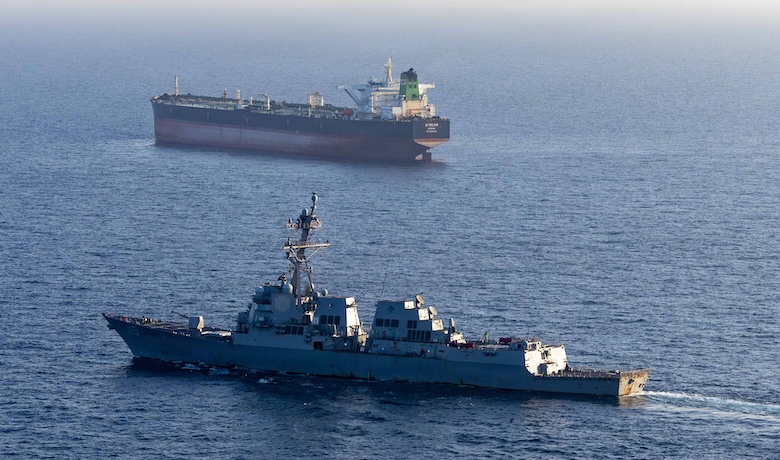
The most recent and legally significant development in contemporary blockade practice is the United States’ ongoing naval blockade of the Islamic Republic of Iran, initiated in April 2026 in the context of an international armed conflict. Unlike earlier patterns of U.S.–Iran maritime interaction, which were largely characterized by sanctions enforcement, selective interdiction, and freedom of navigation operations, the present measures constitute a comprehensive attempt by the United States to deny maritime access to Iranian ports through sustained naval enforcement.
The U.S. blockade of Iranian ports commenced on April 13, 2026 and has been implemented through a substantial deployment of naval and air assets, including carrier strike groups, amphibious ready groups, and long-range surveillance systems. The blockade has been effective, with the complete cessation of commercial maritime traffic to and from Iranian ports, coupled with interception, diversion, or disablement of vessels attempting to breach the blockade zone.
For the purposes of this post, the legal significance of these operations lies not in their strategic effectiveness, but in their characterization under the customary law of naval warfare. The United States has explicitly stated that it is conducting a naval blockade of Iran. This characterisation is legally relevant in that it reflects the invocation of the specific belligerent right of naval blockade as recognized under customary international law.
On its face, the operation satisfies the classical definitional elements of blockade. It is directed against an enemy coastline in the context of an international armed conflict. It is maintained by a force sufficient to render ingress and egress from Iranian ports practically dangerous. It has been notified through operational warnings and public statements. And it is applied on a non-discriminatory basis to vessels irrespective of flag.
The most legally significant feature of the present operation is its scale and scope. Unlike historical blockades, which were typically confined to the immediate maritime approaches to an enemy coastline, the current measures extend across a wider operational theatre, incorporating surveillance and interdiction capabilities in the Gulf of Oman and beyond. This reflects a structural transformation in naval warfare rather than a transformation in legal principle. The customary requirement of effectiveness does not prescribe the spatial configuration of naval forces; it requires only that access to enemy ports be rendered practically unsafe or infeasible. Contemporary technology permits that condition to be achieved through distributed systems of maritime control rather than static cordons of surface vessels.
Of particular significance in the current blockade is how effectiveness is demonstrated. Unlike earlier conflicts, where effectiveness could be assessed primarily through observation of blockade-running and interception rates, the contemporary blockade of Iran operates in an environment characterized by a combination of physical presence, predictive intelligence, automated surveillance, and multi-domain targeting. Effectiveness is therefore established not solely through actual interdiction, but through the demonstrated inability of commercial shipping to access designated ports without incurring a material risk of interception or attack. This represents an evolution in evidentiary assessment rather than a change in the underlying legal standard.
Where a blockade is comprehensive in scope and enforced with sufficient effectiveness, neutral commerce is inevitably affected. In the case of the U.S.-Iran conflict, the effects of the blockade have been compounded by the Iranian closure of the Straits of Hormuz, which has effectively stopped all maritime traffic from entering and leaving the Persian Gulf, and thus accessing ports in the Gulf States. The combined actions have thrown global energy markets into deep uncertainty, choking off flows through the Strait of Hormuz and set off severe price swings and shortages. Despite protests from countries that are heavily impacted by the situation in the Persian Gulf, none has initiated any serious challenges to the use of blockade in this conflict. The same however cannot be said for the closure of the Straits of Hormuz, an action which is virtually universally considered to be in violation of international law, both in the form of customary law and the Transit Passage Regime in UNCLOS.
The Iranian case thus provides a clear contemporary example of blockade as a fully articulated and explicitly invoked naval operation. Unlike the situations in Ukraine and Gaza, where the legal characterization is either partial or contested, the U.S. blockade of Iran represents a direct and formal reliance upon the customary law of blockade as an operative legal framework for maritime warfare.
It follows that contemporary practice in this context provides compelling evidence of the continuing vitality of blockade as a customary rule. Far from being displaced by sanctions law, freedom of navigation doctrine, or general humanitarian constraints, blockade remains an available and actively employed method of warfare in international armed conflict.
Conclusion
Across the three case studies examined, a consistent distinction emerges between the existence of blockade as a lawful method of warfare and the legality of its specific application in particular factual circumstances. In the case of Ukraine, naval operations in the Black Sea demonstrate that the scope of effectiveness must evolve to incorporate modern means, such as distributed sensor networks, long-range strike systems, and unmanned weapons platforms. In the case of Gaza, sustained legal and political controversy revolves around the characterization of the type of armed conflict and the humanitarian consequences of the blockade rather than the existence of blockade as a legal category. In the case of Iran, contemporary U.S. naval operations, combined with compliance of neutral States and vessels, demonstrate the continuing willingness of States to recognize the legal existence of blockade where the factual and legal conditions of international armed conflict are present.
Taken together, these developments suggest that contemporary practice reflects not an erosion of the law of blockade, but continuing challenges to the legality of specific operations conducted within increasingly complex legal and operational environments. The customary requirements of declaration, notification, effectiveness, respect for neutral ports, and impartiality remain fundamentally intact.
What has changed is the interpretive context in which those requirements are applied, particularly through the increasingly significant interaction between the law of blockade and broader humanitarian norms governing civilian protection and humanitarian relief. Those norms may constrain the how a State exercises a blockade, but they do not displace or replace its underlying legal framework. In this respect, the basic rules reflected in the London Declaration more than a century ago retain their fundamental character, as does blockade itself as an established and lawful method of naval warfare.
***
Phillip J. Drew is a Fellow at the Centre for International and Defence Policy at Queen’s University.
The views expressed are those of the author, and do not necessarily reflect the official position of the United States Military Academy, Department of the Army, or Department of Defense.
Articles of War is a forum for professionals to share opinions and cultivate ideas. Articles of War does not screen articles to fit a particular editorial agenda, nor endorse or advocate material that is published. Authorship does not indicate affiliation with Articles of War, the Lieber Institute, or the United States Military Academy West Point.
Photo credit: U.S. Navy
