

The Madleen Incident and the Gaza Naval Blockade
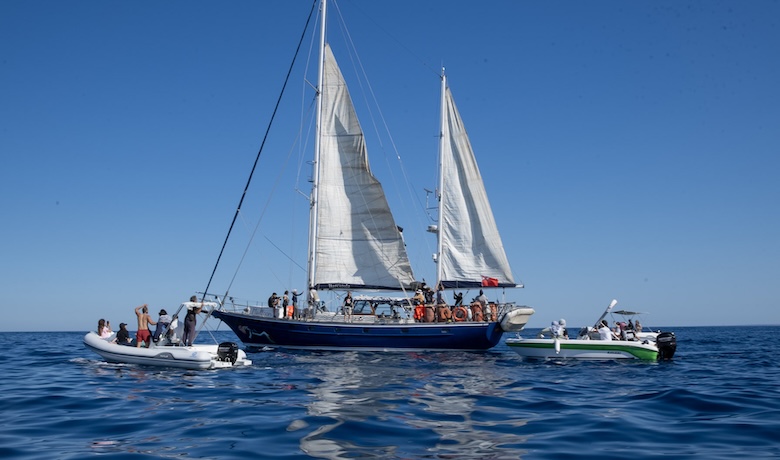
On June 9, 2025, Israeli naval forces intercepted the Madleen, a UK-flagged sailboat operated by the Freedom Flotilla Coalition, attempting to breach Israel’s longstanding naval blockade of Gaza. Among those aboard were notable activists, including climate activist Greta Thunberg and Rima Hassan, a French member of the European Parliament with Palestinian heritage, heightening international attention on the incident.
The Israeli Foreign Ministry confirmed the interception, stating that the vessel was redirected to the Israeli port of Ashdod, that all passengers were safe and would return to their home countries. Footage released by Israel showed military personnel providing food and water to the activists. The Freedom Flotilla Coalition condemned the boarding as unlawful. They also reported that Israeli forces deployed drones and sprayed an irritant on the vessel before boarding it in international waters. The incident has reignited debate over the legality of Israel’s naval blockade. This post explores the legal framework governing naval blockades and examines the lawfulness of the interception of the Madleen.
The Law of Blockade
Blockade is a method of warfare that developed in the context of international armed conflicts (IAC). The Newport Manual, a recent scholarly restatement of the law of naval warfare, defines a blockade as “a belligerent operation intended to prevent vessel traffic from all States from entering or leaving specified coastal areas that are under the sovereignty, occupation, or control of an enemy. Such areas may include ports and harbors, the entire coastline, or parts of it” (para. 7.4.1). A blockading State, therefore, has the right to intercept all vessels bound for the blockaded territory. Crucially, enforcement focuses on vessels based on their destination, not their cargo. In other words, that the vessel breaches, or attempts to breach, a blockade is enough to make the vessel liable to capture.
The law of blockade is generally considered to reflect customary international law. Although its landmark text, the London Declaration of 1909, has not become binding international law, it contains several provisions that help define the law, which is mostly contained in military manuals and soft law instruments. A maritime blockade is established lawfully if the following requirements are met:
(1) A blockade must be declared, and the international community must be duly notified. The declaration must include the date the blockade commences and its geographical limits.
(2) The blockade must not bar access to neutral ports.
(3) It must be enforced impartially. In other words, it applies against all ships of all nations.
(4) The blockade must be effective. This means that there must be a high chance that ingressing and egressing vessels breaching the blockade are intercepted.
The Lawfulness of the Gaza Blockade
Israel imposed its naval blockade on Gaza in January 2009. The blockade aims to prevent weapon smuggling, terrorist movement, and access to resources to force Hamas into military submission. Its details were publicly announced through an official Notice to Mariners. Since then, Israel has effectively enforced the blockade, most notably during the 2010 Mavi Marmara incident (see also Lahav).
As mentioned, legal scholars generally consider that naval blockades can only be lawfully established during an IAC. Given the unique nature of the Israeli-Gaza situation, conflict classification in this situation remains rather complex. Hamas does not seem to be an agent of the Palestinian Authority, which does not endorse Hamas’s hostilities. Commissions of inquiry, including the UN’s Palmer Report and Israel’s Turkel Commission, classify the Gaza conflict as international based on the fact that Gaza and Israel are distinct territorial and political areas, that Hamas is the de facto political and administrative authority in Gaza, and that it routinely fires rockets into Israeli territory (Palmer Report, p. 41). Others argue that the conflict is a non-international armed conflict (NIAC) based on, for example, the fact that Hamas forces do not represent a State.
While it makes sense to argue that a NIAC is ongoing in Gaza between Israel and Hamas, in the author’s view, even if there was a NIAC prior to the blockade an IAC is now taking place. Through the declaration of the blockade, Israel has recognized the belligerent status of Hamas; thus, the laws applicable to an IAC govern the conflict. The U.S. Supreme Court also recognised this in the Prize Cases, where it held that the declaration of a blockade in a NIAC means that the blockader recognises the belligerency of the enemy, thereby converting the NIAC into an IAC. Applying this precedent, the author argues that Israel’s blockade of Gaza signals recognition of Hamas’s belligerency and elevates the conflict from a NIAC to an IAC (see also Drew, and Heintschel von Heinegg).
Israeli Actions as “Acts of Piracy”?
The interception was conducted by the Israel Defense Forces (IDF) to prevent the entry of the vessel into Gaza. The Freedom Flotilla Coalition condemned the boarding in international waters as unlawful, describing it as an act of “international piracy” and claiming that “Israel has absolutely no jurisdiction, no lawful authority, to take over this vessel.”
Article 101 of the UN Convention on the Law of the Sea (UNCLOS) provides that piracy consists of any of the following acts:
(a) any illegal acts of violence or detention, or any act of depredation, committed for private ends by the crew or the passengers of a private ship or a private aircraft, and directed:
(i) on the high seas, against another ship or aircraft, or against persons or property on board such ship or aircraft;
(ii) against a ship, aircraft, persons or property in a place outside the jurisdiction of any State;
(b) any act of voluntary participation in the operation of a ship or of an aircraft with knowledge of facts making it a pirate ship or aircraft;
(c) any act of inciting or of intentionally facilitating an act described in subparagraph (a) or (b).
The vessel from which the act of piracy is launched must also be a private vessel. The Castle John v. NV Mabeco case is illustrative: the Belgian Court of Cassation held that Greenpeace operating from a private vessel had committed piracy against a Dutch vessel by attacking it, because the act of violence was “in support of a personal point of view … even if [it] reflected a political perspective” (Honniball, p. 313). Therefore, a distinction between lawful naval measures and piracy is that the latter is committed for private ends. The accusation of piracy is, therefore, inapplicable to the IDF’s actions.
Knowledge, the High Seas, and Proportionate Enforcement
As the Madleen’s crew openly acknowledged their purpose to break the blockade, they cannot claim ignorance of the blockade’s existence. Blockade law focuses not on the nature of the cargo, but on the vessel’s destination. The Freedom Flotilla Coalition wrote that “[u]narmed and nonviolent, ‘Madleen’ poses no threat. She sails in full accordance with international law. Any attack or interference will be a deliberate, unlawful assault on civilians.” While enforcement action against a vessel without constructive knowledge of the existence of a blockade is indeed unlawful (Newport Manual, para. 7.4.7(3); San Remo Manual, rule 98), the publicly declared objective of the Madleen’s mission was to breach the blockade of the Gaza Strip. Thiago Avila, one of its crew members, said that “we are breaking the siege of Gaza by sea, but that’s part of a broader strategy of mobilizations that will also attempt to break the siege by land.” Therefore, it is reasonable to infer that the crew was very much aware of the blockade’s existence and their intention of breaching it.
The Madleen was intercepted on the high seas. Under blockade law, a vessel can be lawfully intercepted in international waters. In fact, a blockade is, by necessity, established in international waters to prevent vessels from entering the coastline under blockade. Also, the Newport Manual stipulates that if a vessel sails towards the blockaded area with the intent to breach it, the blockading party has the right to intercept the offending vessel (para. 7.4.7).
Lastly, in terms of proportionate enforcement, the white paint-like substance that the IDF sprayed on the crew could be seen as a disproportionate measure, although it could equally be viewed as a precautionary measure if the crew were to prove resistant. However, if evidence showed the crew posed no threat and the irritant was used excessively or indiscriminately, it could be considered disproportionate (Newport Manual, para. 8.8.1). Israel’s enforcement measures contrast with disproportionate responses that could have included excessive use of force, harm to crew members, or unnecessary property damage (Heintschel von Heinegg, section 7, para. 49). Recordings show that no harm was caused to crew members. Thus, Israel’s actions align with necessity and proportionality standards.
Conclusion
The interception of the Madleen illustrates the difficult balance between humanitarian concerns and the application of the law of naval warfare. Although the Freedom Flotilla Coalition framed their voyage as a peaceful mission, international law governing blockades emphasizes the vessel’s destination rather than the nature of its cargo or hostile intent. Given the well-publicized and effectively enforced naval blockade, the Madleen’s attempt to breach it rendered the vessel subject to enforcement under the law of blockade. Israel’s measured, non-lethal enforcement actions appear consistent with the principles of necessity and proportionality.
***
Dora Velenczei is a PhD candidate and sessional academic at Monash University, specialising in “cyber blockades” and the law on the use of force.
The views expressed are those of the author, and do not necessarily reflect the official position of the United States Military Academy, Department of the Army, or Department of Defense.
Articles of War is a forum for professionals to share opinions and cultivate ideas. Articles of War does not screen articles to fit a particular editorial agenda, nor endorse or advocate material that is published. Authorship does not indicate affiliation with Articles of War, the Lieber Institute, or the United States Military Academy West Point.
Photo credit: Freedom Flotilla
