

Military Chaplains and Other Religious Personnel under IHL
Editors’ note: This post is drawn from the author’s article-length work, “Military Chaplains and Equivalent Religious Personnel Under International Humanitarian Law” appearing in the International Review of the Red Cross.
Military chaplains and similar religious personnel have long accompanied State militaries and non-State armed groups to provide “spiritual support, pastoral care, and moral guidance” to fighters. Though the term “chaplain” has a Christian etymology, reflecting the development of this role in the West, it describes remarkably similar functions in other traditions, suggesting those functions meet a common human need in times of war.
While chaplaincy in the twenty-first century has therefore shed its exclusively Christian connotations, such that chaplains of many traditions are attached to militaries around the world, some fighting forces use different appellations to describe similar roles, and international humanitarian law (IHL) has adopted the term “religious personnel” to encompass them all.
Humanitarian Equivalency of Religious and Medical Personnel
The ramifications of attaching religious personnel to fighting forces, and the challenges and opportunities this poses for the secular institution of IHL, are underappreciated. IHL states that parties to an armed conflict should respect and protect religious personnel on condition that they are non-combatants and engage exclusively in religious duties. The stated assumption is that they therefore fulfil a humanitarian role. According to IHL, religious personnel are equivalent to medical personnel in this respect, administering spiritual rather than physical care to combatants. This entitles them to the same special protections as medical personnel, including use of the distinctive protective emblems.
However, IHL does not specify the content of religious personnel’s ministry or the qualifications they require, leaving these factors to the discretion of State or non-State parties. While this is an advantage in some respects, allowing religious personnel the flexibility to develop a range of support activities in accordance with the religious and military cultures they represent, this lack of definition also means there is significant scope for religious personnel to perform tasks that test the parameters of their humanitarian function, and might jeopardize their protections under IHL.
Indeed, IHL contains more detail on the responsibilities and protections of medical personnel than their religious counterparts. Provisions for religious personnel are generally appended to IHL articles concerning medical personnel, and many of the rules applicable to medical personnel are be applied mutatis mutandis to them, although how the relevant party should accomplish this is not always fully clear. The role of religious personnel is therefore underdefined, and gives the impression that they are an adjunct to medical services.
Underestimation of Religious Personnel’s “Religious” Activity
This is to underestimate the scope of “religious” activity, and the degree to which religious personnel are variously involved in military operations, especially given that their spiritual care extends to all members of the fighting forces they support, not only those with medical needs. It also overlooks the essentially moral nature of their work, and the force-multiplying and restraining effects that it has on combatant behaviour.
Studies have shown that religion has a positive effect on the will to fight, and religious personnel play an important role in motivating and raising the morale of personnel, as well as encouraging them to adhere to religious or humanitarian norms. Indeed, many military commanders value religious personnel precisely because of the important religious contribution they make to the discipline, morale, and operational effectiveness of fighting forces, especially when embedded in front-line units under extreme combat stress.
Lack of Definition of Religious Personnel’s Religious and Humanitarian Function
Under IHL, religious personnel lose their special protections if they commit, outside of their religious and humanitarian function, “acts harmful to the enemy.” However, there is no description of this religious and humanitarian function, nor of these harmful acts, in treaty law. Short of direct participation in hostilities, there is therefore significant latitude for fighting forces to decide which religious activities constitute humanitarian or harmful acts, ranging from liaison with local religious leaders or input into military planning, for example, through to involvement in military recruitment and indoctrination.
The point at which religious personnel’s work, or the enemy’s perception of it, might shift from humanitarian into harmful activity is sometimes therefore hard to gauge. This can blur the boundary between their humanitarian and military support functions thus jeopardising their protections under IHL.
Given these lacunae, International Committee of the Red Cross Commentaries state that a party must measure acts harmful to the enemy “in a nuanced way,” and that such acts do not automatically signal that religious personnel become lawful targets of attack. Indeed, IHL stipulates that an affected party must forewarn the religious personnel to cease their harmful acts and give them a reasonable period of time to comply.
Religious personnel would subsequently lose their special protections only if they continue to commit those harmful acts thereafter. Even when religious personnel lose their protection, rather than making them the object of attack the enemy might instead cease to facilitate their work or might interfere with it, by detaining them for example, should the opportunity arise. When it is unclear whether religious personnel have carried out acts harmful to the enemy, the enemy must also give them the benefit of the doubt.
Some suggest that the notion of direct participation in hostilities, which applies to civilians, provides clearer and more cautious IHL criteria for the targeting of religious personnel, the application of which can reduce the likelihood of their being targeted for acts that the enemy arbitrarily considers harmful. However, this approach risks exposing religious personnel to automatic attack for actions amounting to direct participation in hostilities which would otherwise have been construed as acts harmful to the enemy, requiring the enemy to give advance warning. It also undermines the requirement of humanitarian exclusivity which inhibits religious personnel from mobilizing religion for military purposes short of direct participation in hostilities, whether as ideologues, recruiters or indoctrinators of fighting forces.
Ideally, IHL should combine special protections linked to acts harmful to the enemy and civilian protections linked to direct participation in hostilities. Should rules of engagement equate religious personnel with civilians for the purpose of targeting, for example, they might nevertheless insist on a warning when they carry out harmful acts that reach the threshold of direct participation.
Clearly, this is an under-developed area of law which is yet to strike a balance between holding religious personnel to high humanitarian standards and laying down practicable rules for their protection.
Protections in Frontline Units
The practical limitations of religious personnel’s special protections are particularly apparent when they are in frontline units. Here, the wearing of the distinctive red cross and red crescent emblems risks breaking the camouflage of the fighters they accompany, thereby exposing them to potential attack. Some religious personnel also lack confidence that the opposing forces will respect the distinctive emblems, and see wearing a red cross as analogous to wearing a target, especially where it might be perceived as a Christian or Crusader symbol.
While some religious personnel do still use the distinctive emblems, many religious personnel therefore wear only small, camouflaged religious insignia (not the distinctive emblems) on their uniforms, and are otherwise indistinguishable from combatants, except for the fact that they often do not bear arms. The utility of the distinctive emblems for protecting religious personnel in practice is therefore questionable.
Although religious personnel are permitted under IHL to carry light individual weapons to defend themselves and the wounded and sick from unlawful attack, many armed forces insist that religious personnel should remain unarmed so as not to compromise their non-combatant status. Though the armed forces may then assign bodyguards for their protection, they often expect religious personnel to demonstrate conspicuous bravery in this regard. Interestingly, these same armed forces do generally allow medical personnel to carry light individual weapons, despite the fact that they have equivalent status to religious personnel under IHL.
Apart from the real risk of misidentification as combatants, this suggests that the armed forces hold religious personnel to a higher moral standard than medical personnel, and the real reason why they are prevented from bearing arms is that this would taint the aura of sanctity on which their religious credibility, and therefore their protection, depends, at least in some traditions. Religious considerations would therefore appear to override IHL in this regard.
Influencing the Conduct of Hostilities
The fact that many religious personnel are relatively autonomous, occupying a liminal space between religious and secular military authority, is highly relevant, especially given IHL’s dependence on unreliable State and non-State parties for its respect and enforcement. Many religious personnel therefore have a dual allegiance to the religious institutions that have trained and endorsed them for military service and the fighting forces they are assigned to support. While they are in the military, they are not necessarily of it. Religious personnel are accordingly well positioned to maintain an impartial humanitarian attitude and to challenge immoral or illegal actions. Indeed, fighting forces often expect religious personnel to act as a moral compass for fighters and actively encourage them to speak out when required.
As representatives of non-State institutions embedded within military structures, many religious personnel therefore enjoy a unique degree of access to, and separation from, the chain of command, and can leverage this religious/humanitarian autonomy to influence the conduct of hostilities. Despite this, religious personnel often fail to use the influence they possess, identifying too closely with comrades and military goals or lacking the moral courage or opportunity to challenge the military hierarchy when required. For their interventions to be effective, and to avoid censure or retaliation themselves, they must also find a balance between criticizing military behaviour and maintaining the trust of the combatants they support.
The more that religious personnel’s autonomy is compromised, such that they become invested in the achievement of a fighting force’s military objectives, or are involved in its military operations, the likelier it is that they will test the parameters of their humanitarian function, and the special protections they enjoy under IHL. Much depends on the position of religious personnel within fighting forces, and the degree to which they are integrated into military culture, whether as officers, civilians, or volunteers. Entanglements between secular/military and religious authority in more religious fighting forces can also mean that religious and military objectives become conflated, and there is little or no space for clerics to fulfil the exclusively humanitarian function of religious personnel.
Though religious belief can increase respect for the innocent, religious identity can serve to sow division and devalue members of other groups. Radicalized clerics can use this to undermine military discipline and adherence to humanitarian norms, weaponizing religion to actively incite military excesses. The potential of some clerics or religious personnel to support, and sometimes to undermine, adherence to IHL rules is therefore significant. Either way they must be engaged.
The Role of Clerics and Religious Personnel in Different Traditions
The degree to which clerics may involve themselves in military affairs varies across religious and military cultures. This might have an impact on how different traditions understand IHL rules for religious personnel. While no religion is a monolith, restrictions on clerical participation in war are particularly strong in Buddhism and Christianity, both of which contain important pacifist or nonviolent streams (though there have been exceptions such as the Buddhist Shaolin monks and the Knights Templar). Forms of pastoral care developed in these traditions as a response to the belief that war was spiritually harmful for its participants, especially should they be killed in a state of sin or negative karma, and a central role of clergy was to help purify the intentions of combatants or absolve them of their sins, thereby easing their passage into the next life.
Religious leaders in other traditions such as Islam and Sikhism have commonly played more prominent and religiously mandated roles in military action. The Prophet Muhammad and the early caliphs were religious leaders and successful military commanders, for example. Though Islamic laws of war include rules to protect clergy and other non-combatants during wartime, there is less insistence on Muslim clerics being non-combatants themselves, and it is incumbent on all able-bodied Muslims to participate in defensive war (jihād al daf’) should Muslim territory be invaded. Given the legalistic nature of Islam, many clerics are also jurists, occupying military roles closer to legal advisors than religious personnel, and do not benefit from the same special IHL protections. Because there is no formal ordination in Islam, there is also less of a divide between the clergy and laity than in most Christian and Buddhist traditions, and the distinction between clerics and combatants is therefore not so clear cut.
While many Muslim, Sikh, and other clerics serve as non-combatant religious personnel, it is therefore necessary to bear in mind that some clerics attached to fighting forces might not aspire to non-combatant or exclusively humanitarian status, though they might perform some of the functions of religious personnel some of the time.
Mobilizing Religious Personnel in Support of IHL
While commanders in many militaries now make no targeting decision without consulting their legal teams, and this is surely a positive development, there is sometimes a disconnect between the application of legal rules, moral values, and the wider human context. Armed forces often adopt expedient and permissive interpretations of IHL intending to expand rather than reduce their scope for killing, making a mockery of IHL’s protective function. Though religious personnel retain an important position as moral advisers, and might also liaise with military lawyers, religious and legal personnel often tend to work parallel to one another, or in separate silos, and opportunities to reconnect IHL to its moral foundations, and to ethical, religious and cultural considerations in different traditions, are often missed.
Legal advisers are increasingly involved in forward operations, and the armed forces they support sometimes call upon them to assess the legality of military actions in close to real time. As commanders become increasingly reliant on lawyers for legal cover, and sometimes for moral and psychological support, the stress of wielding this “divine power” over life and death has caused some lawyers to suffer from moral injury themselves. Indeed, one military lawyer said he sometimes felt more like a chaplain, because commanders relied on him for moral absolution as well as legal advice, a role for which he was neither trained nor prepared. Conversely, many religious personnel are experts in pastoral care and military ethics, including conceptions of just or righteous war, but often receive only basic training in IHL. They might therefore lack knowledge of the legal considerations behind some targeting decisions, and the confidence to promote IHL themselves.
Indeed, religious and ethical resources are an important second language that can make IHL more accessible to combatants in the cultures they inhabit. Greater knowledge of IHL among the religious organizations that send personnel to fighting forces would also enable those organizations to better support religious personnel and would increase ownership of IHL among such personnel and the congregations they represent, especially where it ostensibly aligns with religious teachings.
In militaries or non-State armed groups where legal checks are less meticulous or IHL rules are commonly disregarded, the moral guidance of religious personnel is even more important, and will likely be even more effective if religious personnel and other clerics associated with fighting forces are knowledgeable about IHL. Indeed, many non-State armed groups have few if any legal personnel (other than experts in religious law) and are often more dependent on religious leaders for guidance on their conduct, or the sanctioning of offenders in religious courts.
Conclusion
Religious personnel’s work, by its very nature, poses questions for IHL. Religious personnel sometimes operate in a grey area where their religious, humanitarian, and military functions overlap. It is during armed conflict that fighting forces most need religious personnel, however, and the tensions and ambiguities between their humanitarian and military support functions are integral to their cross-cutting role. The contribution that religious personnel can make to humanizing war, and socializing IHL or corresponding religious principles, depend on them being present to support combatants and not confining themselves to a separate, but less effectual, humanitarian space, and contemporary challenges to IHL are too grave to not enlist religious personnel in its defence. Criteria for religious personnel’s humanitarian exclusivity, attachment to fighting forces and protections under IHL therefore require some clarification, and need to take into greater account the specific characteristics of religious functionaries and the content of their ministries.
While it is common to detach IHL from its moral and religious underpinnings, practitioners are well-advised to engage the religious traditions from which IHL rules have developed and to mobilize religious personnel in its service. Pioneers of international law such as Muhammad al-Shaybani (749–805 CE), Fransciso de Vitoria (1483–1546) and Hugo Grotius (1583–1645) were also religious experts, and as such they pose a challenge to modern-day legal, religious, and military specialists to work together towards more holistic understandings of, and comprehensive solutions to, the conduct of contemporary wars. State and non-State actors still use moral or religious rather than legal arguments to justify military campaigns and their conduct, as well as to mobilize combatants and the public at large. Religious personnel can help to contextualize IHL in diverse military cultures and to bridge it with the moral psychology and motivations of combatants.
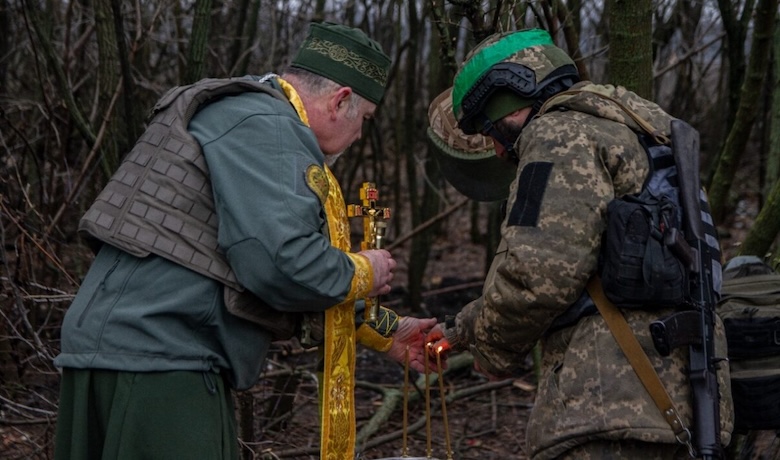
Finally, and concerning an ongoing conflict, the reemergence of religious personnel in several post-communist contexts illustrates their enduring relevance. The Russian Federation reestablished its military chaplaincy service in 2009 to support increasing numbers of religious military personnel and contribute to raising morale and enforcing discipline in the ranks. Following the Russian invasion of Crimea in 2014, the Ukrainian armed forces rapidly transitioned from informal chaplain arrangements with volunteer clergy to the establishment of a fully-fledged military chaplaincy service in 2021. While much has been made of the technological improvisation of the Ukrainian military, chaplaincy is also “a critical capability for Ukrainian commanders” and the humanitarian and military support functions of religious personnel often go hand in hand. It is precisely this dual function of religious personnel, along with their proximity to fighters and the suffering of war, which makes them such an important group for IHL practitioners to encompass.
***
Andrew Bartles-Smith is an Associate at the Centre of Applied Human Rights at the University of York, and is on the advisory board of the Beyond Compliance Project.
The views expressed are those of the author, and do not necessarily reflect the official position of the United States Military Academy, Department of the Army, or Department of Defense.
Articles of War is a forum for professionals to share opinions and cultivate ideas. Articles of War does not screen articles to fit a particular editorial agenda, nor endorse or advocate material that is published. Authorship does not indicate affiliation with Articles of War, the Lieber Institute, or the United States Military Academy West Point.
Photo credit: Ministry of Defense of Ukraine, armyinform.com.ua
