

(Past) Debates on the Legal Nature of Belligerent Occupation
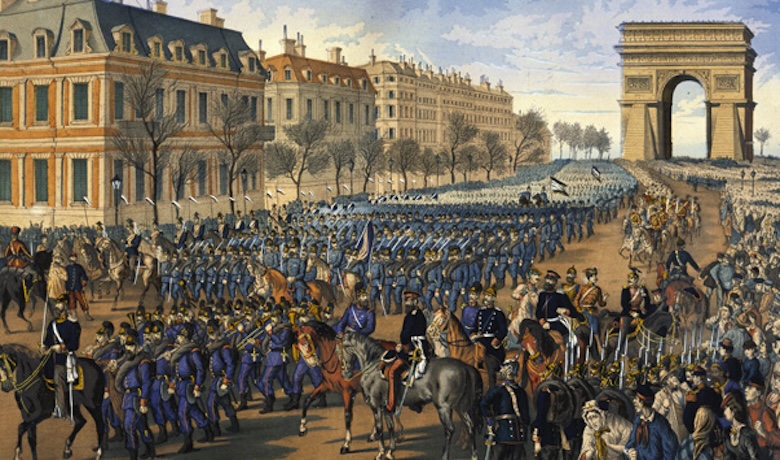
The many theories on belligerent occupation that were raging at the beginning of the 20th century are little known, especially in the English-speaking world. This post will shed light on competing constructions of that time-honored notion, highlighting the breadth of competing conceptualizations. These issues are no longer hotly debated. Today, the legal regime of belligerent occupation is the object of doctrinal attention, much more than its fundamental legal construction. The same is true for the divide between fully-fledged occupation under the classical Hague rules, and fragmented, though contested, functional occupation under the newer Geneva rules.
It is useful, for the contemporary reader, to recall the categories of occupation recognized by classical law. There were four such types: (1) hostile occupation or belligerent occupation, be it as an incident of warfare or as a consequence of complete surrender or debellatio; (2) occupation of a neutral or allied territory, in large part covered by the law of belligerent occupation; (3) peacetime occupation, which is created by treaty, in situations such as grant, lease, military bases, etc.; (4) armistice or mixed occupation, where the law of belligerent occupation applies subject to modifications under the armistice agreement. The very concept of an “occupation” is to superpose or to articulate the actions of two States on a single territory.
Some brief historical references may be apposite. In the classical period of international law, beginning with Hugo Grotius, war was a means of acquiring territory and property. Thus, war constituted a title to property; conquest immediately displaced the title to sovereignty. Later, with Emer de Vattel, there was a shift towards a more modern conception. The title to territory was not the conquest as a military fact, but the title created after the war by a peace treaty or the debellatio. Possession must have been “assured” to operate a transfer of title. During the war, such possession could not be assured. It would be so only once the peace treaty (after the end of hostilities) finally consolidates the situation or the defeated State is entirely defeated.
From this doctrinal position, the law of belligerent occupation developed in the 19th century. It now perfectly fits the idea of nationalities and people’s self-determination, so strong in that century, that the territory does not pass to the conqueror as a mere fact of war, but rather needs a legal imprimatur, mainly by a treaty of peace. If sovereignty does not pass automatically with the fact of military control (conquest), room is opened for a regime of belligerent occupation as an interim situation between the status ante bellum and the status post bellum, with its treaty of peace, i.e., as in the case of war not transferring sovereignty to the occupant. This was the reason for the development of the law of belligerent occupation.
Let us now interrogate the legal writings of bygone times. How is the basis of belligerent occupation configured? We will mainly consider the “deviant” theories, not the mainstream one that has imposed itself and is well known today.
Issue of Fact or Issue of Law
A classical divide pits belligerent occupation as a mere situation of fact, devoid of legal clothing, against belligerent occupation as a legal regime under international law. During the 19th century, small States (especially Belgium) feared codifying any law of belligerent occupation because they did not want to grant legal rights to the occupier. They did not want to organize an anti-patriotic “regime of defeat,” to let flow rights from mere might. “No rights out of usurpation” was their credo. This argument, which poured jus ad bellum arguments into jus in bello inadequately, was replicated in other areas of the law of war, e.g., when it was avoided to codify these laws for fear of giving the impression not to believe in the solidity of the law prohibiting recourse to force (an argument the International Law Commission still used in 1949).
The controversy was taken over by legal doctrine. Thus, some authors refused to consider the law of occupation a “legal regime” and treated it only as a fact of might, while others insisted that the fact of occupation triggered legal rights and obligations under international law of occupation. Some authors further qualified the facts as follows: belligerent occupation was based on the broad foundation of military necessity; a belligerent came to control territory as an incident of warfare, and there was now a necessity to administer it; this military necessity was a matter of fact.
The consequence of the construction regarding occupation as a mere issue of fact is that, carried to its logical end, it denies the existence of any international law of occupation. Belligerent occupation remains under this view a legal blind spot; it is only an issue of fact and might. Far from serving the interests of the small States advocating it, it is based on a purely ideological position and leads to the deprivation of fundamental legal protections for the benefit of the local civilian population.
Further, Article 42 of the Hague Regulations of 1907 (Hague Regulations) still bears some hallmark of this traditional controversy. Its paragraph 1 reads as follows: “Territory is considered to be occupied when it is actually placed under the authority of the hostile army.” The French text, more important at that time, is even clearer regarding the factual side of occupation. It reads, for paragraph 1, “Un territoire est considéré comme occupé lorsqu’il se trouve placé de fait sous l’autorité de l’armée ennemie.” Paragraph 2 adds, “L’occupation ne s’étend qu’aux territoires où cette autorité est établie et en mesure de s’exercer.” This reference can be read as limiting itself to stating the general trigger for occupation, which is a fact, i.e., the foreign army’s control of the territory. But it has also been read as an implicit reference to the doctrine of occupation as “mere fact” and has then been criticized for being imprecise and unwelcome.
The Occupant as “Representative” of the Occupied
According to one view sustained in this formative stage of belligerent occupation law, the rights of the occupant stem from international law, but the occupant acts only as a representative of the occupied State. The main rule of occupation under international law is to place the occupier in a position to exercise the powers of the occupied within the latter’s municipal legal order. We are confronted with a sort of negotiorum gestio, an acting for a third party.
We encounter here the extreme opposite of the mere-fact-conception discussed above. That is, not only does the occupier exercise rights in the occupied territory, but even more so, it can exercise all the powers of the occupied State under its municipal law. So to say, it slips into its sovereign powers as a representative. In other words, the norm of international law on belligerent occupation mainly contains a reference (a renvoi, as it were) to the internal law of the occupied State. The triangular relationship is the following: international law refers to the internal law of the occupied State; moreover, the occupier can probably exercise some rights under its own legal order, because it does not lose its own sovereign status. Another important consequence of this view must be emphasized. There is no unitarian law of belligerent occupation, coagulated into a set of rules of international law equally applicable to all States. On the contrary, the content of the law of belligerent occupation applicable in a single case depends on the State of the municipal law of the occupied power.
Thus, for example, the protection of civilians there will be a function of the legal positions recognized to them under their internal law before the occupation. The law of belligerent occupation is therefore kaleidoscopic; there are as many laws of belligerent occupation as there are States. For the minoritarian, it should not be forgotten that this “representative of the occupied” view has remained.
The Occupant as Quasi-Sovereign over the Occupied Territory
In contrast to the view just discussed, some authors have argued that the occupant exercises its own powers in the occupied territory, i.e., that its own municipal legal order applies when it controls foreign territory as an incident of war. In such a case, the occupier is not the sovereign over that territory, but (legally) it behaves as such. It will administer the territory as if it were its own, consequently as quasi-sovereign.
According to the view exposed in the previous section, the occupier slips into the legal position of the occupied State, it exercises the powers according to the municipal law of the latter; according to the present view, to the opposite, it retains its own position and exercises powers in the occupied territory according to its own municipal law. Moreover, because it is the sole master of that law, it can change it at will to grant itself all the powers it wishes. It becomes an almost-sovereign over the occupied territory during the occupation. Its extensive powers may conveniently pave the way for a later act of annexation.
Occupation as a Private Law Analogy
There have been some attempts to configure occupation law as the result of private law analogies pertaining to varying legal institutions such as contract, mandate, negotiorum gestio, possession, usufruct, etc. Such notions have influenced the codified law of belligerent occupation in the Hague Regulations to a marginal extent, as evidenced by the reference to usufruct in Article 55 of the Hague Regulations on the administration of public property of the occupied State. However, these restatements have not been seminal on the construction of the institution of belligerent occupation as a whole. They have remained a marginal phenomenon, except in the “representation” limb (negotiorum gestio) discussed above. This much can be understood: no private law institution really fits the situation encountered in the case of a belligerent occupation and the exercise of administrative powers by the occupier. All private law institutions rest on the concept of some form of agreement or quasi-agreement, whereas the fact of occupation is a unilateral fact in warfare.
Belligerent Occupation as Dependent on the State of War
Another view on the basic trigger of belligerent occupation holds that the latter is based on the facts described in Article 42 of the Hague Regulations, but that it also supposes a “state of war” which normally is triggered by a declaration of war, manifesting the will of the declaring State to be in such a state of war. If there is an occupation flowing from mere acts of violence, but without a state of war, or if occupation is flowing from acts establishing control over territory without violence, there would exist no belligerent occupation but only pacific occupation, to which, however, a great part of the rules of belligerent occupation will be applicable. Indeed, the Hague Regulations merely codify a general custom applicable to all cases of occupation. It does so for the specific case of belligerency with its belligerent occupation. But the rules it codifies have a broader application; they customarily apply to all cases of occupation, whether belligerent, pacific, or mixed.
If this view is followed, it means that a belligerent occupation rests on a legal act of will, i.e., the state of war, normally triggered by a declaration of war. It is thus a unilateral act as is recognition or promise. Quaere whether the doctrine of war “in the material sense” (a notion developed to consider as a real war, to which the laws of war apply, also fully-fledged hostilities of a significant scope, even if the state of war was not formally triggered) could be applied here, so that even absent a state of war a belligerent occupation could exist in some cases.
The author quoted seems to exclude it. In this reading, notice that, in passing, the law of belligerent occupation is to some extent aligned with the law of neutrality. The latter was also considered to be triggered only by a state of war, and not by mere hostilities of fact, and any war in the material sense had to reach a certain intensity to trigger the laws of neutrality. Be that as it may, the result of this conception is to add to the main elements of Article 42 of the Hague Regulations (namely, army, factual control, hostile presence) another element, which is a legal act.
There is a manifest tension here: the Hague Regulations and thus the classical law of belligerent occupation refer to a “fact,” whereas the “state of war” theory requires a legal act by one of the belligerents (each one can unilaterally create a state of war). As has been rightly said, States are not declaring war anymore and thereby avoid creating states of war. Hence, in the contemporary law of belligerent occupation, the emphasis shifts from the cause of occupation (war) to the result of occupation (control over territory), i.e., to the phenomenon of occupation, with its own phenomenology.
Conclusion
As can be seen in the preceding lines, the very concept of belligerent occupation has been the subject of competing legal constructions. If we try to order them, the gravitational points of the various types are as follows:
1. Some are based on an international norm referring to municipal law, be it to grant the occupier the rights of the occupied State, or to grant the occupier rights as over its own territory. There is a triangular relationship here, but international law is the weakest part of it, since it is merely there to open the door and to then leave the stage to municipal law.
2. Others are based on an interpretation of international law that is much more substantive and powerful, adding definitional elements of belligerent occupation to the ones generally accepted under the Hague Regulations, thus altering the legal complexion of occupation law.
Finally, these views were not blessed with lasting success. The mainstream view, which emerged from the stormy waves of the formative stages, is that belligerent occupation is a fact, based on military control over foreign territory as an incident of armed conflict, exercised without the territorial sovereign’s consent, and substantively regulated by international law. The occupier exercises its rights and duties under international law. The municipal law of these States is, however, not erased; it applies when a norm of international law refers to it, e.g., when the occupying power is allowed to legislate to ensure the security of the occupying forces or when it is allowed to establish its own occupational zone tribunals, organized under its own laws. The main movement regarding all these constructions has thus been to ensure the primacy of international law and to bolster it from the substantive point of view.
***
Robert Kolb is a Professor of Public International Law at the University of Geneva and former legal staff member of the ICRC. Prof Kolb is also a member of the legal section of the Swiss military high command (IHL section).
The views expressed are those of the author, and do not necessarily reflect the official position of the United States Military Academy, Department of the Army, or Department of Defense.
Articles of War is a forum for professionals to share opinions and cultivate ideas. Articles of War does not screen articles to fit a particular editorial agenda, nor endorse or advocate material that is published. Authorship does not indicate affiliation with Articles of War, the Lieber Institute, or the United States Military Academy West Point.
Photo credit: Adolf Göhde via Wikimedia Commons
