

Belligerent Reprisals Series – Reprisals with Weapons
Editors’ note: This post is part of a series related to Francesco Romani’s book “Belligerent Reprisals from Enforcement to Reciprocity” published by Cambridge University Press.
Francesco’s impressive work on belligerent reprisals and this series are welcome reminders that, in truly exceptional circumstances, the law of armed conflict (LOAC) allows the commission of acts that would ordinarily be war crimes. Such conduct is permissible only when this is strictly necessary to persuade an adversary to cease perpetrating serious violations of the law. As the International Committee of the Red Cross (ICRC) determined in its Study of Customary International Humanitarian Law, “(w)here not prohibited by international law, belligerent reprisals are subject to stringent conditions.”
To be lawful, a party may only take reprisals in reaction to prior serious violations of LOAC. As the ICRC further recalls, the party must only conduct reprisals “for the purpose of inducing the adversary to comply with the law.” Reprisals must also be announced as such, not claimed retrospectively in an attempt to justify war crimes, and they must be “a measure of last resort.” Furthermore, the action ostensibly taken as a reprisal must be proportionate in extent to the original violations. Certain targets may never be the subject of belligerent reprisals whatever means are used to harm them. Thus, in an international armed conflict (IAC), the Geneva Conventions of 1949 and customary law explicitly prohibit reprisals against protected persons: the sick or wounded on land or at sea; prisoners of war; and civilians from an adverse party who have fallen into the power of the enemy, including those residing in occupied territory.
This post considers the extent to which weapons whose use is illegal under LOAC may be used in belligerent reprisals. Some weapons of course are inherently indiscriminate or of a nature to cause superfluous injury or unnecessary suffering and as a consequence may not be used as a means of warfare. In addition, use of certain specific weapons is prohibited, whether the salient rule exists under LOAC and/or disarmament law. All other weapons may be used subject to customary rules governing the conduct of hostilities, which means their use against certain people, particularly civilians and those hors de combat, as well as their indiscriminate use is unlawful.
I have discussed the legality of the use of nuclear weapons in reprisal elsewhere and will not revisit that (hopefully purely theoretical) scenario here. The legality of belligerent reprisals in non-international armed conflict (NIAC) as a general rule is discussed elsewhere in this series and is likewise not addressed in this post. The post nevertheless cites relevant case law from the International Criminal Tribunal for the former Yugoslavia (ICTY) that involved the use of weapons as a possible reprisal during a NIAC, and assesses this for its broader validity.
Use of an Unlawful Weapon Against Those Taking a Direct Part in Hostilities
As a starting point, at the least in IACs, where the general requirements for a reprisal are all met, a weapon whose use is prohibited by LOAC may potentially be used against a combatant or a civilian participating directly in hostilities in reprisal. Hence, if an enemy tortures your prisoners of war you could never torture theirs in reprisal, but you could potentially use expanding or exploding ammunition or a blinding laser weapon against their combatants in hostilities on the battlefield. In this regard, Protocol IV to the Convention on Conventional Weapons does not explicitly prohibit use in reprisal of “laser weapons specifically designed, as their sole combat function or as one of their combat functions, to cause permanent blindness to unenhanced vision.” As noted below, the situation is different under another Protocol to that Convention.
This potential use of an unlawful weapon in reprisal does not, however, extend to the use of a weapon that a disarmament law treaty comprehensively prohibits. This is due to the wording of the obligation upon States parties to such treaties “never under any circumstances” to use the prohibited weapon at issue (para. 1.10). As a consequence, use of chemical weapons would never be lawful in a belligerent reprisal, at the very least for the 193 States parties to the 1992 Chemical Weapons Convention.
In this regard, for many months now, Russia has been accused of using chloropicrin on the battlefield to force Ukrainian soldiers out of their trenches, leaving them vulnerable to enemy fire. Chloropicrin is a toxic chemical, prohibited as such under the 1992 Convention, and explicitly listed in its Schedule 3. Russia’s actions are a serious violation of the Convention, “which prohibits the use of this chemical choking agent under any circumstances.” Ukraine could not, however, use a similarly illegal chemical agent in lawful reprisal and still comply with the Chemical Weapons Convention.
Indiscriminate Use of a Weapon Against the Civilian Population of the Enemy
On trial before the ICTY, Milan Martić, the former president of the self-styled Republic of Serbian Krajina, invoked the possibility that the attack he ordered against the Croatian capital, Zagreb, in May 1995 amounted to a reprisal. At trial, the ICTY deemed the weapon used—artillery-delivered cluster munitions—to be inherently indiscriminate and rejected the argument that they were a lawful reprisal. The Trial Chamber held that the action was not a measure of last resort. In addition, no formal warning was given prior to the shelling that reprisals would be conducted to bring to an end the violations Martić alleged the Croatian armed forces had committed against ethnic Serbs in the Krajina (paras. 463-68).
On appeal, the ICTY corrected its analysis of the legality of cluster munitions, now accepting that they were a potentially lawful weapon, but declared that in the circumstances at hand, the munitions had been used in an indiscriminate manner. The Appeals Chamber reaffirmed the holding at trial that the conditions for a belligerent reprisal had not been met (paras. 247, 263-67).
Taken in the round, however, the ICTY’s treatment of the issue of reprisals indicates a willingness to at least entertain the notion of the potential legality of a reprisal perpetrated against a civilian population where this concerned use of an indiscriminate weapon or indiscriminate use of a weapon. Of further note, the jurisprudence came after the famous judgment in the Kupreškić case in which the ICTY had decided that reprisals were always unlawful in NIAC as a matter of customary law. At trial in that case, the ICTY held that “the sacrosanct character of the duty to protect civilians” entailed “the absolute character of the prohibition of reprisals against civilian populations” (paras. 513, 517-24). It is certainly true, as the Trial Chamber further opined, that reprisals against civilians “are inherently a barbarous means of seeking compliance with international law.” Whether they are always outlawed by LOAC is more contentious.
The Use of Anti-Personnel Mines in Ukraine
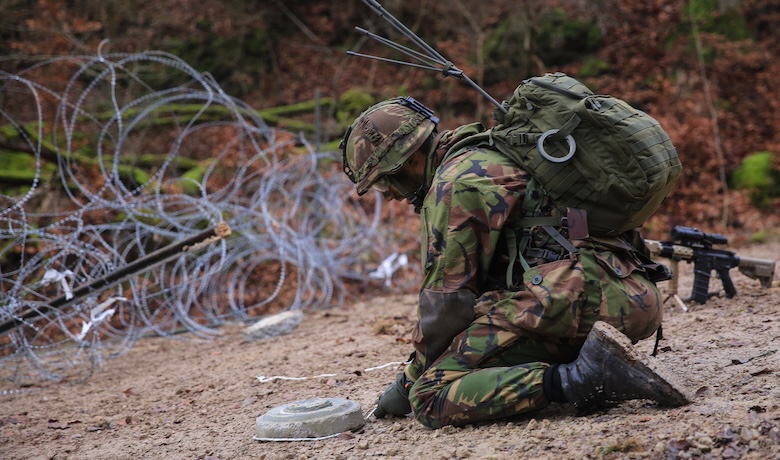
Moving to the present day, it is necessary to consider one more scenario, involving anti-personnel mines. Ukraine is a State party to the 1997 Anti-Personnel Mine Ban Convention and has been since June 2006. In July 2025, however, Ukraine communicated to the depositary of the Convention, the Secretary-General of the United Nations, that it had decided to “suspend the operation” of the Convention due to a “fundamental change of circumstances” associated with its ongoing armed conflict with Russia. This claimed suspension is unlawful. Ukraine cannot suspend operation of the Convention as there is no provision within it to do so, and as further noted below, it has formally undertaken “never under any circumstances” to use anti-personnel mines under its Article 1(1). It is also not a fundamental change of circumstances as foreseen by the Vienna Convention on the Law of Treaties (VCLT).
In this regard, Article 62(1) of the VCLT stipulates that the fundamental change of circumstances “which has occurred with regard to those existing at the time of the conclusion of a treaty” must not have been “foreseen by the parties” when they adopted it. In fact, the existence of armed conflict was clearly and expressly foreseen by the States negotiating the Anti-Personnel Mine Ban Convention. Indeed, its Article 20(3) provides that notice of intent to withdraw to the depositary would not take place upon the stipulated six months if, “on the expiry of that six-month period, the withdrawing State Party is engaged in an armed conflict.” In such a case, the withdrawal “shall not take effect before the end of the armed conflict.”
Finally, the Amended Protocol II on mines, to which Ukraine is also a State party, explicitly prohibits in its Article 3(7) “in all circumstances” the directing of landmines “by way of reprisals … against the civilian population as such or against individual civilians or civilian objects.” Russia, which has made massive use of landmines on Ukrainian territory during its ongoing aggression, is not a State party to the Anti-Personnel Mine Ban Convention but it is a party to the Convention on Certain Conventional Weapons and this Protocol. This means that Ukraine and Russia are bound by this provision in their mutual relations.
To comply with its obligations under international law, Ukraine must simply stop using anti-personnel mines. It could not even use them against Russian soldiers given its undertaking “never under any circumstances” to use anti-personnel mines in the 1997 Convention. This unequivocal obligation is further reinforced by the prohibition on reservations to any of the articles of the Convention set forth in Article 19.
***
Stuart Casey-Maslen is Visiting Professor at the Faculty of Law of University of Johannesburg.
The views expressed are those of the author, and do not necessarily reflect the official position of the United States Military Academy, Department of the Army, or Department of Defense.
Articles of War is a forum for professionals to share opinions and cultivate ideas. Articles of War does not screen articles to fit a particular editorial agenda, nor endorse or advocate material that is published. Authorship does not indicate affiliation with Articles of War, the Lieber Institute, or the United States Military Academy West Point.
Photo credit: U.S. Army, Spc. Justin De Hoyos
