

The Sack of Cities: Laws of War and Evolving Attitudes in Historical Perspective
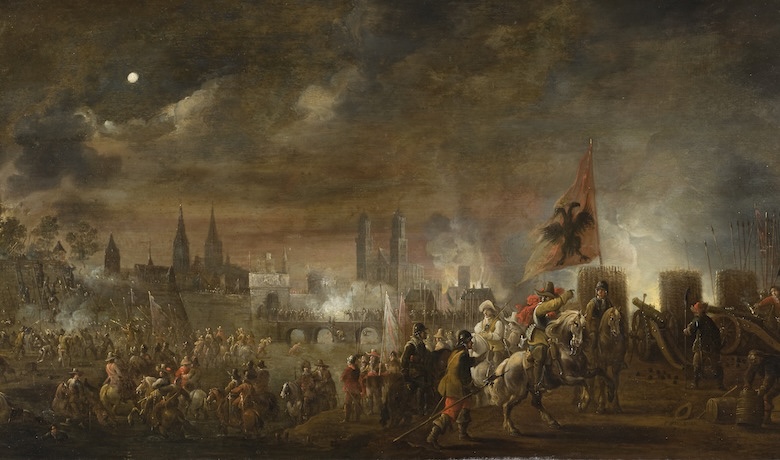
Throughout most of Western history, stretching back to the Homeric tradition of Troy, the right to sack a besieged city that refused to surrender was part and parcel of the customary laws of siege warfare. Under this law of war, cities and towns continued to be sacked until well into the nineteenth century. The early modern era in Europe, however, especially from the eighteenth century on, saw growing calls for minimising civilian suffering in war on moral and humanitarian grounds. This ideal of humanity in war was very much at odds with the centuries-old customary law of war on sack. This tension is the central theme of my recent book, Storm and Sack: British Sieges, Violence and the Laws of War in the Napoleonic Era, 1799–1815.
Sack and the Laws of Siege Warfare
Amongst the body of unwritten customary laws of war that framed the conduct of war in early modern Europe, the right to sack an obstinately defended city gave licence to the abandonment of restraint and mercy. If a besieged town refused to surrender when its walls had been breached, then both the garrison and the inhabitants lost their protective rights. If the town was subsequently stormed, it was “lawful” for the stormers to withdraw quarter to the garrison and to sack the town, which involved plunder and often atrocities against civilians.
Leading sixteenth and seventeenth-century jurists on the law of nations (including Vitoria, Gentili and Grotius)—notwithstanding stressing moderation as a general guiding principle of war—affirmed the lawfulness of sack. “If necessity decrees,” wrote Francisco Vitoria, “it is not unlawful, even if the probability is that the soldiers will commit crimes” (p. 323). This era also saw the emergence of a growing number of national military codes and articles of war to regulate the behaviour of State armies. This corpus of military law outlawed plunder, the killing of unarmed regular combatants, and the murder and rape of civilians in general. But it was silent on the storming of towns. In that distinct war-time context, plunder and violence remained “legitimate” under customary laws of war.
The traditional justification for this post-storm violence and plunder was three-fold: as retributive justice or vengeance for the casualties the attacking force sustained in the storm; as exemplary punishment, to deter other towns from obstinate defences; and plunder was considered a reward for soldiers risking their lives in a breach assault.
This customary law of war was put into practice many times in sixteenth and seventeenth-century Europe, from the sacks of the Italian Wars in the first half of the sixteenth century to the massacres of wars associated with the religious divides of the Reformation. The most infamous of all sacks occurred in 1631 when Imperial troops stormed the Protestant city of Magdeburg during the Thirty Years’ War, with violence and conflagration claiming an estimated 20,000 lives (Wilson, p. 467–70).
The Decline of Sack in the Eighteenth Century
As European warfare entered the eighteenth century, however, the storm and sack of besieged towns became rarer in Western Europe. The eighteenth century has traditionally been seen as a time of “limited war” within Europe relative to the pre-1648 era of Religious Wars. One key moderating influence here was the Military Enlightenment. Reform-minded military publicists and educationalists stressed not only the scientific and technical demands of war-making, but also the moral dimensions of soldiering. The principles of humanity and civility in war, and a sensitivity to wartime suffering, were increasingly seen as integral to military professionalism and martial honour and to human progress itself. In The Law of Nations (1758), Emer de Vattel declared that the protection of women, children, the elderly and the sick was a “maxim of justice and humanity” and idealistically proclaimed that now within Europe the people “generally have nothing to fear from the sword of the enemy” (bk. III, secs. 145, 147).
Yet such ideals applied strictly to enemies and peoples considered to be “civilised” as defined by the Enlightenment. And in practice, eighteenth-century European warfare was hardly a paragon of limited war, especially if we consider Eastern Europe and the European colonial world.
Nevertheless, with respect to siege warfare at least, there was a marked decline in storms and sacks relative to the past. As scholars have noted, Western European sieges from the early eighteenth century increasingly ended on honourable and humane terms, with capitulation at the point of a practicable breach. This was precisely why the French sack of Bergen-Op-Zoom in 1747 caused such shock and outrage, it was very atypical of the age (Browning, p. 320). Writing in 1769, the British deputy judge-advocate and artillery officer, Stephen Payne Adye, observed: “Towns taken are never now given up to plunder, as was formerly the practice among the Ancients” (p. 138).
War and Sieges in the French Revolutionary-Napoleonic Wars
The siege as the dominant form of early modern European warfare effectively came to an end with the French Revolutionary-Napoleonic Wars (1792–1815). The siege was surpassed by a proliferation of ever larger field battles, mass conscript armies, and a strategic emphasis on operational speed. In the heightened politically and ideologically charged environment of the revolutionary era, some scholars have seen the origins of modern total war, stressing the erosion of restraint and the escalation of violence against the enemy, whether combatants or civilian populations.
Traditionally neglected relative to battles, the sieges of the period offer important insights here. No longer accorded their traditional primacy, siege operations nevertheless featured in most campaigns of the Revolutionary-Napoleonic Wars, especially in the Peninsular War in Spain (1808–1814), which saw about 30 regular sieges (Haythornthwaite, p. 419-23). And across the sieges of these wars and campaigns, there were a number of notorious sacks and massacres, notably Bonaparte’s 1799 sack of Jaffa during his Egyptian/Syrian campaign and, in the Peninsular War itself, those perpetrated by both French (most infamously at Tarragona in 1811) and British besieging armies.
British Sacks in Spain
The Duke of Wellington’s army stormed and sacked three French-held Spanish towns: Ciudad Rodrigo (January 1812), Badajoz (April 1812) and San Sebastian (August 1813). In each case, the French garrisons, adhering to a general order issued by Napoleon in 1810, refused to surrender when the town walls were breached. In each case, the storming British soldiers extended mercy to the French garrisons but plundered and sacked the towns. At Badajoz and San Sebastián, this included the murder and rape of Spanish civilians, whom the British were meant to be liberating from French rule. The sacks of these two towns each lasted about three days, before order was finally restored.
These sacks have traditionally been viewed as among the worst massacres of the Napoleonic Wars and sometimes likened to the siege atrocities of earlier centuries. Some British military memoirs played a key role in establishing this reputation, presenting the sacks as sites of gothic horror and akin to some of the worst sacks in history. On the fate of Badajoz, one memoirist wrote, “no city, Jerusalem excepted, was ever more strictly visited to the letter than was this ill-fated town” (p. 194).
Rethinking the Sacks
Yet recent historical estimates and evidence—together with inconsistencies across surviving British accounts—indicate that the scale of civilian deaths was much lower than the historical reputations of these sacks would suggest, around 125 civilian victims in the case of Badajoz (Daly, p. 236–42). Moreover, sack itself was rare across the sieges of the Napoleonic Wars. It was largely limited to the Peninsular War, which saw the most sustained violence and atrocities of the Napoleonic era. But even in Spain, the majority of sieges, whilst often brutal, still ended with negotiated capitulation.
The scale of violence of the British sacks was relatively historically low, but it nevertheless produced many emotionally charged responses across the eyewitness written accounts of British officers and common soldiers. In particular, these writings expressed horror, sympathy for the civilian victims, and moral outrage at those responsible for the atrocities.
On the one hand, British accounts sought to explain or contextualise the sacks including: by invoking customary laws of war with respect to the “right of conquest” (p. 157); by pointing to the horrific loss of life sustained in the breach assaults, and to the psychological toll this had on soldiers’ behaviour; and by stressing that it was impossible to maintain order beyond the breaches. Some soldiers also partly blamed the victims, accusing the inhabitants of being inhospitable to the British during the war, or of supporting the French.
Yet such explanations rarely sought to affirm or legitimise the violence. To be sure, most common soldiers participated in the plunder. And whilst most officers did not encourage or approve of this plunder, they were largely resigned to it, given the customary right and the circumstances. But the murder and rape of civilians was almost universally condemned as an affront to humanity and to the principle of protecting the innocent in war. Reflecting the sentiment of many, one officer described the victims as “poor innocent and defenceless inhabitants” (p. 68). Another decried the sexual violence as “revolting to any man of feeling” (p. 90). Common soldiers were equally appalled, one finding the sack simply “too dreadful and disgusting to relate” (p. 159). Some soldiers, especially officers, personally intervened to save civilians from harm.
The fact that the perpetrators were British only deepened the sense of national shame and martial dishonour. Lieutenant Colonel George Bingham feared that the British army at Badajoz had forever disgraced itself,
Much as the glory has been to those who achieved the conquest, that glory has been tarnished by their subsequent conduct … . I conceive they have fixed a stigma on our army, which time will never efface, and when history records their bravery to posterity, it will be sullied by the tales of murder, plunder and rapine, which followed (p. 114).
Towards the Outlawing of Sack
Senior officers were aware of the limitations of the prevailing British articles of war in preventing or at least minimising the sack of stormed towns. As General Sir Thomas Graham remarked to Wellington on the sack of San Sebastián, “It would require a different military code from ours to stop men from being disorderly on such an occasion” (p. 301). Nevertheless, following Ciudad Rodrigo, Wellington increasingly issued orders against post-storm plunder and sent provost marshals into the towns to restore troop discipline.
The “different military code” that Graham imagined in 1813 was first realised some 50 years later—although not in Europe, but rather in the United States—with Article 44 of the Lieber Code of 1863, “all robbery, all pillage or sacking, even after taking a place by main force, all rape, wounding, maiming or killing of such inhabitants, are prohibited under the penalty of death” or other severe punishment relative to the offence. The following decades saw the development of international treaty law. Its realisation included the outlawing of sack under Article 28 of the 1899 Hague Convention (II) with Respect to the Laws and Customs of War on Land providing, “The pillage of a town or place, even when taken by assault, is prohibited.”
Concluding Thoughts
The enduring custom of sacking obstinately defended towns and cities over the centuries can obscure important shifts in both sentiments and practices. For early modern Europeans, in the context of siege warfare in Western Europe, the sacking of cities increasingly became a contested site between an ancient customary law of war that gave licence to plunder and atrocities and the constraining influences of military professionalism, martial honour, and, above all, the ideal of humanity in war. In 1804, during the Napoleonic Wars, a book on ethics for British officers, The Military Mentor, singled out the aftermath of the storming of a town as the circumstance when “it becomes more peculiarly necessary to watch with severity the conduct of the soldiers in the article of humanity” (vol. 1, p. 165). Over the course of the second half of the nineteenth century, military codes and international law caught up with those long-term shifts in moral and humanitarian revulsion towards sack.
***
Dr Gavin Daly is Senior Lecturer in Modern European History at the University of Tasmania.
The views expressed are those of the author, and do not necessarily reflect the official position of the United States Military Academy, Department of the Army, or Department of Defense.
Articles of War is a forum for professionals to share opinions and cultivate ideas. Articles of War does not screen articles to fit a particular editorial agenda, nor endorse or advocate material that is published. Authorship does not indicate affiliation with Articles of War, the Lieber Institute, or the United States Military Academy West Point.
Photo credit: Peeter Meulener (Magdeburgs belägring 1631), Erik Cornelius / Nationalmuseum
