

State-Criminal Enterprise
Criminal enterprises, once primarily associated with localized crime, are increasingly becoming a destabilizing force beyond national borders. A 2006 report from the Global Initiative Against Transnational Organized Crime details how organized criminal groups have transformed themselves from traditional covert illicit actors engaged in local criminal activities such as drug trafficking or extortion into “a recognized lever of state power” (p. 1).
Such criminal enterprises are acting as significant geopolitical actors, as they combine advanced technology with financial resources to orchestrate sophisticated activities such as arms dealing and cybercrime. They exploit ruptures in cross-border law enforcement cooperation and weak governance structures (p. 5), in some cases providing essential services that compensate for the void left by a weak or failing State. Persistent gang violence in Haiti, narco-terrorist activities originating from Venezuela, and cyber-scamming centers harbored in Myanmar, among others, offer stark illustrations of a growing global challenge: the rise of State-criminal enterprise.
A particularly concerning trend is the use of criminal entities for political ends as proxies in gray zone competitions. A recent study conducted for the European Parliament classifies organized criminal groups into three types: 1) State-opposed criminal groups (i.e., criminal insurgency in active opposition to State governance); 2) State-embedded criminal groups (i.e., criminal spoilers who exploit weak governance through corruption, graft, and clientelism); and 3) State-sponsored criminal proxies (i.e., criminal groups enjoying tacit support and protection by State actors).
Of these, States are increasingly leveraging the third type of State-criminal enterprise to achieve strategic objectives while officially maintaining plausible deniability. North Korea’s State-sanctioned cybercriminal activities, China’s intellectual property theft, Russia’s sleeper sabotage networks, and Iran’s outsourcing of assassination missions to foreign criminal groups are all examples of the reframing uses of criminal networks. These and other State-criminal enterprises enable the expansion of political influence by destabilizing adversaries, undermining foreign governments, and advancing their interests without triggering open State-to-State military confrontations.
The rise of State-criminal enterprise as a form of transnational geopolitical actors presents significant challenges to the existing framework of international law, which is largely based on territorial sovereignty and rigid conflict classification. The traditional distinction between peacetime law enforcement, international armed conflict (IAC), and non-international armed conflict (NIAC) is increasingly strained and may no longer adequately capture the complexity of these evolving forms of organized violence. The State-criminal enterprise can achieve strategic objectives by supporting or merely tolerating cross-border criminal activities if these activities align with the State’s national interests. This elusive relationship allows States to support acts of indirect aggression and destabilization without triggering the full application of the law of armed conflict.
However, as we argue in this post, victim States targeted by State-sponsored or State-tolerated criminal activities also play a decisive role in determining how the situation is legally classified. Victim States’ political and strategic choices shape this classification, which in turn dictates the legal framework governing their response to extraterritorial criminal conduct that reaches or penetrates their territory. This post explains the strategic advantages associated with each classification of a conflict—peacetime law enforcement, NIAC or IAC—as well as the legal risks involved in each approach.
The Law Enforcement Approach
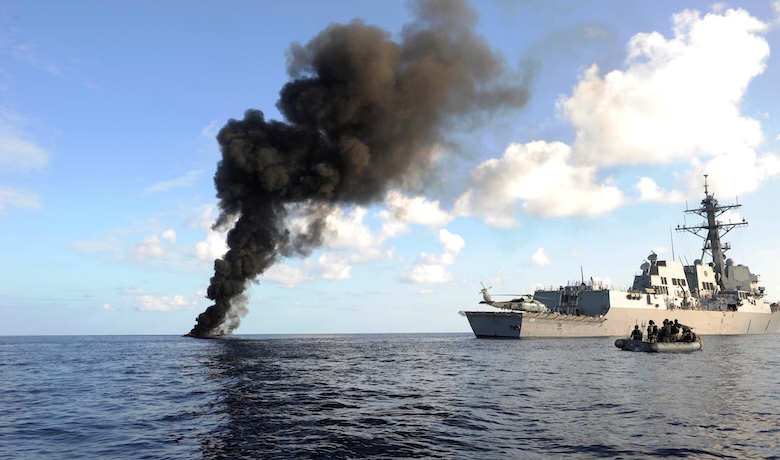
The nexus between sovereign States and criminal enterprises is far from a novel phenomenon. Somalia, for example, was widely characterized as a failed State during the 1990s when protracted internal conflict and the collapse of central governance institutions created a persistent condition of instability. The absence of effective authority generated significant spillover effects, mostly notably the emergence of piracy off the coast of Somalia targeting commercial ships, even far from shore, for financial gain. These acts posed a serious threat to international maritime navigation, particularly along critical sea lanes linking the Suez Canal to the Gulf of Aden. In response, concerned States took coordinated maritime law enforcement action, deploying naval forces to suppress these loosely organized and opportunistic criminal networks.
When undertaken in a coordinated manner, law enforcement action among States can serve as an effective mechanism to investigate, apprehend, and prosecute individuals involved in cross-border criminal activities through established judicial processes. Multinational initiatives such as Combined Task Force 151 and NATO’s Operation Ocean Shield, conducted under the auspices of UN Security Council Resolution 1816, illustrate how cooperative frameworks can successfully address transnational threats such as piracy. Another example is Operation Endgame, in which law enforcement authorities from multiple countries conducted coordinated searches, arrests, and seizures to dismantle global malware networks that had infected millions of systems worldwide.
The law enforcement approach, however, comes with significant jurisdictional constraints and substantial financial costs associated with cross-border operations and cooperation. As a matter of international law, the exercise of enforcement jurisdiction is territorially limited, prohibiting States from undertaking law enforcement actions within foreign territory, including territorial waters, without the consent of the host State. As such, this option becomes politically and legally unviable when criminal activities are embedded within, or sponsored by, the host State. State-sponsored or State-tolerated cyber activities originating from China exemplify this challenge, where political structures and competing priorities impede coordinated enforcement efforts despite the transnational nature of the harm.
In the Somali context, some of these limitations were mitigated through a series of UN Security Council resolutions, which authorized counter-piracy operations extending into Somalia’s territorial waters. Even so, enforcing States continued to face complex legal challenges, particularly in relation to the apprehension, transfer, and prosecution of suspects in jurisdictions far removed from the place where the alleged crime was committed. Moreover, European countries have had to navigate the additional complexity of complying with their obligations under the European Convention on Human Rights, where progressively expansive interpretations of its jurisdiction have extended procedural and substantive protections even to extraterritorial enforcement activities.
Additionally, international law imposes restrictions on the use of force employed in law enforcement even when confronting a highly organized criminal enterprise capable of conducting robust, sustained patterns of hostile engagement. In traditional contexts, law enforcement authorities are generally allowed to employ force only when it is strictly necessary to achieve a legitimate objective and when it is reasonably proportionate to the seriousness of the offence. In the United States, a similar standard of objective reasonableness governs the permissible use of force for law enforcement under the Fourth Amendment, as established in the Supreme Court decision in Graham v. Connor. A comparable set of rules has also been developed to restrict the use of force in maritime law enforcement under the law of the sea.
However, a reasonable degree of force may be significantly greater—especially in the maritime domain or national airspace—if, for example, force is used against a ship carrying arms to dissidents in the enforcing State (p. 441) or against intruding military aircraft. Because international law restrictions are largely driven by the loss of human life, forcible action directed against drones and other uncrewed systems may be regarded as more readily justifiable as an exercise of law enforcement powers. By eliminating the human element, such a use of force for law enforcement purposes poses no immediate risk to life or limb.
The NIAC Approach
It is legally plausible for criminal enterprises to qualify as parties to an armed conflict, provided that certain conditions are met. In Prosecutor v. Tadić, the International Criminal Tribunal for the former Yugoslavia held that an armed conflict exists when there is protracted armed violence involving organized armed groups (para. 70), assessed through two criteria: the intensity of the conflict; and the level of organization on the part of a non-State armed group (para. 562). Crucially, these criteria are indifferent to the belligerent group’s motives (p. 182). The classification of a NIAC does not depend on whether the parties pursue political or criminal objectives. Accordingly, the criminal character of a group does not, in itself, preclude its qualification as a party to a NIAC. Criminal enterprises, including gangs, drug cartels, and similar networks, may meet the legal threshold for participation in a NIAC where they demonstrate a sufficient level of organization and are engaged in violence of the requisite intensity.
Criminal insurgency (those in active opposition to State governance) illustrates how criminal enterprises can satisfy the thresholds of organization and the intensity of violence. As such groups expand beyond profit-seeking and assume governance functions, they increasingly resemble conventional non-State armed groups. In Haiti, for example, powerful gangs have moved beyond episodic violence to assert territorial control and perform quasi-governmental roles. Similar patterns observed in Mexico and Brazil in recent years also demonstrate how organized criminal violence can approximate the structure and intensity associated with armed conflict. Through organized violence, these criminal groups have exhibited their enhanced capacity to plan and execute coordinated, military-style operations, thereby meeting the qualitative indicators of organization and engaging in protracted armed violence.
However, the salient question is not whether criminal enterprises can qualify as parties to an NIAC, but whether States can unilaterally invoke that classification against State-sponsored or State-tolerated criminal armed violence. This uncertainty allows State-criminal enterprises to exploit under-classification, even where criminal groups exhibit functions and capabilities analogous to those of non-State armed groups. The current framework confers a structural advantage on adversaries seeking to operate below the threshold of armed conflict. State-criminal enterprises can exploit this ambiguity by calibrating the scale, diffusion, and visibility of their violence to avoid direct military confrontation, fragmenting operations geographically, and maintaining a level of intensity that falls short of triggering a NIAC classification.
The United States, therefore, adopts the “intent-based test,” as well as the act-based test in determining the applicability of the law of armed conflict (§ 3.4). Under this framework, the existence of a NIAC may not be assessed solely by the actual conduct of hostilities but also informed by a party’s intent to engage in them. The fact that a non-State group has not escalated its violence to sustained and protracted levels is not dispositive because the victim State may still respond with military force (lawfully or unlawfully). When a State elects to deploy military forces against a criminal enterprise, the scale and intensity of that force can cross the NIAC threshold. In this sense, NIAC classification is inherently interactive and therefore shaped by the responding State’s strategic choices. While this does not suggest that a State may unilaterally create a NIAC through mere characterization, the combined effect of a criminal group’s conduct and the State’s military response may, in practice, satisfy the legal criteria for a NIAC classification.
For a victim State, classifying a situation as a NIAC can present practical advantages. The law of armed conflict governs its military operations, providing the legal basis for the use of lethal force within far more permissible constraints than those governing peacetime law enforcement. This legal regime enables broader targeting of organized criminal groups wherever they may be located. At the same time, the victim State preserves its ability to apply domestic law for criminal prosecution when it captures members of the criminal group without affording them combatant immunity (§ 17.4.1). Thus, where criminal groups exhibit levels of violence and organization that exceed law enforcement capabilities, framing the situation as a NIAC becomes an attractive option for States seeking to respond effectively against hybrid threats posed by a State-criminal enterprise.
Classification as a NIAC, however, is not without legal risk, particularly where military operations extend into the territory of another State. The application of the law of armed conflict does not negate the need for justifying the use of force across borders. Even if a State characterizes its operations against a criminal group as occurring in the context of a NIAC, it must still independently justify any extraterritorial military action under the jus ad bellum framework. In this respect, the territorial State may regard such operations as violations of its sovereignty, intervention, or even a use of force prohibited under international law.
Additional complexity arises in non-territorial operational domains such as cyberspace and maritime environments, where the contours of NIAC rules remain underdeveloped and contested. For example, there is unresolved debate over whether and under what circumstances cyber operations conducted between a State and a non-State armed group can meet the intensity threshold required for a NIAC (p. 389). In the maritime domain, how the law of naval warfare—developed in the context of inter-State armed conflict—might apply to NIACs remains uncertain. Domain-specific belligerent rights, such as blockade or belligerent visit and search, are structurally tied to inter-State conflict, particularly with the regulation of relations with neutral States, and therefore ill-suited to NIAC settings. These gray areas further complicate efforts to apply established legal classification to evolving forms of transnational criminal violence, heightening the risk of legal uncertainty and contestability.
The IAC Approach
An alternative approach available to the victim State is to engage the host State directly by characterizing the situation as an IAC between them. This approach is plausible where the host State exercises overall control over the criminal groups, for example, by organizing, coordinating, or planning the latter’s military activities (para. 137). In such situations, the criminal groups are regarded as acting on behalf of the host State in conducting hostile activities directed at the victim State. Unlike the NIAC classification, there is no requisite level of intensity that armed violence must reach. Instead, the IAC classification turns on a factual assessment of whether there is a resort to armed force between two or more States, irrespective of the duration intensity, or scope of the fighting (§ 3.4.2).
States increasingly characterize indirect violence not as ordinary criminal behavior but as forms of indirect aggression, proxy warfare, or hostilities associated with the host State. Both the United States and Israel, for example, have framed hostilities conducted by Iranian-backed groups as part of an armed conflict involving the Islamic Republic of Iran itself. By linking the hostile conduct to Iran, an IAC classification activates the law of war as applicable to military operations against Iran as a belligerent party to the conflict but also to direct attacks against proxy actors. In a similar way, this approach enables the victim State to frame its military action against criminal groups as the conduct of hostilities, even where they lack the degree of organization sufficient to qualify as non-State actors capable of participating in a NIAC. Thus, the IAC classification serves as a strategic tool for characterizing the relationship between a criminal group and its sponsoring State as a symbiotic arrangement in which the former advances the strategic objectives of the latter.
However, this approach is open to challenge when the sponsoring State’s involvement falls short of the requisite level of control. A State’s failure to suppress criminal activities within its jurisdiction or its mere tolerance of such conduct originating from its territory is not, by itself, sufficient to transform the situation into an IAC. The analysis becomes more contested when the sponsoring State provides support through financial assistance, logistical supply, or intelligence sharing without participating in the planning, direction, or coordination of particular operations. One view is that, under certain circumstances, such support alone may suffice to render the sponsoring State a party to an armed conflict. An idea originally developed in the distinct context of foreign assistance to a government engaged in an NIAC, this support-based theory should be treated with caution when transposed to the context of proxy warfare. At present, it enjoys little support in law or State practice (p. 729) as the basis for classifying hostilities involving proxy actors as an IAC between the victim State and the sponsoring State.
Another reason a victim State may hesitate to classify the situation as an IAC lies with the risk that invoking this classification to frame military action as part of an ongoing IAC could be criticized as an attempt to circumvent the jus ad bellum requirements. Ultimately, this is a choice of law question on which reasonable minds may differ depending on strategic considerations and normative commitments. In the absence of pre-existing hostilities, the victim State can seek to initiate an IAC by taking military action unilaterally against the responsible State. However, such action would be difficult to justify under the jus ad bellum when the criminal activities in question do not rise to the level of an armed attack capable of triggering the right of self-defense.
Moreover, characterizing criminal groups as participants in an international armed conflict may introduce additional humanitarian obligations toward their members upon capture. Under Article 4A(2) of Geneva Convention III, members of irregular armed forces such as militia and volunteers belonging to a party to the conflict are entitled to prisoner-of-war (POW) status, provided that their organizations meet the requisite conditions. If a criminal group is deemed to “belong to” an enemy State because of overall control exercised over its activities, the detaining power may have to accord POW protection to criminals as members of irregular armed forces. Admittedly, such an interpretation to determine whether individuals or groups “belong to” a belligerent State remains controversial. As such, a victim State may prefer to treat hostilities with the criminal group as a distinct NIAC, rather than part of an IAC. By doing so, the detaining power can avoid any obligation to accord POW status to captured members of the criminal groups and preserve its ability to prosecute them under domestic criminal law.
Concluding Observations
The conflict classification is not merely a question of fact; it is often a strategic choice for the responding State. The increasing use of criminal groups as proxies in gray zone operations poses a significant threat to international security and the rule of law. By relying on criminal proxies, States frequently seek to avoid the legal consequences associated with armed conflict classifications by limiting their involvement to supporting, facilitating, coordinating, or tolerating criminal activities without exercising the degree of control necessary to trigger an IAC, while also keeping violence below the intensity threshold required for a NIAC. Proxy warfare is therefore an especially attractive instrument of statecraft, enabling States to project coercive influence while preserving ambiguity regarding their relationship with criminal groups.
However, this ambiguity does not deprive victim States of agency. Faced with competing legal characterizations, a victim State may actively advocate for a particular conflict classification that best advances its strategic objectives, legal authorities, and operational flexibility. Conflict classification thus becomes not only a question of fact but also a contest over which legal framework will govern the courses of action that each actor takes.
The State’s conflict classification is decisive but not necessarily determinative, as seen in Hamdan v. Rumsfeld, where the United States government characterized the conflict with Al-Qaeda through a particular legal lens, yet the Supreme Court independently characterized it as an NIAC and held that Common Article 3 applies as a matter of law. Hamdan underscores that the classification of the conflict depends not solely on the executive’s characterization but also on the legal and factual determination of the hostilities and the conflict. As criminal enterprises continue to evolve, especially in gray zone operations, the debate surrounding conflict classification will continue to shape not only how States respond to transnational criminal violence but also how the boundaries of armed conflict evolve.
***
MAJ Zara M. Scribner is an Assistant Professor in the Department of Law an Philosophy at the United States Military Academy.
Hitoshi Nasu is a Professor of Law in the Department of Law and Philosophy at the United States Military Academy.
The views expressed are those of the authors, and do not necessarily reflect the official position of the United States Military Academy, Department of the Army, or Department of Defense.
Articles of War is a forum for professionals to share opinions and cultivate ideas. Articles of War does not screen articles to fit a particular editorial agenda, nor endorse or advocate material that is published.
Photo credit: Cassandra Thompson, U.S. Navy
