

Ukraine’s Suspension of the Anti-Personnel Mine Ban Convention
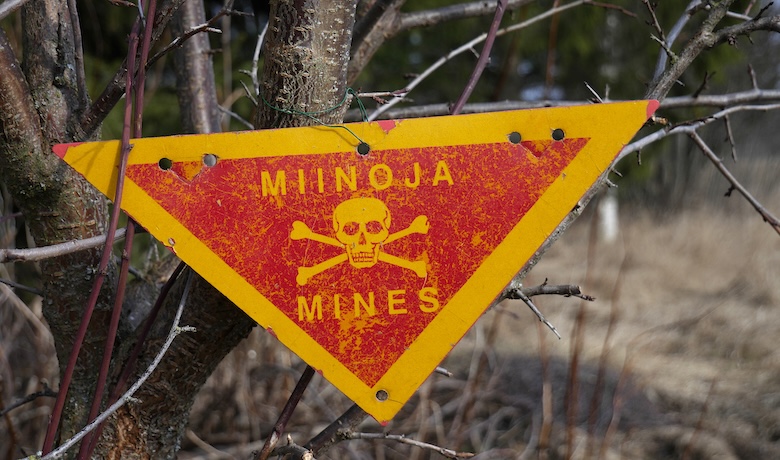
On July 17, 2025, Ukraine suspended operation of the Anti-Personnel Mine Ban Convention (Oslo-Ottawa Convention) and notified other State Parties through the UN Secretary General, the treaty’s designated depositary. The reason for the suspension can be understood through the lens of reciprocity. Russia, which is not a party to the Convention and not bound by its strict obligations, has used anti-personnel mines on several occasions in its armed conflict with Ukraine. Ukraine suspended the Oslo-Ottawa Convention to establish reciprocity in the use of anti-personnel mines and to avoid being disadvantaged in the conflict.
However, Ukraine’s suspension is problematic from the standpoint of the law of treaties. The Oslo-Ottawa Convention is indeed aligned, for issues of withdrawal, with other IHL treaties. When a State Party is engaged in an armed conflict, Article 20(3) of the Convention postpones the effect of the State’s withdrawal to the end of the armed conflict. Article 20(3) states,
Such withdrawal shall only take effect six months after the receipt of the instrument of withdrawal by the Depositary. If, however, on the expiry of that six-month period, the withdrawing State Party is engaged in an armed conflict, the withdrawal shall not take effect before the end of the armed conflict.
Moreover, there is no separate provision for suspension in the Convention. Because a suspension clause would be an exception to the obligation of continued performance of a treaty (VCLT, art. 26), the absence of such a clause would preclude suspension, unless there is a reason flowing from the general international law of treaties to suspend.
Response to Ukraine’s Suspension
Switzerland and a handful of other States formally objected to Ukraine’s suspension, and expressed their opinion that the suspension was inadmissible. The depositary transmitted these objections to the Assembly of States Parties, which convened in December 2025. Switzerland clearly stated its position as follows,
Switzerland expresses its deep concern regarding Ukraine’s announcement of its intention to suspend the application of the Convention. We acknowledge the difficult context in which this decision was taken, due to the ongoing war waged against Ukraine by Russia. We condemn in the strongest possible terms this war and Russia’s use of anti-personnel mines on Ukrainian territory. This constitutes a serious violation of international law, in particular the prohibition on the use of force, as well as the territorial integrity and sovereignty of Ukraine. However, we consider the suspension of the Convention during an armed conflict to be incompatible with both the provisions of this Convention and those of the 1969 Vienna Convention on the Law of Treaties. … While Ukraine’s announcement has no legal effect, we urge it to continue to work actively as a State Party to the Convention and hope for the establishment of a process facilitating cooperative dialogue between the parties concerned (Author’s translation).
A final report issued by the Assembly concluded that the Convention does not permit suspension and, consequently, called on Ukraine, “as a State Party, to further engage within the framework of the Convention” (para. 51). In contrast, the recent withdrawals of five other States—Finland, Poland, Estonia, Latvia, and Lithuania—could take effect. Because these States are not engaged in an armed conflict, they could exercise their right to withdraw in accordance with Article 20(2) of the Oslo-Ottawa Convention. All five of these States are neighbors of Russia and fear being at a disadvantage with respect to anti-personal mines use in the event of an armed conflict with Russia. Russia’s war of aggression has thus had grave effects on the acceptance of conventional obligations on certain weapons.
Interpreting the Suspension of a Treaty
The regime of the Vienna Convention on the Law of Treaties (VCLT) of 1969 and the customary law of treaties do not provide much guidance regarding the suspension sought by Ukraine. The situation must be evaluated according to the particular law and the general law, i.e., under the treaty at issue and under the general law of treaties. Let us start with the particular law of the Oslo-Ottawa Convention itself.
If a treaty does not contain a suspension clause, a suspension can be subsumed under the treaty’s withdrawal clause: Article 20 in the case of the Oslo-Ottawa Convention. The argument applicable here can be expressed in the maxim, “who can do more, can do less” (in maiore minus inest). If a State can withdraw altogether, it can also take the lesser measure of temporary suspension, which is more compatible with the principle of pacta sunt servanda as stated in Article 26 of the VCLT.
However, in Ukraine’s case, such a suspension must respect the conditions of withdrawal, and as we have seen, withdrawal from the Oslo-Ottawa Convention cannot take effect during the suspending State’s engagement in armed conflict. This means that the effects of the act of suspension are postponed to the end of the armed conflict (Hague and Geneva Law), not that the act of suspension is null and void.
If a convention cannot be suspended under the terms of its own particular provisions, we must look to the general law of treaties regarding suspension. Article 42(2) of the VCLT provides that a suspension may take place only under the provisions of the treaty (which, in the case of the Oslo-Ottawa Convention, do not allow suspension during an armed conflict) or the VCLT. Under the VCLT, suspension is possible in the following circumstances:
– with the consent of all treaty parties (art. 57(b));
– with the consent of two or more treaty parties, inter se, under certain conditions (art. 58);
– by the conclusion of a later treaty (art. 59);
– as a consequence of a material breach by another party (art. 60);
– as a consequence of a temporary impossibility of performance (art. 61);
– as a consequence of a fundamental change of circumstances (art. 62(2)); and
– under certain conditions by the severance of diplomatic or consular relations (art. 63).
Could one of these general reasons provide an argument for the suspension of Ukraine to be invoked successfully in the present situation? Note that Ukraine does not appear to have invoked any of these grounds—apart from change of circumstances—to justify its suspension of the Oslo-Ottawa Convention.
Possibilities for Suspension under the VCLT
The consent of all treaty parties does not exist in the present case, nor does the consent of some treaty parties inter se. No later treaty on the same object has been concluded. Because Russia is not a party to the Convention, its conduct does not constitute a material breach of the treaty, and even if Russia were a party, Article 60(5) of the VCLT would probably preclude a suspension. Article 60(5) precludes suspension based on a material breach with respect to provisions “relating to the protection of the human person contained in treaties of a humanitarian character.” The impossibility of performance supposes a vis compulsiva, i.e., a material impossibility preventing compliance with the Convention’s obligations, not just an inconvenience or some imbalance, and there is no such supervening impossibility in the present case. Further, the existence of diplomatic or consular relations is in no way indispensable for the application of the Convention, and therefore cannot be invoked as a reason for suspension.
Having eliminated the preceding reasons for suspension under the VCLT, the last remaining basis for suspension is a fundamental change of circumstances. As outlined in Article 62, the conditions necessary to trigger that provision are so exacting that no international tribunal has ever found a fundamental change of circumstances since the VCLT entered into force. On the other hand, the persistence of the conflict in its present phase since 2022 could arguably constitute such a change. Establishing such an argument, however, will depend on various factors. Did the state of peace constitute an essential basis for Ukraine’s consent to be bound? Are the treaty obligations radically transformed by the armed conflict? Was the situation of imbalance regarding Russia not foreseen at the time of conclusion?
Fundamental Change of Circumstances
Overall, it is possible to view the armed conflict in Ukraine as a fundamental change of circumstances, even though the change of circumstances doctrine is very strict and represents an exception that threatens the cardinal principle pacta sunt servanda. Perhaps Ukraine’s consent to be bound by the treaty was given under the implied condition that it would not find itself at a disadvantage in an armed conflict against a non-Party State willing to use anti-personal mines. It could also be argued that the circumstances created by Russia’s act of aggression and the consequent imbalance resulting from Russia’s use of anti-personnel mines was not foreseen at the time Ukraine became a party to the treaty.
In any case, the “foreseeability” of a fundamental change of circumstances is not the applicable standard. A change must have been actually “foreseen” if it is to be excluded from the range of Article 62 VCLT, and this fact is subjected to the burden of proof. If it was so foreseen, it was manifestly not considered to be sufficiently fundamental to warrant some specific regulation; consequently, it cannot be invoked later to terminate or suspend the treaty.
We may recall that war and armed conflicts were traditionally significant triggers for the clausula rebus sic stantibus. However, this is manifestly not the case for IHL treaties, which are concluded in view of and for the time of armed conflict. But the Oslo-Ottawa Convention is in the first place a disarmament treaty concerning a specific type of weapon. True, the issue of the “use” of such mines is essentially linked to armed conflicts, and in this regard the Convention is partially also an “IHL treaty.” Consequently, perhaps armed conflict cannot be invoked as a fundamental change of circumstances regarding the use of such mines, especially in light of the treaty’s sweeping prohibition in Article 1, “Each State Party undertakes never under any circumstances … [t]o use anti-personal mines.”
Be that as it may, it seems that Ukraine indeed invoked Article 62 of the VCLT, but the depository, for obscure reasons, has not addressed that part of the Ukrainian argument. This aspect of the suspension should therefore be analyzed further with the benefit of possible additional information. In any case, the suspension cannot operate immediately and independently as a self-sufficient unilateral act. Under the VCLT, invoked by Ukraine, there is a procedure to be followed (art. 65), which brings into play the other State Parties, and under customary international law, there is also a duty to consult the other contracting States, without the benefit of the stricter procedural constraints of the VCLT. It is therefore clear that the Convention is not suspended eo ipso.
Concluding Thoughts
Under the situation as it stands, Ukraine cannot suspend the Oslo-Ottawa Convention of 1997 with immediate effect. Therefore, it remains legally bound by it during the current armed conflict, with the caveat that the fundamental change of circumstances provisions of the VCLT might apply, although their applicability is quite uncertain. It remains to be seen whether this aspect of strict law regarding withdrawal discourages States from ratifying or acceding to some IHL conventions for fear of being caught at a disadvantage in armed conflict due to an asymmetric legal prohibition. That would represent a further adverse effect of the aggressive war of Russia in Ukraine.
***
Robert Kolb is a Professor of Public International Law at the University of Geneva and former legal staff member of the ICRC. Prof Kolb is also a member of the legal section of the Swiss military high command (IHL section).
The views expressed are those of the author, and do not necessarily reflect the official position of the United States Military Academy, Department of the Army, or Department of Defense.
Articles of War is a forum for professionals to share opinions and cultivate ideas. Articles of War does not screen articles to fit a particular editorial agenda, nor endorse or advocate material that is published. Authorship does not indicate affiliation with Articles of War, the Lieber Institute, or the United States Military Academy West Point.
Photo credit: Santeri Viinamäki
