

When Belligerent Drones Knock on Neutral Waters: Archipelagic Sea Lanes in the Age of Kamikaze Systems
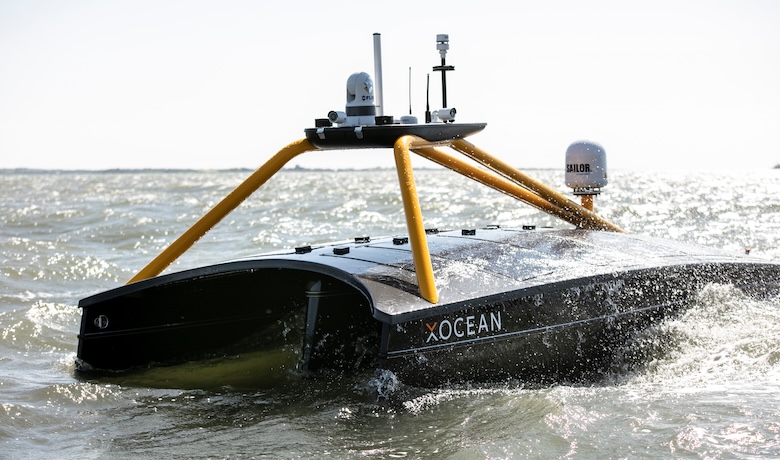
In 2024 to 2025, escalating tensions between Israel and Iran saw waves of missiles and drones cross regional skies. Jordan, a neutral (non-belligerent) State, intercepted many of these projectiles as they entered its airspace. From an international law perspective, the violation was clear: missiles and drones had penetrated neutral territory and the responsible States therefore violated their obligations under the law of neutrality. But what if a similar situation occurred in an archipelagic State? Could a belligerent lawfully fly drones or sail a sea-borne unmanned craft through designated archipelagic sea lanes on their way to strike enemy targets?
The UN Convention on the Law of the Sea (UNCLOS) provides that “all ships and aircraft” enjoy the right of archipelagic sea lanes passage. This right applies even to the warships and military aircraft of belligerents in times of armed conflict. UNCLOS is silent on the transit of lethal drones or unmanned vessels through such sea lanes. The Harvard Program on Humanitarian Policy and Conflict Research Manual (HPCR Manual) also does not expressly forbid it. As a result, there appears to be a grey zone in which so called “kamikaze” unmanned systems—systems that are designed to explode on impact—might use neutral archipelagic waters as part of their attack trajectory.
Archipelagic Sea Lanes and Legal Ambiguity
UNCLOS codifies a unique regime for archipelagic States, balancing sovereignty with navigational freedom. Articles 53 and 54 provide that “all ships and aircraft” may exercise the right of archipelagic sea lanes passage, a regime distinct from innocent passage. Ships and aircraft may pass in a continuous and expeditious manner, without prior notification or authorisation.
Crucially, however, UNCLOS limits the beneficiaries of this right to “ships” and “aircraft.” Expendable weapons such as torpedoes, missiles, or loitering munitions are not expressly covered. The treaty drafters never contemplated kamikaze drones or kamikaze unmanned surface vessels. This leaves room for exploitation, with belligerents experimenting with unmanned systems that blur the boundary between a weapon and platform.
One could argue that drones or unmanned surface or underwater craft with some navigational capacity fall within the ordinary meaning of “ships” or “aircraft.” Recent debates at the International Maritime Organization suggest that unmanned surface craft may indeed be classified as ships, depending on autonomy levels. By contrast, a missile lacking return capability has traditionally been treated as a weapon. Yet, modern kamikaze drones mimic aircraft in form and navigation, raising the possibility that States could bestow them with legal “aircraft” status to claim the right of overflight above archipelagic sea lanes.
Neutrality and Unmanned Systems
Alongside UNCLOS, the law of neutrality provides a critical legal constraint. Neutral States must not allow their territory, waters (territorial seas and, if applicable, archipelagic waters), or airspace to be used as a base of operations by belligerents. They must prevent violations of their neutrality and resist efforts to employ their territory for military advantage.
Traditionally, this rule applies to warships entering neutral ports, or military aircraft transiting neutral skies. Extending it to unmanned kamikaze systems is straightforward: if such systems are launched from or transit through neutral archipelagic waters en route to enemy targets, the neutral State’s territory has effectively been used as part of the battlespace. Neutrality law therefore suggests that archipelagic States should prohibit the passage of kamikaze drones, even if UNCLOS appears to allow it.
The problem is that neutrality rules have historically coexisted with navigational freedoms. Belligerent warships enjoy passage rights even in neutral waters, provided they do not engage in hostilities while transiting. This leaves open the possibility that kamikaze drones, if formally classified as ships or aircraft, could insist upon passage rights that neutral States are doctrinally obliged to grant.
When is a Drone a Weapon, and When is It a Ship or Aircraft?
Much of the debate turns on how international law defines “ships” and “aircraft.” Unfortunately, there is no universally accepted definition in UNCLOS. Different treaties adopt different criteria: navigation, buoyancy, or functionality. States themselves vary in how they classify unmanned vessels. For aircraft, the HPCR Manual distinguishes between UAVs (unmanned aerial vehicles), UCAVs (unmanned combat aerial vehicles), and missiles. UAVs and UCAVs may qualify as aircraft, while missiles are deemed weapons. Kamikaze drones straddle the line: designed as expendable, yet operating with the flight profile of aircraft. Sea-borne kamikaze craft raise the same dilemma: should they be considered ships if capable of navigation, or weapons once programmed to self-destruct?
This distinction matters. If kamikaze drones are classified as ships or aircraft, archipelagic States are obliged to permit their passage. If classified as weapons, they fall outside UNCLOS protections, and their use of archipelagic sea lanes would constitute a violation of neutrality.
Toward Legal Clarity
To prevent neutral waters from becoming inadvertent highways for lethal unmanned systems, the international community must urgently close these legal gaps. UNCLOS and customary international law require reinterpretation or supplementation to draw a clear line between archipelagic sea lanes passage rights for conventional ships and aircraft, and those for expendable or autonomous weapons.
The central question is stark: should unmanned maritime systems be categorically barred from transiting archipelagic sea lanes during armed conflict, regardless of their designation? Should the ban apply only to unmanned vehicles explicitly designed for one-way, kamikaze-style missions, such as those carrying incendiary or high-explosive payloads? Or should transit rights be determined solely by whether the platform has been legally recognised as a “ship” or an “aircraft”?
Complicating matters further, some operator States may find it useful to leave these questions deliberately vague, claiming maximum flexibility for operational planning while shifting the burden of legal interpretation onto neutral archipelagic States. This ambiguity risks placing neutral States in impossible positions: either allowing passage and being accused of complicity, or denying passage and facing accusations of unlawfully interfering with navigational rights. The need for clear, unambiguous rules is therefore pressing; rules that provide legal certainty, protect neutral States from entanglement, and preserve the integrity of archipelagic sea lanes for peaceful navigation.
Closing the Gap Before it Widens
Closing this gap will not be easy. Amending UNCLOS is politically unrealistic, and customary law evolves slowly. Yet in the meantime, leaving the rules undefined is in itself destabilising. Operator States gain an incentive to push the limits of archipelagic sea lanes, while neutral States face pressure to choose between conflicting duties.
One way forward is through reinterpretation. Neutrality law already prohibits the use of neutral territory as an extension of the battlefield. Applied consistently, this principle could serve as a limiting rule on UNCLOS passage rights: if the object transiting an archipelagic sea lane is itself a weapon, rather than a platform, then its movement is not protected navigation.
Another path is through functional clarification by State practice. Just as cruise missiles are not treated as “aircraft” despite flying through airspace, expendable unmanned systems, regardless of their legal status, could be expressly categorised as weapons. This would not require rewriting UNCLOS, only political will and consistent articulation in State declarations and practice.
Neither option is perfect, but they would both offer greater clarity than the current vacuum. The core issue is less about labels, and more about ensuring neutral waters are not left open to exploitation.
***
Pornomo Rovan Astri Yoga is a PhD candidate in International Law at the Australian National Centre for Ocean Resources and Security (ANCORS), University of Wollongong, and an officer in the Indonesian Navy (TNI AL).
The views expressed are those of the author, and do not necessarily reflect the official position of the United States Military Academy, Department of the Army, or Department of Defense.
Articles of War is a forum for professionals to share opinions and cultivate ideas. Articles of War does not screen articles to fit a particular editorial agenda, nor endorse or advocate material that is published. Authorship does not indicate affiliation with Articles of War, the Lieber Institute, or the United States Military Academy West Point.
Photo credit: XOCEAN-XO-450
