

Where the Environment Sits: Proportionality and Strikes on Russian Oil Infrastructure
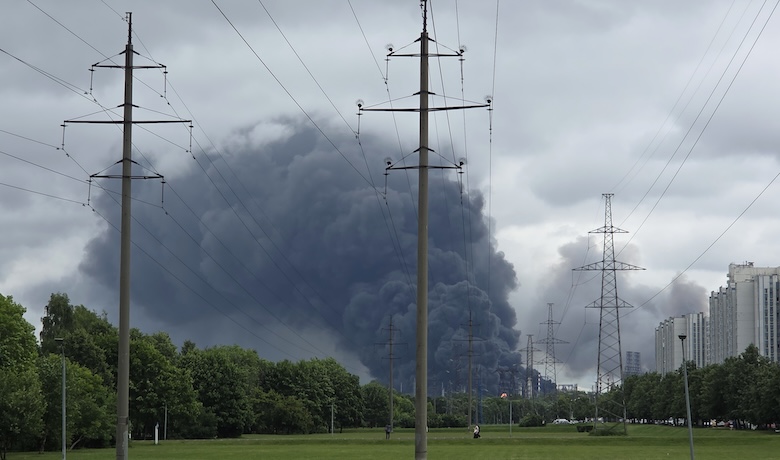
Through the spring and summer of 2026, Ukraine turned its long-range drone fleet into a systematic weapon against Russia’s refining sector. By late June, drones had struck eight of Russia’s ten largest refineries by processing capacity. Independent analysts placed roughly a third of national refining capacity offline, and fuel rationing appeared across a State that had long counted itself among the world’s largest energy producers. Drones hit the Moscow Oil Refinery twice within a week in mid-June. Kyiv described the facilities as lawful targets because they sustain the Russian war effort.
The lawfulness of striking a refinery is an easy question. The harder one involves refinery fires as environmental events. They release sustained air pollution over dense civilian areas and add a measurable pulse to the atmosphere. Where does that harm sit when a commander runs the proportionality assessment? Does the natural environment have a seat at the table at all, or does it register only when the damage has already become catastrophic?
This post works through that question with the refinery campaign as its factual anchor. It argues that the environment does have a place in the everyday proportionality calculus, though a fragile one that responsible targeting must defend deliberately rather than assume.
The Refineries are Lawful Objectives
Article 52(2) of Additional Protocol I (AP I) confines lawful attack to objects that by their nature, location, purpose, or use make an effective contribution to military action and whose destruction offers a definite military advantage. Both Russia and Ukraine are parties to AP I, so its targeting rules govern the campaign as a matter of treaty law.
Refineries that produce fuel for armed forces, and the depots and terminals that move it, contribute to military action through their use, and their neutralisation offers a concrete advantage in degrading an adversary’s operational logistics. Some refinery output feeds the war economy at one remove rather than military operations directly; the analysis here proceeds on the narrower operational logistics rationale, which comfortably satisfies Article 52(2).
Two Regimes
International humanitarian law (IHL) protects the environment along two tracks. Article 35(3) AP I prohibits methods or means of warfare intended or expected to cause widespread, long-term, and severe damage to the natural environment. Meanwhile, Article 55 restates the duty of care while tying it to the health or survival of the population. The three criteria are cumulative, and the drafting history reads “long-term” as damage measured in decades rather than seasons, which places the threshold far above anything an ordinary strike produces (see here paras 1452-54). The customary formulation in Rule 45 of an International Committee of the Red Cross (ICRC) study on customary international law mirrors the treaty language. Its claim of customary status, however, is itself contested, with several specially affected States, notably the United States, France, and the United Kingdom, questioning whether the first sentence reflects custom at all. The ICRC study itself records these three as persistent objectors to all or part of the rule. On the other hand, the Convention on the Prohibition of Military or Any Other Hostile Use of Environmental Modification Techniques, which addresses environmental modification as a weapon rather than incidental battlefield damage, sets its “widespread, long-lasting or severe” criteria in the alternative.
Refinery fires do not approach that ceiling. However dramatic the smoke, harm from a single strike is localised, and its atmospheric and contamination effects, while real, fall below decades-long, widespread, and severe degradation. That leaves the general track—the proportionality rule in AP I, Articles 51(5)(b) and 57(2)(a)(iii)—which forbids attacks expected to cause incidental civilian death, injury, or damage to civilian objects excessive in relation to the concrete and direct military advantage anticipated. The natural environment appears nowhere in that enumeration. The question is whether it enters the equation.
Does the Environment Enter Proportionality?
On the narrowest reading, air pollution over Moscow affects civilian health and contamination of farmland constitutes damage to a civilian object, while purely ecological loss with no human vector never registers. Article 55 lends this reading textual support because it frames environmental protection through prejudice to the health or survival of the population. The refinery case fits this frame uneasily, because much of the foreseeable harm does travel through human channels, yet the reading leaves ecological damage as such outside the ledger.
The stronger view gives the environment an independent place by way of its status as a civilian object. Because Article 52(2) defines civilian objects as everything that is not a military objective, the natural environment is presumptively civilian and cannot be attacked or incidentally damaged without the usual constraints. Rule 43 of the ICRC study states this directly: the general principles on the conduct of hostilities apply to the environment, its destruction is prohibited absent imperative military necessity, and, most relevant here, an attack expected to cause incidental environmental damage excessive in relation to the anticipated military advantage is prohibited. The crucial feature of Rule 43(C) is that it pegs the environmental proportionality test to excessiveness, and not to the widespread, long-term, and severe threshold. Under the ICRC’s vision of custom, in other words, excessive environmental damage is already prohibited well below the absolute ceiling, and the ICRC treats this as customary in both international and non-international armed conflict. A set of ICRC Guidelines, published in 2020, and the International Law Commission’s 2022 Draft Principles consolidate the position. Draft Principle 13 restates the general protection of the environment and the military objective limitation, and Draft Principle 14 provides that the principles of distinction, proportionality, and precautions apply to the environment with a view to its protection.
Lastly, in its Nuclear Weapons advisory opinion, the International Court of Justice advised that States must take environmental considerations into account when assessing what is necessary and proportionate in the pursuit of legitimate military objectives, and that respect for the environment is one of the elements that go to assessing whether an action conforms with necessity and proportionality (para. 30). That formulation forecloses the argument that the environment is simply absent from the calculus.
The environment does occupy a place in the proportionality assessment of the refinery strikes, both as a presumptively civilian value and as a consideration the commander is bound to weigh. The place is precarious precisely because the harm is diffuse and the operative test remains excessiveness measured against a concrete and direct military advantage. Under this test, fuel denial offers a substantial military advantage. A commander who counts the environmental cost honestly may still find the strike proportionate. The legal conundrum lies elsewhere: in never entering the environmental cost into the ledger at all.
Environmental Harm as a Reverberating Effect
The environmental cost of a refinery strike is almost entirely indirect. The plume of combustion products drifting over civilian districts, the contamination of soil and groundwater beneath the tank farm, and the downstream health consequences all sit one or more steps along the causal chain. There is a growing consensus that the reasonably foreseeable reverberating effects of an attack must be factored into both proportionality and precautions, even where their precise scale and scope cannot be fully anticipated or quantified (see here p. 7-8 ). The knock-on civilian harm from the 1991 coalition strikes on Iraq’s electrical grid, cascading through collapsed health and sanitation systems, was arguably not foreseeable at the time. However, such effects have since entered common military knowledge and are now precisely the kind of harm a reasonable commander is expected to anticipate (here p. 123-24).
Indirect effects that are too remote, or that cannot be reasonably foreseen, fall outside the assessment (U.S. DoD, Law of War Manual § 5.12.4). Igniting a distillation unit or a storage tank farm foreseeably produces sustained fires, a toxic plume over a populated area, and localised contamination. After months of strikes on the same class of facility, no planner can credibly claim these effects are speculative. By contrast, the marginal contribution of a single strike to atmospheric carbon, or diffuse health outcomes years removed, sits at or beyond the foreseeability line, and a commander who excludes them acts within the doctrine. The reverberating effects framework thus does for environmental harm what it earlier did for essential services. It moves the foreseeable core of indirect damage into the “expected” incidental harm the rule already governs, while leaving the speculative tail outside.
International Criminal Law
International criminal law offers a comparative light rather than a governing standard, and it clarifies the picture by contrast. It contains the single positive law text that expressly places environmental harm within a proportionality frame. Article 8(2)(b)(iv) of the Rome Statute criminalizes attacks launched in the knowledge that they will cause, among other consequences, widespread, long-term, and severe damage to the natural environment clearly excessive in relation to the concrete and direct overall military advantage anticipated. It imports the cumulative, widespread, long-term, and severe threshold into the proportionality frame, so it reaches only harm that is already catastrophic, the very harm the absolute prohibition covers.
At the same time, the provision raises the standard from “excessive” to “clearly excessive.” And it widens the denominator by attaching “overall” to military advantage. The single codified attempt to weigh the environment in proportionality was calibrated to reach almost nothing, and it has never grounded a charge. Indeed, no international tribunal has yet held a belligerent responsible for environmental harm during hostilities, even after major pollution events and oil well fires. The criminal provision confirms the blind spot rather than curing it. Where the international crime sits at the far ceiling, the everyday proportionality assessment becomes the only place environmental harm below that threshold can be weighed at all, which is exactly the space Rule 43(C) governs and the refinery campaign occupies.
Precaution, Uncertainty, and the Scale of a Campaign
Two features of the refinery campaign expose where the proportionality assessment is most likely to fail in practice. First, proportionality is anticipatory, judged on the harm a reasonable commander expects at the moment of decision. Environmental harm is delayed, cumulative, and often scientifically uncertain, which makes it the item most easily discounted to zero when the strike is planned. Rule 44 of the ICRC study requires that means and methods be employed with due regard to the environment, that all feasible precautions be taken to minimise incidental environmental damage, and, pointedly, that a lack of scientific certainty about environmental effects does not absolve a party from taking those precautions. The precautionary logic converts uncertainty from a reason to ignore environmental harm into a reason to plan around it, through timing, weaponeering, and target selection within the refinery complex.
Second, the proportionality rule assesses each attack against the advantage of that attack. A campaign that strikes nearly every major refinery, many of them repeatedly, can produce cumulative environmental degradation that no single assessment captures. Although the strike-by-strike assessment remains orthodox, a view increasingly canvassed in the literature holds that such incidental harm may aggregate across a campaign, in the way that repeated subthreshold civilian harm can accumulate beyond what any one strike would justify. A systematic campaign against a whole sector should prompt planners to treat the environmental dimension as a recurring and compounding cost.
Conclusion
None of this puts the lawfulness of Ukraine’s strikes on Russia’s refineries in doubt. The takeaway here is that the environment has a seat at the proportionality table, secured by its civilian status under Article 52(2), by the customary rule that incidental environmental damage must not be excessive, and by the Court’s instruction that environmental considerations must be taken into account. The seat is fragile because the harm from strikes like these is diffuse, the operative test is anthropocentric in its habits, and the dedicated prohibitions sit too high to bite. Responsible targeting of Russia’s oil infrastructure, or of any comparable dual-use installation, does not require pretending that a lawful strike becomes unlawful whenever it produces smoke. It requires that the foreseeable environmental cost be entered honestly into the proportionality ledger and built into precautions, even and especially below the widespread, long-term, and severe threshold.
The record is clear that courts will not do this work after the fact. The environment’s place in the assessment is real. Whether it is respected depends on the discipline of those who make the call.
***
Davit Khachatryan is an international law expert and researcher with a focus on operational law, international criminal law, alternative dispute resolution, and the intersection of various legal disciplines.
The views expressed are those of the author, and do not necessarily reflect the official position of the United States Military Academy, Department of the Army, or Department of Defense.
Articles of War is a forum for professionals to share opinions and cultivate ideas. Articles of War does not screen articles to fit a particular editorial agenda, nor endorse or advocate material that is published. Authorship does not indicate affiliation with Articles of War, the Lieber Institute, or the United States Military Academy West Point.
Photo credit: Rotafinus via Wikimedia Commons
