

Prisoner of War Repatriation and Interpretive Choice – Part III: A Lesson from Military History?
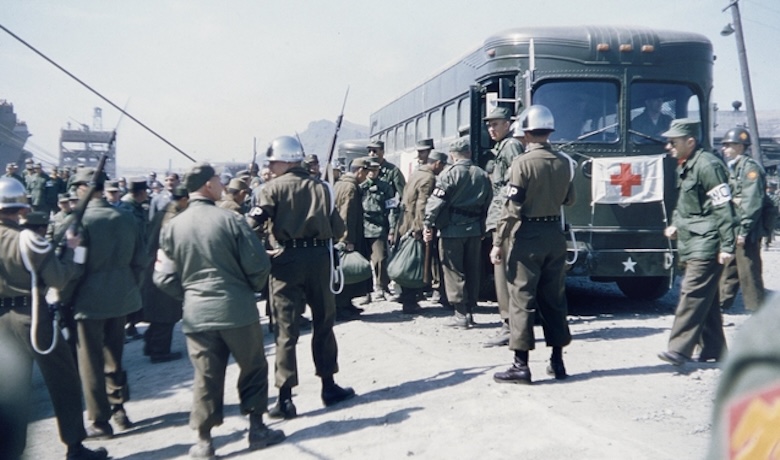
Parts I and II of this three-part post outlined the legal framework applicable to post-war repatriation of prisoners of war and highlighted two prominent fault lines in its interpretation and implementation by States. This final part recounts an often-forgotten episode in the history of post-conflict prisoner of war repatriation and offers concluding thoughts on efforts to further refine and harmonize views on this critical law of war protective regime.
Korean War Repatriations
No episode involving prisoner of war repatriation illustrates its complexities better than the Korean War. Begun in June 1950, the war’s first months featured bold maneuvers and fluid battle lines that surged the length of the peninsula. Control of Seoul changed hands six times in the first months of the conflict (p. 318). By January 1951, however, the front lines had settled almost exactly where they started along the 38th parallel. By the summer of 1951, both sides had agreed to conduct armistice talks, though without establishing a ceasefire. As the fighting continued, the parties whittled armistice negotiations down to three major issues: reconstruction of military airfields; composition of an armistice supervision commission; and prisoner of war repatriation.
Each side had captured thousands of prisoners of war, though the multinational United Nations Command (UNC) held far more than North Korea and China. As the armistice negotiations dragged on, prisoners resisted or refused repatriation. On the UN side, data concerning South Korean prisoners of war refusing repatriation are difficult to find, though one source estimates several hundred resisted return (p. 114, n.2). Another indicates that 335 South Koreans desired to stay (p. 104). Meanwhile, one British prisoner of war and 23 U.S. prisoners of war reportedly refused return (see p. 114, n. 2; see also Levie, p. 425, n. 156 (reporting 18 U.S. refusals)).
North Korean and Chinese prisoners of war, however, refused repatriation en masse. In April 1952, the UNC screened its Chinese and North Korean prisoners of war for repatriation with a view toward carrying out an exchange. Of 170,000 prisoners of war held, only forty percent or 70,000 prisoners of war indicated they would prefer repatriation. By the time the UNC shared its findings with China and North Korea, 83,000, including only 6,400 Chinese, indicated they desired repatriation (UNC Report, p. 958). The remainder did not wish to be repatriated.
During screening, riots took place in camps over rumors concerning forced repatriation (p. 63-64). In one infamous case, prisoners kidnapped a U.S. Army Brigadier General at a camp in relation to repatriation plans (Levie, p. 274). But the extent to which these repatriation refusals were truly voluntary or originated with Chinese and North Korean prisoners is complicated by reports of elaborate psychological campaigns to turn many against returning (p. 326). Repatriation refusals on the Chinese and North Korean sides have also been attributed to the forcible conscription of Nationalist Chinese loyal to Chiang Kai-shek and captured South Koreans into the communist side’s armed forces (p. 20).
As armistice negotiations continued into 1952, the UNC appeared prepared to concede the airfield reconstruction issue and to settle the armistice commission question. However, the belligerents remained deadlocked on involuntary repatriations. While the 1949 Geneva Conventions were not applicable to the conflict as a matter of law—only Switzerland had ratified the Conventions at the outbreak of the war—the sides agreed that the Conventions would guide debate in their negotiations (p. 215). To the enormous surprise of Chinese and North Korean negotiators at Panmunjom, the UNC insisted it would not forcibly repatriate any prisoner of war (p. 96). The stunned China and North Korea side, assisted greatly by a Soviet legal submission at the UN, held fast to the absolute and unconditional duty of repatriation, demanding repatriation of all their fighters. Their arguments framed repatriation as a clear and absolute obligation owed mutually between States irrespective of individual considerations of prisoners. Academic and media responses of the time conceded somewhat the textual case but criticized the analysis as too “literalist” (p. 395).
By contrast with the Chinese and North Korean view, the UNC firmly asserted that repatriation could not be understood independently from the interests of individual prisoners. The UNC cited the object and purpose of the Geneva Conventions in improving the conditions of prisoners and ensuring considerations of humanity in their treatment. Meanwhile, a December 1952 UN General Assembly Resolution reaffirmed the Third Geneva Convention as the relevant standard for repatriations and insisted that no prisoner of war could be forcibly repatriated under it.
The parties bickered over the issue for more than two years. Meanwhile, the human cost of the war mounted. Although the frontlines did not move far from the 38th parallel in this period, savage fighting took place during the repatriation negotiations (p. 13-15). In many cases, the belligerents launched attacks specifically to influence the balance of power at the armistice table (p. ix, 174-78). Tallies of casualties from the Chinese and North Korean side, as well as for South Korean forces and civilians, are difficult to locate. A U.S. Army history of the war, however, estimates the UNC suffered 125,000 total casualties in fifteen months of the armistice negotiation period while the Chinese and North Koreans may have lost “hundreds of thousands” (p. 432). More reliable casualty data for the negotiation period are available for U.S. Army forces. While the repatriation issue was argued, the U.S. Army suffered 3,500 killed in action and 9,000 wounded (p. 109-10).
The parties did not settle the issues of repatriation and armistice until June 1953. Professor Levie concludes, “Had it not been for the dispute over the question of voluntary versus involuntary repatriation, the armistice which brought the hostilities in Korea to an end would probably have been signed in June or July 1952, instead of July 1953” (p. 421, n. 134). A 1952 U.S. State Department report noted similarly that by 1952, failure to agree on total repatriation was the only remaining reason for the conflict (p. 272-73).
In the end, the Korean War Armistice Agreement provided for repatriation of prisoners of war within 60 days of its conclusion of “those prisoners of war … who insist on repatriation.” Rather than a default condition, the agreement required prisoners to affirmatively express their wish to be repatriated (art. III(51)(a)). If prisoners did not request repatriation within 120 days, the detaining power released them without return to the State of origin. An annex set a role for a Neutral Nations Repatriation Commission including ensuring prisoners had opportunities to exercise their choices, closing this dark period for prisoner of war repatriation as well as for the return to peace.
Concluding Thoughts
Some have concluded that the Korean War repatriation dispute was never about the law of war or even the thousands of prisoners of war who were caught up in it. Political historians estimate that because the sides were unable to win militarily, they seized on the repatriation question instead to compete for world opinion (p. 323). The UNC used the opportunity to market itself as a righteous defender of human rights and individual liberty, while the communist side purported to champion commitment to a rules-based and collective-minded legal order. In that sense, the armistice episode was an early phase of the Cold War battles of ideology that exacted a terrible human toll for decades.
Still, the episode permits consideration of the enduring interpretive questions that surround prisoner of war repatriation as well as the role of law of war interpretation in bolstering a return to peace. Whether the Chinese and North Korean insistence on textual and doctrinal integrity really served the law-of-war interests of sovereignty, military necessity, and humanity remains unclear, even doubtful. Meanwhile, the interpretive stand taken by the UNC was in some senses ahead of its time, prioritizing humanitarian considerations over textual integrity or doctrinal dogma. Though preceding the term by several years, the UNC could be said to have applied the spirit of “international humanitarian law” over the then-prevailing and highly sovereigntist laws of war. However, whether its insistence on a purportedly human-focused, humanitarian resolution of the involuntary repatriation question truly served humanity remains open to question, even doubtful.
After conclusion of the Korean War Armistice, Admiral C. Turner Joy, Chief Negotiator for the UNC wryly observed, “Voluntary repatriation cost us over a year of war and cost us our United Nations Command prisoners in Communist camps a year of captivity” (p. v). In fact, the Admiral may have understated that cost. In total, negotiation of the voluntary repatriation issue spanned closer to two years of fighting, internment, and civilian suffering. The point is perhaps made more starkly when expressed in terms of deaths, casualties, and prolonged internments rather than in temporal terms. A historian who asked whether the UNC insistence on voluntary repatriation was worthwhile expressed still more personally: “A Chinese prisoner of war who was repatriated to Taiwan rather than Communist China might argue the results were favorable. An American POW, living in a prisoner of war camp on the Yalu River and loved ones of those who died in the period from 1 July 1952 to 27 July 1953 might argue otherwise” (p. 166).
The purpose of highlighting this sad outcome and the persistent legal disputes behind it is not to second-guess diplomatic or military choices made almost 75 years ago. Nor is it to definitively resolve an important but seemingly intractable debate about prisoner of war repatriation doctrine. The point instead is to suggest that legal ambiguity and disunity in the Third Convention’s post-war prisoner of war repatriation regime may serve a helpful purpose. If competing, dogmatic visions of the law of war played any part in prolonging the conflict, some reconsideration of the role legal interpretation played in this episode is surely in order. Whether the law of war and its goals, including “to diminish the evils of war, as far as military requirements permit,” are better served by narrow fidelity to preserved diplomatic bargains or by admitting dynamic, though decentralized reworking is worthy of consideration.
Similarly, whether seeming legal gaps are dilemmas to be resolved or tools for dispute settlement demands thought. Further, the extent to which an inter-State or individual-focused conception of the law of war better guarantees humanity and peace in every instance calls for conversation. In addition to reflecting the limits of international consensus and providing an honest picture of States’ legal common ground, ambiguities afford interpretive flexibility that permit States to adapt to the diplomatic, military, and humanitarian idiosyncrasies of armed conflicts, particularly when they present an opportunity to achieve peace. Although no doubt frustrating from academic and judicial perspectives, an ambiguous, even uncertain prisoner of war repatriation regime may offer hidden humanitarian and diplomatic potential.
***
Sean Watts is a Professor in the Department of Law and Philosophy at the United States Military Academy, Co-Director of the Lieber Institute for Law and Warfare at West Point, and Co-Editor-in-Chief of Articles of War.
The views expressed are those of the authors, and do not necessarily reflect the official position of the United States Military Academy, Department of the Army, or Department of Defense.
Articles of War is a forum for professionals to share opinions and cultivate ideas. Articles of War does not screen articles to fit a particular editorial agenda, nor endorse or advocate material that is published.
Photo credit: Donald Douglas George Bushby
RELATED POSTS
Prisoner of War Repatriation and Interpretive Choice – Part I: The Legal Framework and Reciprocity
by Sean Watts
December 15, 2025
–
Prisoner of War Repatriation and Interpretive Choice – Part II: Involuntary Post-War Repatriation
by Sean Watts
December 16, 2025
