

Laws of Yesterday’s Wars Symposium – Introduction
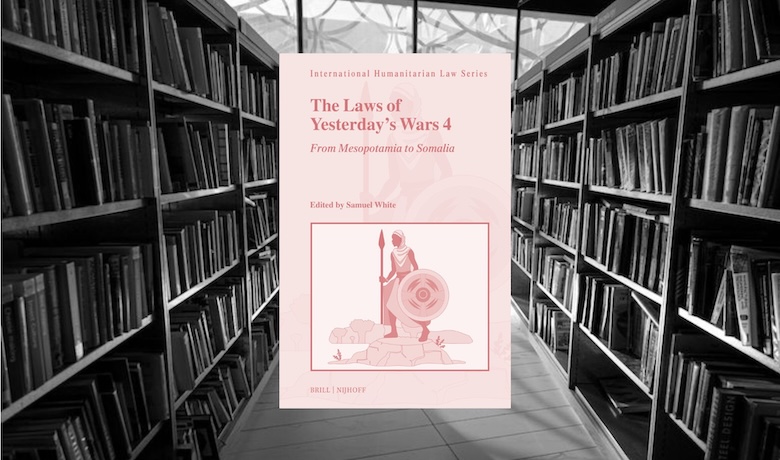
The Laws of Yesterday’s Wars series began with what I assumed was an idle question, almost a thought experiment. While watching a dramatized Viking raid on television, I wondered whether the brutality on screen could have violated any norms that Vikings themselves recognised. That curiosity, hardly profound at the time, opened the door to a much larger and far more important inquiry: how universal is the impulse to regulate violence? And more pointedly: how international is international humanitarian law?
The volumes that followed have attempted to answer these questions through a deliberately expansive, cross-cultural methodology. The project has never aimed simply to catalogue the laws of ancient societies. Rather, it seeks to trace the genealogy of restraint in human conflict, recognising that the modern treaty system, while indispensable, is neither the first nor the only way through which communities have sought to limit the cruelty of war.
This latest symposium for Articles of War focuses on the most recent work in the Laws of Yesterday’s Wars series: Volume 4: From Mesopotamia to Somalia. It marks a particularly meaningful stage of that journey. The volume draws together six chapters spanning the ancient Near East and sub-Saharan Africa, and includes contributions based not only on textual and archaeological sources, but also on extensive qualitative field research. The result is a collection that speaks as much to the lived experience of communities as it does to the doctrines they produced.
Volume Chapters
Several features distinguish this volume within the series.
First, it bridges worlds often kept apart in legal scholarship. The early chapters on ancient Egypt, the Hittites, and the Torah draw from rich written sources, diplomatic records, and religious texts. The African chapters on Somalia and West Africa, and the International Committee of the Red Cross’s (ICRC) wider analysis of the continent, by contrast, rely heavily on oral traditions, poetry, ritual, and community memory. Yet both approaches unveil similar patterns: rules governing who may be harmed, what property must be protected, how conflict must be declared, and which rituals must accompany its end. The convergence across such diverse contexts challenges the often-assumed narrative that humanitarian limits are the intellectual inheritance of Europe alone.
Second, the volume embraces methodological pluralism. Scholars have long debated whether comparative legal history should favour functionalism (focusing on what legal systems do) or contextualism (focusing on the world in which they emerged). Several chapters here reject the binary approach altogether, instead demonstrating that detailed description and cautious comparison can co-exist. Ayan Abdirashid Ali’s Somali research, for example, is grounded in ninety-one interviews conducted in Somali and translated by the author herself, a methodological undertaking that stands almost alone in contemporary humanitarian legal scholarship.
Third, and perhaps most importantly, the volume emphasises the practical value of historical and customary perspectives today. For humanitarian actors, peacebuilders, and operational lawyers, understanding local normative traditions is not merely a matter of academic curiosity. It is central to achieving compliance, legitimacy, and community engagement. As the ICRC’s Roots of Restraint in War highlighted, and as Articles of War frequently explores, restraint often emerges not from formal legal obligation but from socialisation, identity, and reciprocity. Volume 4 provides real-world illustrations of these forces across civilizations separated by centuries and continents.
Finally, this symposium presents an opportunity to connect these findings to the broader conversation that Articles of War fosters: namely, how history informs modern military practice, how culture shapes the battlefield, and how law evolves through the complex interplay of doctrine, politics, and lived experience. Whether one looks at the Lieber Code’s pragmatic duality of humanitarianism and military necessity, or at recent debates on compliance with IHL in non-international armed conflicts, the underlying question remains the same: why do some actors choose restraint?
Concluding Thoughts
Volume 4 suggests that the answer lies not solely in punishment or legal obligation, but in something much older and more fundamental: the shared human recognition that unregulated violence is socially, economically, spiritually, and politically corrosive. The chapters in this symposium each illuminate one expression of that recognition. Together, they offer a powerful demonstration that, at their core, the laws of war have always been about managing relationships, preserving communities, and preventing cycles of harm.
This symposium invites readers to engage with these insights, explore the chapters’ findings, and consider their implications for both historical understanding and contemporary application. It is a reminder that the study of ancient laws of war is not peripheral to the modern legal project, it is one of its deepest roots.
***
Dr Samuel White is the Senior Research Fellow in Peace and Security at the National University of Singapore’s Centre for International Law.
The views expressed are those of the authors, and do not necessarily reflect the official position of the United States Military Academy, Department of the Army, or Department of Defense.
Articles of War is a forum for professionals to share opinions and cultivate ideas. Articles of War does not screen articles to fit a particular editorial agenda, nor endorse or advocate material that is published. Authorship does not indicate affiliation with Articles of War, the Lieber Institute, or the United States Military Academy West Point.
Photo credit: Pexels, Brill Nijhoff
