

Anti-Personnel Mines in a Post-Hostilities Environment: The Case of Armenia-Azerbaijan Conflict
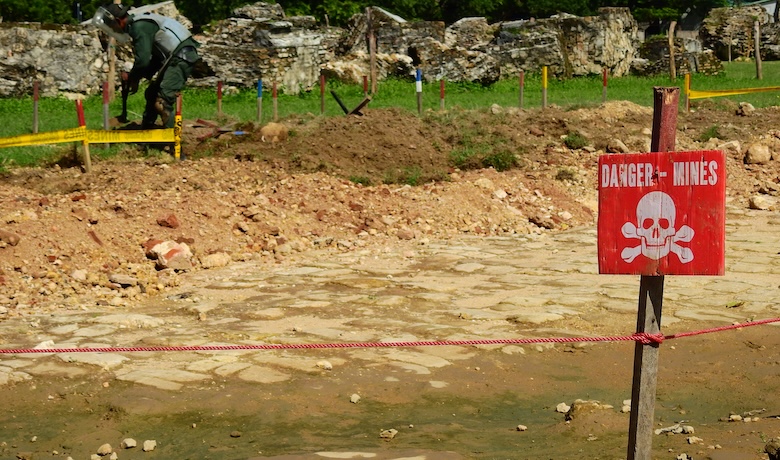
Few contemporary conflicts have been as deeply saturated with landmines as the protracted confrontation between Armenia and Azerbaijan. Over three decades of intermittent warfare and fortified front lines have produced extensive mine contamination across battle zones, border areas, and civilian settlements. Even after large-scale hostilities ceased in 2020 and territorial control shifted again in 2023, mine incidents continued to cause fatalities among soldiers, journalists, and the security landscape.
The use of anti-personnel mines in the conduct of hostilities is unlawful for State parties to the 1997 Convention on the Prohibition of the Use, Stockpiling, Production and Transfer of Anti-Personnel Mines and on Their Destruction (Ottawa Convention). For States that remain outside the Convention, the legal position differs. Their obligations continue to be governed by international humanitarian law (IHL), which regulates landmines indirectly through the principles of distinction, precautions, and proportionality, and through post-conflict duties of clearance and risk mitigation. That framework presumes a temporal connection between the weapon’s effects and an ongoing military advantage. Where hostilities have largely ceased, territorial control has consolidated, and civilian exposure to mine-related harm has become foreseeable and persistent, that presumption weakens. The legal question that now arises is whether continued reliance on this permissive, context-dependent regulation remains coherent in a factual environment defined by post-conflict administration rather than battlefield necessity.
The Armenia-Azerbaijan context brings this shift into sharp focus. Large-scale hostilities have ended, territorial authority has changed decisively, and sluggish border delimitation is underway. Azerbaijan exercises consolidated control over Nagorno-Karabakh and adjacent districts, while portions of Armenia’s internationally recognized territory along the eastern border remain under Azerbaijani control. In these areas, landmines no longer operate solely within active combat zones. While their defensive military rationale may persist in limited form, their dominant legal significance lies in their continuing effects on civilians and in the obligations of States exercising effective control over territory.
Conflict Saturated with Mines
After the large-scale armed conflict in 2020, mine incidents in areas controlled by Azerbaijan became a recurring feature of public reporting, including the June 2021 explosion that killed two Azerbaijani journalists and a local official. The landmine file quickly evolved into a matter of inter-State leverage. In June 2021, Armenia transferred minefield maps in exchange for the release of fifteen Armenian detainees, a transaction publicly framed as a humanitarian confidence-building measure but followed by disputes over the completeness and accuracy of the information provided. By late 2022, Azerbaijan was raising allegations concerning newly laid mines and incomplete disclosures, presenting land contamination as an ongoing obstacle to the return of displaced persons and reconstruction.
The issue also came before the International Court of Justice. On September 23, 2021, Azerbaijan requested provisional measures in its proceedings against Armenia under the Convention on the Elimination of All Forms of Racial Discrimination (CERD), alleging that continued mining and the withholding of minefield information prevented the safe return of displaced Azerbaijanis. In its 7 December 2021, order, the Court recorded these allegations, but declined to indicate provisional measures on the mining question, holding that it was not plausible, at that stage, that the CERD imposed obligations requiring Armenia to cease mining or to facilitate demining (para. 53). The case thus placed the landmine issue on the judicial record as a legally cognizable harm, even where the parties do not invoke the relevant treaty framework.
States have invoked the landmine narrative as a pretext for the use of force. On September 19, 2023, Azerbaijan announced a military operation in Nagorno-Karabakh after citing mine explosions earlier that day as the immediate trigger for what it termed “local anti-terrorist activities.” The operation culminated in the exodus of more than 100,000 ethnic Armenians and the effective removal of the Armenian population from the territory. Whether or not such incidents could justify the scale of force employed, their invocation underscores the degree to which landmines have continued to function as destabilizing factors well beyond the cessation of large-scale hostilities.
Ottawa Convention
The Ottawa Convention establishes a comprehensive prohibition regime. Article 1 prohibits the use, development, production, acquisition, stockpiling, retention, and transfer of anti-personnel mines. Articles 4 and 5 require the destruction of stockpiles and the clearance of mined areas under a State party’s jurisdiction or control within specified timeframes. Article 6 provides for international cooperation and assistance, including support for clearance and victim assistance. Article 9 obliges State parties to adopt domestic implementation measures, including penal sanctions. The Convention also regulates withdrawal under Article 20, requiring notice and a statement of reasons, and precluding withdrawal from taking effect during an armed conflict.
Structurally, the Convention replaces context-dependent regulation with categorical prohibition. It removes reliance on case-by-case assessments of military necessity and instead treats the weapon class itself as incompatible with civilian protection in contemporary conflict environments.
The Doctrinal Baseline
Some may assume that anti-personnel landmines are inherently indiscriminate, but that characterization is not doctrinally exact. The legality of anti-personnel mines depends on context and manner of use. Mines emplaced within clearly marked, fenced, and exclusively military defensive zones, directed against military objectives and accompanied by recording and warning measures, may comply with the principles of distinction and feasible precautions at the time of emplacement. The Demilitarized Zone on the Korean Peninsula, for example, contains extensive minefields embedded within a static military boundary separating opposing armed forces that effectively precludes civilian access, and the military confrontation remains ongoing.
The Armenia-Azerbaijan setting does not replicate that structure. The belligerents did not confine the mined territories to permanently demarcated, fenced, and exclusively military belts. Moreover, the parties contest and strategically leverage minefield maps as assets. In such conditions, the assumption of stable, civilian-excluded defensive minefields does not hold.
This transformation matters for the legal assessment. The duty to protect civilians against the effects of hostilities, reflected in Article 48 of Additional Protocol I (AP I) for Armenia and in customary IHL for Azerbaijan, continues to govern the consequences of weapons after their emplacement. The prohibition of indiscriminate effects, articulated in AP I Article 51 and recognized as customary law, becomes increasingly salient once landmines operate autonomously in areas of civilian presence. Likewise, the obligation to take feasible precautions, set out in AP I Article 57 and binding on Azerbaijan as a matter of custom, does not terminate with the completion of an attack where the danger remains known and preventable. In parallel, customary IHL imposes post-hostilities obligations to record, mark, remove, or otherwise render landmines harmless once active fighting has ceased (rules 81–84).
Accession as Regulatory Calibration
None of this establishes a legal obligation for Armenia or Azerbaijan to accede to the Convention. Treaty participation remains a matter of sovereign choice. Where a State faces active hostilities or a credible and immediate threat of renewed large-scale conflict, the retention of anti-personnel mines may be defensible on grounds of military necessity. The recent decision by Ukraine to suspend its obligations under the Convention following Russia’s full-scale invasion demonstrates that where existential defense conditions re-emerge, States may reassess previously accepted constraints. In conditions of ongoing, high-intensity international armed conflict, where territorial defense and deterrence are immediate operational concerns, military necessity may outweigh regulatory restraint. Recent developments among State parties also show that the Convention’s constraints are treated as contingent on security conditions.
A similar calculus operated during periods of active hostilities in Nagorno-Karabakh. The current Armenia-Azerbaijan context, however, presents a different configuration. Large-scale hostilities have ceased, belligerents have consolidated territorial control, and the dominant legal issues concern administration, reconstruction, and civilian safety in formerly contested areas, even if security tensions and episodic risks persist. In such an environment, continued reliance on a regulatory model designed to manage battlefield effects rather than eliminate a weapons category reflects a policy choice rather than a legal compulsion. Accession would recalibrate the legal baseline in a setting where the military justification for anti-personnel mines appears increasingly attenuated and their residual risks increasingly central.
Conclusion
The resurgence of security threats and ongoing armed conflict across the globe is undeniable, yet the discipline of humanitarian constraint does not yield uniformly to threat perception. This constraint calls for a carefully calibrated application, particularly in contexts where the factual conditions render restraint not only possible but legally and strategically plausible. The present Armenia-Azerbaijan context is precisely the kind of setting in which such a calibrated reassessment becomes legally and strategically relevant.
***
Davit Khachatryan is an international law expert and researcher with a focus on operational law, international criminal law, alternative dispute resolution, and the intersection of various legal disciplines.
The views expressed are those of the author, and do not necessarily reflect the official position of the United States Military Academy, Department of the Army, or Department of Defense.
Articles of War is a forum for professionals to share opinions and cultivate ideas. Articles of War does not screen articles to fit a particular editorial agenda, nor endorse or advocate material that is published. Authorship does not indicate affiliation with Articles of War, the Lieber Institute, or the United States Military Academy West Point.
Photo credit: Rehman Abubakr
