

Identifying NIAC Series – Aggregating Criminal Violence: Challenges to NIAC-Classification
Editors’ note: This post appears as an entry in a series examining Dr Nathan Derejko’s book, Identifying Non-International Armed Conflict published by Cambridge University Press. The series features alternating posts with our friends at Armed Groups and International Law. The series introduction can be found here.
In many contemporary theatres, violence is plainly extreme yet fragmented among multiple armed actors, so that no single bilateral confrontation reaches the threshold of non-international armed conflict (NIAC) in isolation. At the same time, the cumulative pattern of hostilities makes reliance on ordinary law enforcement tools structurally untenable. Additionally, the operations of those actors are often so entangled, fluid, and overlapping that attributing particular episodes of violence to one group or another becomes evidentially difficult. Taken together, these two features generate some of the hardest NIAC-classification problems.
It is precisely against this backdrop that Chapter Two of Nathan Derejko’s Identifying Non-International Armed Conflict makes a distinctive contribution. Notably, it offers one of the most careful and operationally oriented accounts of the NIAC threshold to date, recasting the familiar Tadić formula into a structured method for distinguishing armed conflict from internal disturbances and other forms of organised violence.
This post develops those twin problems of fragmentation and attribution in some of the hardest corners of current practice: heavily armed criminal organisations in certain regions of Mexico, Brazil, and Colombia. In these settings, criminal actors may engage in sustained clashes with State forces, yet it might be nearly impossible to assess exactly the degree of violence between each individual group and the State (see, e.g., here and here).
Drawing on my earlier “common enemy” proposal and engaging closely with Derejko’s cautious treatment of aggregation, I argue that cumulative assessment of intensity can extend to criminal violence. However, this only extends to its State-directed component, and only where the available evidence allows us to identify which groups, if any, independently satisfy the organisational requirement and thus genuinely contribute to meeting the aggregated threshold. Even then, such configurations are likely to remain exceptional. In most situations of criminal violence, the ordinary law enforcement paradigm will continue to govern.
Aggregation Revisited: Compatible Foundations
In conflict‑classification practice, the orthodox position is the fragmented approach, which requires intensity to be assessed separately for each factual relationship between the State and a given armed group. Yet that approach risks producing the legal and operational paradox described above: cumulative violence between State forces and a constellation of armed groups in a single theatre may be extremely high, while the evidence does not clearly attribute enough of that violence to any one group to show it independently crosses the NIAC threshold.
It also requires State forces to apply international humanitarian law (IHL) to some organised groups and ordinary law enforcement rules to others within the same theatre. That distinction may be difficult to maintain where those groups’ operations and alliances are fluid. In order to address this crucial issue, in a previous publication I argued that the intensity of violence generated by multiple armed groups fighting a common enemy in the same geographical and temporal frame should be assessed in the aggregate rather than in isolation. That argument sits within a wider line of scholarship favouring cumulative approaches to intensity (see notably here, here, and here).
Derejko interprets the intensity requirement in functional terms. He maintains that NIAC begins only once the intensity of armed violence exhausts the capacity of the ordinary law enforcement framework to respond effectively, such that policing alone is no longer sufficient to ensure compliance with the State’s international human rights obligations. Chapter Two distinguishes three forms of aggregation: temporal; geographical; and what Derejko calls “aggregating intensity,” notably the category comprising the “common enemy” proposal advanced here. Among the challenges he raises to its normative and practical utility is that excluding non-qualifying coalition members from the aggregate does not close the “legal and operational loophole” the approach was designed to address, because IHL would still apply to some armed actors in a theatre but not others.
Compatibility with Derejko’s framework therefore turns on whether that loophole can be closed, depending on two conditions. First, aggregation must operate only as a method for assessing intensity, while each group must still satisfy the organisational requirement independently. Second, the analysis must remain anchored in Derejko’s law enforcement exhaustion standard, rather than in some free-floating notion of “overall” violence. Read this way, the two conditions are not a softening of Derejko’s objection but a direct response to it. The loophole he identifies arises only where aggregation extends IHL to groups that have not independently demonstrated the capacity to implement it, which is precisely what these conditions foreclose.
Where each group independently satisfies the organisational requirement and all direct their violence against the same State adversary, cumulative assessment of intensity does not dissolve the party concept; it identifies multiple distinct parties whose combined operations trigger the threshold. Aggregation, in other words, is a methodology for assessing intensity. It cannot displace, and need not displace, the separate inquiry into organisation and party status. The question, then, is whether this methodology can be applied at the more controversial margins of NIAC classification, such as in settings dominated by heavily armed criminal organisations.
Aggregating Criminal Violence: Conditions and Limits
Criminal organisations are not automatically excluded from IHL’s reach simply because their primary motivation is criminal rather than political. To the extent that they demonstrate the ability to plan, coordinate, and sustain military-grade operations against State forces, the organisational requirement may, in principle, be met. However, assuming some criminal organisations can satisfy the organisational thresholds, can their violence be aggregated with that of other such organisations for classification purposes?
The “common enemy” framework developed in my earlier work encounters an immediate complication here. Criminal organisations frequently fight each other as much as, or more than, they fight the State (see, e.g., here and here). Inter-cartel warfare may be the dominant form of violence in a given theatre, so the “common enemy” condition is not met where criminal inter-group violence is as intense as, or more intense than, the violence directed against State forces, and where, in practice, it may be difficult to disentangle these strands of violence for evidentiary purposes.
This is not just an analytical quirk but a limiting principle on aggregated intensity. Aggregation of criminal violence is justified, on a functional reading of intensity, only where the violence directed against State forces, across the groups being aggregated, cumulatively exhausts the law enforcement regime, with inter-group violence treated separately. This refines the earlier “common enemy” condition by specifying that what must be common is not only the adversary but the combined, State-directed pressure that makes ordinary policing untenable in Derejko’s terms. In practice, that is a demanding test in environments where most lethal violence takes the form of turf wars between rival criminal groups. In many such settings, State forces intervene only episodically rather than facing sustained, two‑sided hostilities. The rarity of situations in which this stricter condition is met is part of the conclusion. Aggregation can extend to criminal violence only as to its State-directed component, and such cases will remain exceptional.
As Derejko emphasises, the aggregation question is ultimately connected to the concept of being party to a NIAC, rather than to an abstract notion of “armed conflict” alone. In his account, the existence of a NIAC presupposes at least two identifiable parties, each with sufficient organisational capacity to implement IHL, and the analysis of “networked” armed groups and groups “belonging” to a party is central to that inquiry. An aggregation methodology that assesses intensity cumulatively while evaluating organisation individually must therefore be explicit about who is being treated as a party in the scenario under consideration. If cumulative‑intensity analysis identifies a threshold‑crossing situation involving several criminal organisations, each with its own command structure and each fighting the State independently, the question is whether these are several distinct parties or whether, in exceptional cases, some of them might be said to belong to, or to form, a larger networked party under Derejko’s criteria.
On the approach defended here, aggregation does not itself answer that question and cannot be used to manufacture party status. The fact that several criminal organisations contribute cumulatively to exhausting the State’s law enforcement capacities does not, by itself, transform them into a single party. Instead, it reveals multiple independently organised parties simultaneously engaged in sufficiently intense hostilities with the State. This may leave a patchwork of applicable law within the same theatre—criminal actors that do not independently meet the organisational requirement remain outside IHL regardless of intensity—but that patchwork is produced by the organisational requirement itself, not by the kind of aggregate-gerrymandering Derejko’s loophole challenge targets. Where Derejko’s “belonging” or “networked group” analysis supports the conclusion that several nominally distinct groups in fact form part of a single party, that conclusion must rest on his organisational criteria, not on the aggregation of violence alone. In that sense, aggregated intensity and the law enforcement exhaustion standard can, in rare cases, support the application of IHL to criminal violence, but only insofar as they are tightly coupled to, rather than used to sidestep, a rigorous party identification analysis.
Conclusion: Aggregation at the Margins of NIAC
The criminal organisation scenario shows challenges which are not simply theoretical curiosities, but constitute lived realities in places such as Colombia, Mexico and Brazil, where endemic violence blurs the lines between insurgency and organised crime. In such settings, aggregation of intensity in multi-actor conflicts is not a departure from the Tadić logic but its functional extension. Where several organised actors taken together exhaust the State’s capacity to rely on law enforcement tools, a NIAC may exist, even though no single bilateral relationship reaches the threshold in isolation.
What follows is not that the law should stretch to accommodate every form of “drug war,” but that the tools Derejko develops make it possible to ask, in a structured way, when certain criminal configurations do cross the NIAC line, and when they do not. The stakes for the protection of civilians, for the obligations of State forces, and for the integrity of IHL itself, are too high for the classification of such situations to remain at the margins of current debates.
***
Chiara Redaelli is a Research Fellow at the University of Geneva and Legal Expert for IDLO, Ukraine Office.
The views expressed are those of the author, and do not necessarily reflect the official position of the United States Military Academy, Department of the Army, or Department of Defense.
Articles of War is a forum for professionals to share opinions and cultivate ideas. Articles of War does not screen articles to fit a particular editorial agenda, nor endorse or advocate material that is published. Authorship does not indicate affiliation with Articles of War, the Lieber Institute, or the United States Military Academy West Point.
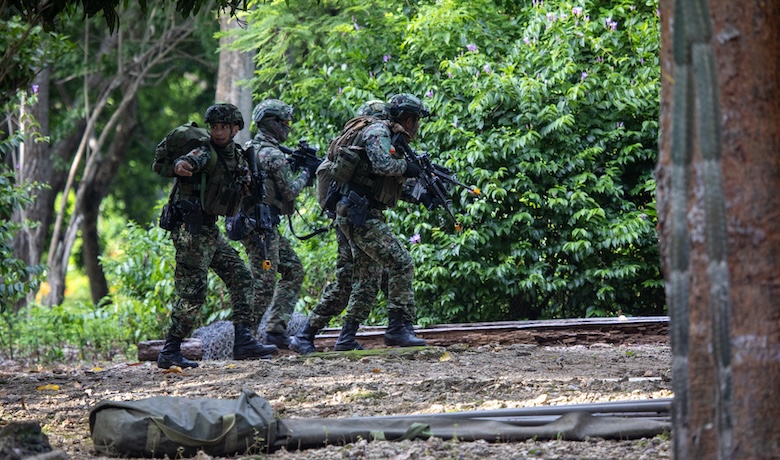
Photo credit: U.S. Army, Staff Sgt. Daniel Lee
RELATED POSTS
Introduction: From Armed Violence to Armed Conflict
August 24, 2026
–
The Concept of Non-International Armed Conflict – Towards a Singular Definition of NIACs?
by Gloria Gaggioli
AGIL
August 24, 2026
