

Anything Other Than a Classic NIAC: Examining Myanmar’s Legal Battlefield
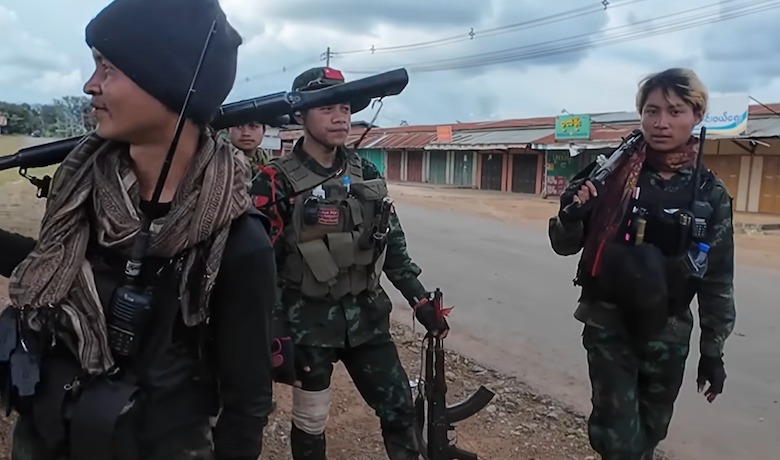
Myanmar’s civil unrest is traditionally characterised as a non-international armed conflict (NIAC). It arguably represents one of the most enduring civil wars in modern history. For the past seven decades, since independence from British colonial rule, the State has been persistently riddled with violence.
Myanmar is not a party to the Second Additional Protocol of 1977, relating to NIACs. Therefore, human rights reporting and scholarly fora have consistently applied Common Article 3 of the Geneva Conventions and the customary law of armed conflict (LOAC) to the situation. Nevertheless, increasing phenomenological and epistemic uncertainty following the 2021 coup casts doubt on its categorisation as a NIAC and the operational threshold necessary for the concrete application of its rules to at least some of the actors involved.
The situation in Myanmar used to operate in familiar patterns that characterise all internal conflicts: armed groups competing with government forces and sometimes amongst each other over territorial control. As Chiara Redaelli summarized back in 2018, “the Myanmar Armed Forces are involved in a multitude of NIACs … notably against the Kachin Independence Army (KIA), the Ta’ang National Liberation Army (TNLA), the Shan State Army-South (SSA-S), the Shan State Progressive Party/Shan State Army-North (SSPP/SSA-N), and the Arakan Rohingya Salvation Army (ARSA).”
However, the situation on the ground has devolved into a rather unprecedented and fluctuating kind of armed confrontation in scale and scope since the February 2021 coup d’état. As military and political authority fragments and transnational criminality escalates, the volatility and structural plurality of Myanmar’s conflict pose significant challenges to LOAC’s authority and application. This post examines that complexity and outlines where the conflict currently stands.
Dual Sovereignty and the Struggle for Legitimacy in Myanmar
The theoretical classification of NIACs remains somewhat contested, but an authoritative test to identify them may be found in the International Tribunal for the former Yugoslavia (ICTY)’s Tadić decision on jurisdiction (para. 70). This test basically rests on two axes: the intensity of the hostilities; and the organisation of the parties involved. While NIACs may also occur between armed groups inter se, in a traditional sense, the legal framework governing NIACs positions State armed forces against dissidents or insurgents, rebels, or other resistance groups.
The situation in Myanmar has also been viewed predominantly through this lens throughout the past decades of hostilities. Indeed, some of the conflict developments support looking at the situation in such a “clean,” antagonistic sense. National peace initiatives such as the 2015 Nationwide Ceasefire Agreement positioned the Myanmar Armed Forces (MAF), comprising the army, navy, and air force, regardless of the ruling administrative entity, against ethnic armed organizations (EAOs). However, this clear dichotomy has become increasingly unsettled following the post-coup emergence of what might be called parallel sovereignties and competing claims to international recognition.
Since 2021 to date, two entities have effectively been struggling for governmental authority in Myanmar. The MAF remain aligned with the State Administrative Council (SAC, recently rebranded as the State Security and Peace Commission, (SSPC)). The SAC argues it represents the governmental power in the sense it was established through Section 419 of Myanmar’s 2008 Constitution.
It is opposed by the National Unity Government (NUG), which was formed by parliamentarians ousted in the 2021 coup through the support of ethnic representatives. The NUG founded its own armed wing, called the People’s Defence Force (PDF), in May 2021. The establishment of the PDF is an attempt to forge an official State armed force in joint coordination with a couple of EAOs to parallel the MAF.
Above that, the NUG asserts de jure authority over Myanmar, which it derives from general elections that took place in 2020. Within its (para)military ranks, the NUG has created a central chain of command, allied itself with major EAOs, and designated the MAF and the SAC as “terrorist organisations.”
This intragovernmental struggle gives rise to the complex question which (if any) entity holds responsibility to fulfil Myanmar’s international legal obligations, including those stemming from the Geneva Conventions, customary LOAC, and international human rights law. While recognition or effective control over territory by either of these entities might help provide some clarity, neither is definitively dispersed to one or the other actor.
First, international and regional recognition are highly sensitive for both the SAC/SSPC and the NUG and their respective narratives of power. Both have mutually campaigned for the other to be viewed as illegitimate or terrorist with varying degrees of success. As for territorial control, battlefields on the ground remain too dynamic to definitively favour any of the entities involved. Some sources place the MAF’s control at a meagre 21 percent of the entire territory.
Over the course of the struggle, diplomatic popularity between the two has shifted, and the line between those unquestionably acting on behalf of the State and non-State actors is becoming increasingly blurry. Additionally, some EAOs assert secessionist or proto-State legitimacy themselves, claiming a mandate over at least part of Myanmar’s territory. Overall, therefore, both de jure and de facto authority are fiercely contested on the ground. Meanwhile, the SSPC-held MAF has renewed its attempts to maintain a central position by calling for highly questionable elections, with the first phase scheduled on 28 December 2025.
The Proliferation of Armed Groups and Threshold Complexity
The range of non-State (or non-MAF) actors involved in Myanmar’s conflict is no less broad or diverse. Since early 2021, Myanmar has experienced a dramatic proliferation of armed actors. Beyond legacy EAOs immersed in the borderlands inhabited by ethnic minorities, post-coup anti-junta movements have grown from street protests into guerrilla mobilisations. These groups are building a multitude of militias in both ethnic States along the border and the Bamar regions situated in the centre. As some of the regions in central Myanmar were historically unaccustomed to and previously untouched by armed violence, this development challenges the traditional periphery-centric view of Myanmar’s conflict.
While the PDF provides a structural umbrella for some of these new groups to join, many of the so-called local defence forces choose to operate outside its hierarchy. Some of these groups align more closely with specific EAOs for political, geographic, or economic reasons. The historical arc and current status of EAOs further complicate this contested landscape of State forces versus non-State actors. Certainly not all EAOs are still clearly opposed to the MAF. For instance, some have agreed to conflict economy pacts if not formally entered into the MAF structure. Others are assumed quasi-retired or in a period of reduced activity, questioning their remaining organisational structure altogether.
At the other end of the spectrum, anti-MAF groups are often seen to coordinate tactically, but their varying degrees of discipline and resources turn any inquiry into who wields power over them into a headache. To clearly identify who controls whom would demand granular, territory-specific assessments of de facto military leadership barely anyone could realistically carry out.
A final prominent new structure under NUG that should be mentioned here is the PaKaPha, which is part of the recently established so-called “3P system” intended for governance. The latter comprises the PaKaPha (defence teams), PaLaPha (security teams), and the PaAhPha (administrative teams). Even though the PaKaPha engage in combat, they operate outside the formalised PDF structure. They might instead be described as village guerrillas, lacking any conventional military organization or weapons capacity. Its members are farmers or civilians; they are scattered and self-mobilised. They clash with pro-junta Pyusawhti, who, in a striking mirror image, are known to be supported by the MAF but lack its organisation and discipline.
Both PaKaPha and Pyusawhti would likely fail to reach the thresholds of command and organisational structure that the ICTY pronounced necessary in Limaj, further complicating determinations of who could effectively be considered a party to Myanmar’s ongoing conflict (Trial Judgment, paras. 566 et seq). On a practical level, it is highly unlikely that any of the lower-level armed actors involved are incentivized or even educated to follow LOAC’s basic rules.
Multi-State Involvement, even Internationalisation?
NIAC classification in Myanmar is challenged not only by internal fragmentation but also by external players. As is the case in many long-standing internal conflicts, neighbouring States have become involved. Myanmar’s neighbours like China, Thailand, India, Bangladesh, and Laos have each been drawn in through insurgency spillover, proxy tendencies, and cross-border criminalities at one point or another.
However, recent developments suggest an evolving hybrid or transnational dynamic. Conventional warfare between the factions has blended with irregular combatancy involving transnational crime and geopolitical competition. In short, the internal conflict has become increasingly entangled with what might be described as a multinational dialogue on neighbours’ and regional security interests or law enforcement. And while there is no hard-line evidence of foreign troops presently involved in the conflict, the entire region is increasingly implicated.
Notably, China mediated after a coalition of three EAOs, called the Three Brotherhood Alliance, launched surprise offensive “Operation 1027” against the MAF in October 2023. What is more, with the so-called “Lashio Model,” Chinese special envoys negotiated border town handovers on the ground, underscoring how China’s influence in conflict management is evolving. Pursuant to this mediating role, Chinese private security teams are now positioned to protect their strategic economic interests, such as oil and gas pipeline infrastructure and Belt and Road Initiative projects, on the ground.
Meanwhile, allegations of proxy activities undertaken by the United States or other Western countries in Myanmar are highly speculative, but they form a critical point of misinformation in the population’s struggle. In the future, these countries might reconsider their strategic interests within the region, too. Given the longstanding Russian and Chinese support for the MAF at the United Nations Security Council and with rare earth element supplies recently gaining global attention, Myanmar presents anything but a strategically irrelevant battleground. And with China gaining law enforcement leverage through the crackdown of scam operations along its border, Thailand and the Association of Southeast Asian Nations (ASEAN) have become interesting conduits for some Western countries to secure favourable rare earth deals and target transnational crime syndicates themselves. Reported deployments of the U.S. Federal Bureau of Investigation in the region reflect what one might consider a black market in exercising sovereignty over Myanmar, where foreign law enforcement actors exert influence in a fragmented conflict ecosystem.
Conspiracy theories aside, Myanmar does not currently meet the necessary criteria to assume the armed conflict has become “mixed” or international. It is, however, increasingly “internationalised.” The multipolarity described above has not manifested in inter-State military operations, and none of the non-State armed groups appear substantially controlled by another State. Instead, the situation on the ground poses a mosaic of entangled law enforcement operations, political manipulation, and proxy sponsorship of specific armed actors, often labelled as the protection of national security or economic interests. This environment, while “hybrid” in style, fails to lift the NIAC in Myanmar to an international level. It does, however, provide a fertile ground for further escalation.
All of the above has left international legal accountability in Myanmar in a state of limbo. This is particularly damaging as the heavy brunt of the chaos in Myanmar’s armed conflict is borne by civilians. Since 2021, the MAF has escalated airstrikes affecting civilians across the country. This “terror from the sky,” which continued even during disaster periods, has left key infrastructure in conflict areas in ruins, rendering education, health, transport, and telecommunication providers hardly able to maintain functioning capacity.
The population in active conflict zones also suffers from a “landmine epidemic,” one that reportedly disproportionately affects children. No national landmine action body is overseeing their use, as most coordination mechanisms have been suspended since 2021. To make matters even worse, the country’s humanitarian plight was exacerbated by a 7.7 magnitude earthquake earlier this year. Under the guise of managing the crisis, the MAF increased surveillance and conscription drafts, cut communication strategically, and co-opted aid to leverage their hold. The earthquake came at a time when the U.S. Agency for International Development, formerly one of the most important and trusted providers of humanitarian assistance in Myanmar, largely withdrew from the country. All of this has led to the displacement of almost 3.6 million people internally. In short, the country is in a poly-crisis, and the lack of effective efforts for hunger alleviation and disease control traps many civilians in dire struggles for survival.
It bears reminding that all groups with definitive authority over civilians or territory, notably the MAF and its affiliates as well as anti-MAF groups, maintain international legal obligations to provide assistance, evacuate where necessary, and take other feasible precautions to keep civilians out of harm’s way. However, the clustered nature of the conflict, combined with the ensuing legal uncertainty, gives rise to a diffusion of responsibility, a condition unlikely to be resolved in the near future.
Conclusion
The conflict in Myanmar must reasonably still be classified as a NIAC. The hostilities remain within Myanmar’s own borders, its direct participants predominantly belong to either Myanmar’s State forces or non-State armed groups, and its overall intensity remains sufficiently high to meet the relevant criteria. After all, Myanmar is ranked the second most dangerous and violent conflict by the ACLED (after Palestine), with an estimated 70 percent of the State’s territory affected by warfare. The organisational element of the NIAC test is likely also still met at least between the MAF and many opposition groups, regardless of messy fragmentation. Beyond the surface, however, the conflict’s classification fails to fit into any neat margins.
This post has shown that the violence in Myanmar is deeply complex and highly pluralised. As the ACLED now records over 2,600 new armed non-State actors, Myanmar epitomizes the need for better measures to spread basic knowledge of LOAC and ensure compliance. The conflict also showcases that an overly narrow understanding of LOAC’s application to non-State armed actors must be remedied to enhance the protections afforded to those who need it the most.
***
Su Myat Thwe is a PhD candidate in Social and Cultural Anthropology at the University of Cologne and a visiting scientist at the Global South Studies Center.
Rosa-Lena Lauterbach is a PhD Candidate at the University of Cologne and a former Visiting Researcher at the Lieber Institute and Columbia Law School and a thematic editor for Articles of War.
The views expressed are those of the authors, and do not necessarily reflect the official position of the United States Military Academy, Department of the Army, or Department of Defense.
Articles of War is a forum for professionals to share opinions and cultivate ideas. Articles of War does not screen articles to fit a particular editorial agenda, nor endorse or advocate material that is published. Authorship does not indicate affiliation with Articles of War, the Lieber Institute, or the United States Military Academy West Point.
Photo credit: Myanmar Now News via Wikimedia Commons
