

Compliance by Design III: LOAC in China’s Autonomous Weapons Development
Editors’ note: This is the eight post in a series dedicated to Lethal Autonomous Weapons Systems (LAWS) and the questions of human oversight and legal accountability under international humanitarian law. Previous posts have focused on LAWS, China, Russia, the United States, and Europe. The second part of the series examines defense industry practices. It analyzes how hardware developers, software providers, and manufacturers approach the integration of law of armed conflict requirements into autonomous combat systems in the United States (see here and here), China, Europe, and Israel.
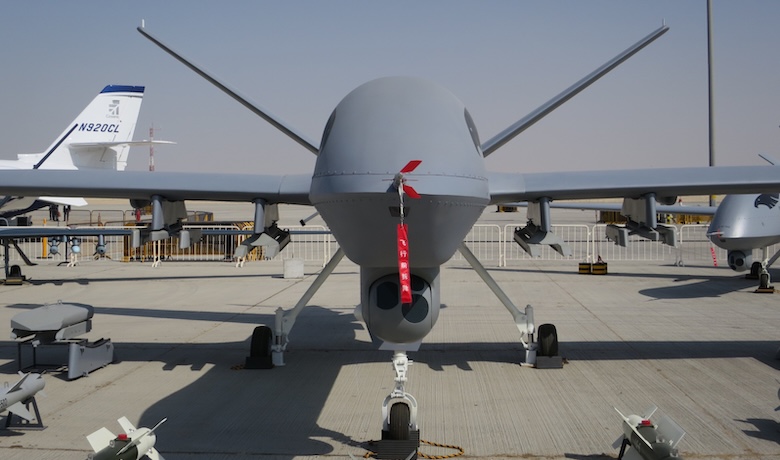
Parallel to its rapid military rise which has produced the world’s second-most-capable military by most metrics, China has become one of the world’s leading exporters of armed drones. Systems such as the Wing Loong II or the CH-4 have found ready markets across the Middle East, Africa, and beyond, at prices that are far below those of Western produced drones. The combination of low cost and advanced capabilities has fueled swift proliferation, underscoring the scale of China’s defense industry in the global market for autonomous combat platforms.
As a High Contracting Party to the Convention on Certain Conventional Weapons and its Protocols, China’s national legal environment governing drone export rests on a framework of defense laws and export controls. It implements oversight through the Export Control Law and related regulations that require State Council and Central Military Commission approval for military items and dual-use goods. Although China does not publish detailed Article 36 weapons review procedures comparable to those of many Western states, its National Defense Law formally affirms the obligation to observe relevant international treaties and agreements (art. 70), thereby incorporating China’s commitments under the law of armed conflict (LOAC), also known as international humanitarian law.
A dedicated emphasis on human control forms a central element of China’s public position. In international discussions on lethal autonomous weapons systems, Beijing has consistently maintained that such systems must remain under meaningful human control to comply with LOAC, while expressing support for a legally binding instrument only when conditions are mature. This stance coexists with Beijing’s goal of building a world-class People’s Liberation Army (PLA) by mid-century. Yet this formal legal framework and public stance on human control are embedded in a defense-industry structure that differs fundamentally from Western models.
Compliance by Design as a Benchmark
“Compliance by design” refers to the deliberate integration of LOAC obligations into the earliest stages of weapons research, development, and procurement so that principles such as distinction, proportionality, precaution, and humanity (the prohibition of superfluous injury or unnecessary suffering) are translated into technical features and auditable processes within the system architecture itself, rather than depending primarily on human judgment during employment. Western defense programs, in the United States for example, have developed iterative legal-review processes that integrate legal counsel, repeated testing for consistency with LOAC practices that serve not as normative ideals but as functional benchmarks against which the compliance-by-design practices of any peer competitor can be measured. The key question is whether LOAC considerations are embedded early, technically, and verifiably into the design and development lifecycle of weapons and dual‑use systems, rather than applied later as rhetorical or post‑design constraints. China has developed a distinct domestic discourse on the broader ethics of military AI, one that emphasizes sovereignty-based ethics, party primacy, and strategic ambiguity in international norm-building. This gap between Western and Chinese approaches reveals much about how different national systems translate international legal obligations into operational reality.
The Chinese Defense Industry and Its Legal-Operational Context
A small number of enormous State-owned enterprises dominates China’s defense production, among them the Aviation Industry Corporation of China, China North Industries Group Corporation, and China Electronics Technology Group Corporation. These conglomerates design and manufacture the full spectrum of PLA equipment, from fighter aircraft and armored vehicles to advanced electronics and autonomous systems.
Although these State-owned enterprises possess formal corporate structures and enjoy substantial operational autonomy in day-to-day management, they remain subject to tightly centralized control by both the State and the Chinese Communist Party. Embedded party committees shape their strategic priorities and ensure close alignment with party and national security objectives.
This top-down control is extended across the broader innovation ecosystem through the national strategy of military-civil fusion. Promoted as a top priority under Xi Jinping, it became a national strategy that deliberately breaks down barriers between civilian research institutions, commercial technology firms, and military production lines. Universities, private tech giants, and State laboratories all feed into a single, party-directed innovation pipeline. The result is a flow of dual-use technologies into military programs that has no close counterpart in Western contractor-government relationships. This centralized model stands in sharp contrast to the defense industries of the United States and Europe, where contractors generally retain greater operational autonomy, and legal reviews often involve external or independent counsel and iterative dialogue during development.
China’s domestic legal framework for LOAC compliance in the development and procurement of weapons systems rests on long-standing treaty obligations. Beijing ratified the Geneva Conventions in 1956, Additional Protocols I and II in 1983, and participates actively in the Convention on Certain Conventional Weapons. These commitments are implemented through the National Defense Law, the Export Control Law, and the 2024 Regulations on Export Control of Dual-Use Items, which require licensing for military and dual-use goods. China’s engagement with international law, however, remains selective. While it formally accepts many treaty obligations, Beijing has shown a willingness to reinterpret or disregard rules when they conflict with its strategic interests. Military standards and directives reference LOAC principles, yet the detailed weapons-review mechanisms equivalent to Article 36 reviews remain opaque to outside observers.
Regardless of such shortcomings, in theory, this top-down architecture could enforce uniform legal standards across the entire research-to-production chain. In practice, however, the fusion of civil and military sectors, combined with overriding strategic imperatives for accelerated capability development in AI and autonomy creates powerful incentives to favor speed and scale over the early stage, technically embedded, and auditable safeguards that define genuine compliance by design. The result is a system that formally acknowledges LOAC considerations in its weapons procurement and development processes, but often subordinates them to military priorities in ways that differ markedly from the iterative, collaborative processes typical of Western defense programs.
Case Studies and Emerging Technologies
High-priority programs illustrate how compliance by design falls short when measured against the benchmark of early, technical, and auditable LOAC integration. Two clear examples are armed unmanned aerial vehicles (UAVs) built for export and AI-enabled targeting systems.
Armed UAVs offer one of the most visible examples. Chinese manufacturers frequently highlight their precision guidance capabilities and stress that the platforms remain under human control. Export licensing under China’s dual-use regulations requires end-user and end-use certificates, and Chinese authorities routinely present this licensing and verification system as evidence of responsible export practices. Yet publicly available documentation provides little evidence that features such as automated target discrimination, abort functions, or auditable proportionality mechanisms were incorporated at the initial design stage. This raises a second-order legal question, whether exporting States bear responsibility when design-stage safeguards are insufficient but foreseeable misuse is likely. Western systems are not uniformly transparent or compliant either, but their review processes are comparatively more institutionalized and subject to external scrutiny. In practice, these platforms function primarily as advanced remotely piloted vehicles, with autonomy limited to navigation and basic targeting functions shaped more by market demand and operational requirements than by precautionary legal engineering.
AI-enabled targeting systems reveal deeper structural problems. Through military-civil fusion, the PLA has moved commercial-grade AI into command networks and sensor-fusion tools with remarkable speed. While Chinese statements at Group of Governmental Experts continue to stress meaningful human control, and some programs reportedly retain a human in the loop for final engagement authority, there is little publicly available information on formal legal vetting during the earliest design phases. The emphasis remains on sensor speed rather than on verifiable LOAC-compliant discrimination thresholds or proportionality metrics built into the software architecture itself.
China advanced autonomous capabilities comparable to those pursued in the U.S. Collaborative Combat Aircraft program. In March 2026, the China Electronics Technology Group Corporation publicly demonstrated the full operational cycle of its Atlas drone swarm operations system, in which a single operator directed up to 96 fixed-wing drones via AI-enabled “individual intelligence” algorithms that claimed to permit autonomous target discrimination, task allocation, formation adjustment, and precision strike. The Hongdu GJ-11 “Sharp Sword” stealth UAV has likewise progressed to operational testing, aimed to function as a loyal-wingman platform with high degrees of onboard autonomy for navigation, electronic warfare, and strike missions.
These programs illustrate the same strategic emphasis on collaborative autonomy that characterizes similar Western efforts. However, they occur within a far less transparent development ecosystem where early-stage, technically embedded, auditable LOAC features such as runtime assurance monitors, explainable decision logs, auditable proportionality metrics, or independent legal-review artifacts comparable to those being developed by U.S. companies are hard to find. While China signals adherence to LOAC in multilateral forums, operational realities subordinate compliance-by-design measures to the drive for technological edge and rapid fielding.
International Implications
The opaque nature of China’s compliance-by-design processes carries real risks for the future credibility of LOAC. Chinese armed drones have reached more than a dozen conflict zones from Africa to Asia, and are supplied to dozens of recipient States. As importing militaries receive weapons whose design stage safeguards cannot be audited, shifting legal responsibility downstream and complicating accountability when incidents occur, unverifiable legal architecture in these platforms has already been quietly weakening global norms of distinction and proportionality.
While the armed drones China has exported to date are not fully autonomous, they already incorporate significant autonomous features in navigation, target identification, and flight control. The real concern is that there is little reason to believe that Beijing will exercise meaningful restraint when exporting systems with higher degrees of autonomy in the future. Consequently, China’s approach risks normalizing a minimalist version of LOAC integration, one that treats legal obligations as post-design operator responsibilities rather than early engineering constraints.
Conclusion
China’s defense industry formally acknowledges LOAC obligations, yet those obligations are subordinated to the drive for rapid modernization under tight Party control. Public statements on human oversight and LOAC compliance coexist with opaque design processes that offer few verifiable safeguards. Measured against the benchmark of genuine compliance by design, the Chinese system produces selective and non-auditable integration. With China’s role as an exporter of armed drones and increasingly autonomous systems poised to grow further, the stakes of its selective and largely non-auditable compliance practices for global LOAC norms will become correspondingly greater.
Nevertheless, limited openings for engagement remain. Beijing’s dual-use export licensing regime and its repeated affirmations at the Convention on Certain Conventional Weapons of meaningful human control create narrow avenues for Track II dialogues and confidence-building measures focused on technical verification rather than broad normative convergence. Dialogues between Chinese and Western military lawyers on Article 36 review practices, increased transparency in dual-use export licensing, and professional exchanges on autonomous-weapons safety features could reduce uncertainty and build limited confidence. These steps are pragmatic rather than optimistic as they recognize that deeper differences will persist.
In the end, the practical force of LOAC amid great-power technological competition will depend in part on whether peer competitors embed legal norms from the very beginning of weapons development. Clear-eyed analysis of China’s model is therefore essential, not because convergence is likely, but because non-engagement guarantees further divergence.
***
Dr Gerald Mako is a Research Affiliate at the Cambridge Central Asia Forum at Cambridge University.
The views expressed are those of the author, and do not necessarily reflect the official position of the United States Military Academy, Department of the Army, or Department of Defense.
Articles of War is a forum for professionals to share opinions and cultivate ideas. Articles of War does not screen articles to fit a particular editorial agenda, nor endorse or advocate material that is published. Authorship does not indicate affiliation with Articles of War, the Lieber Institute, or the United States Military Academy West Point.
Photo credit: Mztourist via Wikimedia Commons
