

In Honor of Françoise Hampson – The Early Interface of IHL and Human Rights: Lessons from the Frontlines of Turkish Litigation
Editors’ note: This post is part of a series to honor Françoise Hampson, who passed away on April 18, 2025. These posts recognize Professor Hampson’s work and the significant contribution her scholarship made to our understanding of international law.
It is a well-observed truism that despite early decades of human rights jurisprudence from the European Court of Human Rights (ECtHR) addressing ongoing armed conflicts, the Court has studiously avoided opining on the interface of human rights and international humanitarian law (IHL). Yet, for scholar/practitioner Françoise Hampson, the ECtHR became an essential tool to address those conflicts and the human rights violations they produced.
Professor Hampson recognized the undisputed connection between these legal regimes in jurisdictions where States insisted there was no armed conflict in play and that the regular peacetime rules of human rights applied. She understood that human rights litigation provided an essential entry point to the regulation of the excesses of such conflicts and functioned as a means to force the application of international legal rules even as States sought to avoid them. Professor Hampson represented hundreds of applications and submitted dozens of third-party interventions at the ECtHR over several decades. For her work on cases concerning the Turkish Kurds, she was named human rights lawyer of the year in 1998 by Liberty, the national civil liberties organisation in the United Kingdom.
For Professor Hampson, the ECtHR was also the place where responsibility for civilian harm in war could be apportioned, and where the limits of human rights jurisdiction in war could be tested. She spearheaded decades of war and peace litigation at the Court, with a particular focus on the complex, low-intensity conflict between the Kurdistan Workers’ Party (PKK) and Turkey. The legal strategies and cases she pursued yielded multiple insights about the interface between human rights law and IHL, as well as exposing the outer edges of human rights law in preventing sustained and systematic violations during armed conflict or situations defined by a State as terrorism.
Professor Hampson particularly recognized a deep lacuna in accountability and standard-setting in the low-intensity conflict between Turkey and the PKK from the mid-1980s onwards. She grasped early on that the ECtHR could play a pivotal role in boundary setting on State responsibility, and that the Court could marshal the ambiguous status of the conflict towards, at a minimum, some human rights oversight. It was also a way to surface human rights violations, including penetrative sexual violence, that the ECtHR had avoided opining on since its establishment. Despite decades of strategic litigation, the Turkey/PKK conflict maintained its stubborn persistence. And despite the benefits of naming human rights violations through individually focused litigation, this approach alone could not capture the totality of the violations being waged by both State and non-State actors.
What We Learnt from Decades of Litigation on Low-Intensity Armed Conflict
Persistent internal conflict is always a harbinger of serious human rights violations. Moreover, democracies hotly contest whether low-intensity armed conflicts meet the threshold for Common Article 3 and Protocol II applicability. Ascertaining the nature, quantity, and form of such violence inside the State is a difficult exercise. It is precisely due to the disputable nature of a State’s control that States often brand forms of internal political violence as terrorism, stripping away any political legitimacy that might accrue to non-State actors.
These conflicts are defined by high-intensity emergency practices, the use of force by the military or militarized police, and by persistent violence. The nature and status of that violence is contentious. States such as Turkey have argued both domestically and internationally that they experienced low-level violence, below the threshold to trigger IHL’s applicability. Turkey claimed that human rights law, as modified by the privilege of derogation, was the appropriate and applicable legal regime to frame and understand the State’s action. Additionally, Turkey claimed that the State should have a wide margin of appreciation in its executive and military decision-making. Some describe such low-level violence as “internal disturbances and tensions,” passing under the radar screens of IHL.
Like Turkey, States experiencing internal violence and wishing to avoid the application of IHL saw this formula as a means of deflecting scrutiny and avoiding the application of humanitarian norms. They were successful to a point, but the strategy led by Professor Hampson of taking case after case to the ECtHR, calling out Turkey’s decades-long practice of hiding behind derogations and emergency justifications, ultimately resulted in a tipping point away from State deference in derogation cases. It also produced a robustness in ECtHR jurisprudence about frontline armed conflict violations, creating the basis for trenchant pushback against Russia and other States engaged in serious human rights violations in the name of countering terrorism in later years.
The persistence of Professor Hampson’s litigation strategy meant that the ECtHR was also forced to contend with institutional memory in derogation cases and conflict framing. While the fundamental rule of an international human rights court is to treat each complaint as an independent hearing for the State and the party bringing the complaint, this rule met its inevitable limits in the Turkish litigation Professor Hampson pursued. The sheer volume of cases and litigants meant that the implications of systematic abuse and rights violations ultimately shaped the caselaw and the boundary between human rights law and IHL.
As Professor Hampson and her colleagues noted in 1997,
[I]n over 60 cases from Southeast Turkey declared admissible, the Commission has found in each case that the applicants did not have an adequate remedy at their disposal to address their particular complaint. However, the Commission has also always held that as the individual applicants on the particular facts of their complaints had no remedy available to them, the question of a systematic failure to provide domestic remedies need not be addressed. The Commission’s approach … nevertheless prompts the question of how many cases are necessary in which applications, raising essentially similar complaints, are admitted by reason of lack of effective remedies, before the conclusion is reached that there is a practice of violation of the right to an effective domestic remedy?
Professor Hampson’s steady and painstaking commitment to taking dozens of these cases from Turkey delivered tangible results. These cases had unmistakable similarities, all raising substantially similar allegations against the Turkish security forces, and all also furnishing the Court with external evidence accumulated by prestigious non-governmental organizations and international organizations. The unmissable conclusions pointed to systematic abuse and violations of rights that simply could not be explained away by the normal and acceptable activities of a democracy under stress. Rather, the cases illuminated an increasingly repressive State misusing emergency powers to expand and cover for military expediency and containment.
The Court’s discomfort grew over time, tracking the increased visibility and consistency of the cases coming to Strasbourg. The result ultimately led to less deference to the State, findings of systematic violations of human rights, and, for many observers, the unavoidable need for a parallel applicability of IHL to the situation on the ground. The Court got serious about questioning the validity of Turkish derogations and became more trenchant in its findings about the responsibility of the Turkish State for a particular breach. For example, while acknowledging that terrorist offences presented meaningful difficulties for the State, the Court incisively held in the case of Sakik and Others in 1997 that,
This does not mean, however, that the investigating authorities have carte blanche under Article 5 to arrest suspects for questioning, free from effective control by the domestic courts and ultimately, by the Convention supervisory institutions, whenever they choose to assert that terrorism is involved.
Outcomes and Reflections
While human rights courts are generally not in the business of making assessments about the status of a conflict or questioning the bona fides of the State’s legitimacy as it is adjudicating on alleged human rights violations, Professor Hampson’s Turkish strategy forced change and new judicial positioning. The Court set limits and defined the Turkish government’s responsibility for serious human rights violations in cases that ranged from village destruction, home destruction, pervasive civilian targeting, enforced disappearances, systematic torture, extrajudicial killing, to widespread targeting of opponents, both real and perceived. Professor Hampson and her co-counsel celebrated the wins but were always realistic about the limits of these judicial decisions.
These cases were the tip of the iceberg in terms of the scale and scope of violations in southeast Turkey from 1984 onwards. Fact-finding on the ground was undulatingly hard, victims experienced retaliation, and the emergency intensified over time. The core problem of comprehensively regulating State behavior in low-intensity armed conflicts persisted even after successes in particular cases in Strasbourg. As a lesson, while human rights law can play a critical role in identifying human rights violations in low-intensity armed conflicts, it neither ends the fighting nor fully addresses the scale, scope, and logic of the violence. Achieving those goals ultimately requires addressing the root causes of conflict, including the thorny question of self-determination, and resolving political questions by negotiation, compromise, and accommodation. All of these ends remain on the distant horizon in Turkey today, despite decades of principled legal work by Françoise Hampson. As a scholar and practitioner who benefited from her guidance and kindness from early early in my career, I and many others, are indebted to her lifetime of work and collegiality.
***
Professor Fionnuala Ní Aoláin is concurrently Regents Professor and Robina Professor of Law, Public Policy and Society at the University of Minnesota Law School and Professor of Law at the Queens University, Belfast, Northern Ireland.
The views expressed are those of the author, and do not necessarily reflect the official position of the United States Military Academy, Department of the Army, or Department of Defense.
Articles of War is a forum for professionals to share opinions and cultivate ideas. Articles of War does not screen articles to fit a particular editorial agenda, nor endorse or advocate material that is published. Authorship does not indicate affiliation with Articles of War, the Lieber Institute, or the United States Military Academy West Point.
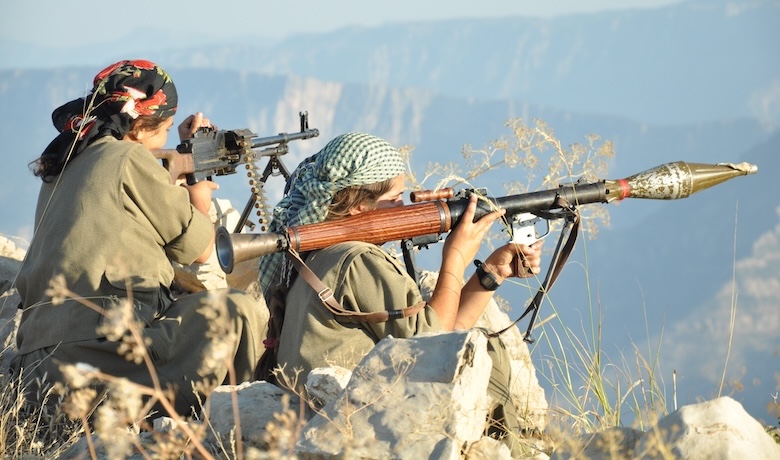
Photo credit: Kurdishstruggle via Wikimedia Commons
RELATED POSTS
by Sean Watts
October 6, 2025
–
by Noam Lubell
October 6, 2025
–
Fact-Finding in Law of Armed Conflict Investigations
October 10, 2025
–
Calibrating the Balance Between Military Necessity and Humanity in LOAC Practice
October 17, 2025
–
Teaching and Operationalising LOAC
October 28, 2025
–
Artificial Intelligence in Military Detention
by Jelena Pejic
November 3, 2025
–
The Persistent Challenge of IHRL Bodies’ Review of Battlefield Situations
by Yuval Shany
November 10, 2025
–
November 25, 2025
