

The Evolving Architecture of the International Law of Military Operations: Mapping the Future of Legal Research in Armed Conflict
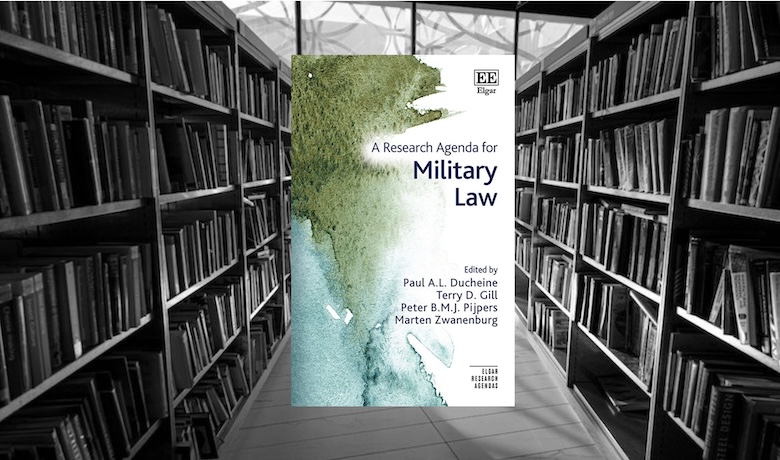
International law governing military operations is undergoing a period of profound transformation. Rapid technological innovation including artificial intelligence (AI), the expansion of conflict into new operational domains such as cyberspace and outer space, the growing influence of non-State actors, and the strategic instrumentalization of legal norms have reshaped the field. A systematic overview of the current legal framework, the intellectual and normative challenges that will define its future development, and a forward-looking research agenda for the international law of military operations (ILMO) are the elements that make up A Research Agenda for Military Law, edited by the authors of this post.
Defining Military Law in an International Context
The concept of “military law” in the context of our volume, refers to the body of international law regulating the use of armed force and related coercive measures by States and other actors in situations of armed conflict and in “grey zone” environments that fall short of full-scale war.
This body of law encompasses several interlocking sub-disciplines. At its foundation lies the jus ad bellum, governing when force may lawfully be used, as recognized in the framework of the UN Charter. Closely connected is the jus in bello, or international humanitarian law (IHL), which regulates how force is used once armed conflict exists. Increasingly central is international human rights law (IHRL), particularly in its extraterritorial application during military operations. Additional regimes—including the law of neutrality, the law of the sea, space law, and legal frameworks governing cyberspace—further complement but also complicate the regulatory landscape.
In the volume, we conceptualize the international law of military operations as a hybrid but coherent field: not a new branch of international law per se, but a functional framework integrating multiple legal regimes to regulate military operations across domains and conflict thresholds. This integrative perspective responds to a reality in which armed conflict no longer unfolds solely on land battlefields but across maritime routes, orbital space, digital infrastructure, and transnational information environments.
Law in an Era of Technological Acceleration
One of the most striking themes running through the volume is the accelerating interaction between military technology and legal regulation. Cyberspace capabilities, artificial intelligence (AI), autonomous systems, and space-based assets are not peripheral developments; they are rapidly becoming central to contemporary and future warfare.
In particular, AI raises complex questions about accountability, compliance with IHL principles such as distinction, proportionality and precaution, and the distribution of responsibility between human operators, commanders, and developers. While public discourse often focuses on “killer robots,” the deeper legal challenge lies in the integration of AI-driven decision-support systems, targeting algorithms, and data analytics into operational planning and execution. As these systems become more widespread, legal frameworks must address not only Additional Protocol I, Article 36 weapons review processes but also broader systemic risks to compliance and transparency.
Similarly, cyberspace has emerged as both an operational domain and a strategic arena for competition below the threshold of armed conflict. Large-scale cyber operations—such as those witnessed in the ongoing war in Ukraine—illustrate how digital infrastructure can become both a target and a tool of warfare. Yet the legal classification of cyber operations, the threshold for use of force, and the interaction between sovereignty, due diligence, and collective defense remain contested. Military operational law must grapple with whether existing rules are sufficiently adaptable or whether normative development is required.
Outer space presents another frontier. While governed by longstanding treaties emphasizing peaceful use, space is increasingly integral to military communications, navigation, intelligence, and targeting. The prospect of hostilities affecting space assets—whether military or dual-use—raises difficult questions about the application of jus ad bellum and IHL beyond Earth’s atmosphere. The interplay between space law and the law of armed conflict exemplifies the fragmentation and overlap that characterize modern military law.
Grey Zones and Hybrid Conflict
Contemporary strategic competition often unfolds in ambiguous spaces between peace and armed conflict (or war). “Hybrid” or “grey zone” activities—including cyber intrusions, disinformation campaigns, economic coercion, and proxy operations—challenge traditional binary distinctions between armed conflict and peacetime rivalry.
From a legal perspective, these scenarios test the adaptability of existing frameworks. If conduct does not meet the threshold of armed conflict, IHL may not apply; yet the activity may still involve coercive or destabilizing measures that implicate obligations related to sovereignty, non-intervention, or human rights. The international law of military operations must therefore operate across a continuum of competition, recognizing that legal rules can both enable and constrain State responses.
The book accentuates that legal uncertainty in these contexts can be exploited. Ambiguity surrounding thresholds, attribution, and applicable regimes may create opportunities for States to evade responsibility or justify aggressive conduct under contested interpretations. Thus, research must not only clarify doctrinal questions but also anticipate strategic uses—and misuses—of legal ambiguity.
Fragmentation and Systemic Integration
Not least as a result of the trends mentioned above, a recurring concern is the fragmentation of international law. Military operations today are regulated simultaneously by IHL, IHRL, the law of neutrality, environmental law, maritime law, space law, and other specialized regimes. These bodies of law were not designed as a unified system, yet they increasingly operate in overlapping factual scenarios.
The traditional focus of fragmentation debates has been the relationship between IHL and IHRL. However, the volume highlights that the challenge extends beyond these regimes. For example, digital rights protection intersects with cyber operations; environmental norms intersect with targeting decisions; and space law intersects with the regulation of force in orbit.
To address these tensions, we advocate methodological tools such as systemic integration and harmonization. We reject a view under which the maxim of lex specialis derogat legi generali leads to the prevalence of an entire regime over another. Rather than privileging one regime at the expense of others, legal interpretation should seek coherence and mutual reinforcement wherever possible. The emerging concept of the “international law of military operations” serves as a frame of reference for this integrative approach, encouraging scholars and practitioners to view diverse legal obligations as components of a broader regulatory architecture.
Non-State Actors and the Weaponization of Law
Modern armed conflict increasingly involves non-State actors including armed groups, private entities, and even technology companies. The involvement of these actors may be regarded as direct participation in hostilities as they are the providers of critical infrastructure, or influential stakeholders in cyber and information domains. Their status as “duty bearers” under international law remains contested, particularly outside classic non-international armed conflicts.
At the same time, States have begun to use legal mechanisms strategically in pursuit of geopolitical objectives. International litigation before courts and tribunals can shape public narratives, mobilize diplomatic support, and exert pressure on adversaries. This phenomenon—sometimes described as the “weaponization” of law—demonstrates that law itself has become part of the strategic environment.
Such developments raise normative concerns. If legal institutions are instrumentalized, their perceived neutrality and legitimacy may erode. Conversely, judicial proceedings can reinforce accountability and clarify contested norms. Research must therefore examine not only doctrinal validity but also the strategic function of law in contemporary conflict.
Why Legal Research Still Matters
Given the persistence of violations and the apparent willingness of some actors to disregard legal constraints, one might question the value of continued legal research in this field.
Our authors directly confront this skepticism and argue that the existence of violations does not negate the relevance of law. On the contrary, recognized standards are a prerequisite for identifying breaches, seeking redress, and promoting deterrence. Law is not a panacea for the political and structural causes of armed conflict; rather, it is one instrument among many—diplomatic, economic, informational, humanitarian—designed to mitigate violence and guide State behavior.
From a utilitarian perspective, military law assists commanders in mission accomplishment by clarifying permissible options and reducing unintended harm. Clear legal guidance can enhance operational effectiveness, conserve resources, and limit collateral damage. Beyond operational utility, law contributes to conflict prevention and crisis management by structuring expectations and signaling boundaries. Finally, it provides essential guardrails to protect civilians, civilian objects, and the natural environment during hostilities.
A Research Agenda for the Future
Looking ahead, several themes emerge as central to future scholarship. First, the regulation of emerging technologies—particularly AI—will demand sustained attention, including issues of accountability, transparency, and human control. Second, domain-specific research on cyberspace, outer space, and maritime operations will be crucial as strategic competition intensifies. Third, methodological innovation will be required to manage fragmentation and ensure coherent interpretation across legal regimes.
Equally important is a normative dimension: identifying where existing law may require clarification, adaptation, or development to keep pace with technological and geopolitical change. This task must balance stability with responsiveness, preserving core humanitarian principles while recognizing new operational realities.
In an era of accelerating change and contested norms, the international law of military operations stands at a crossroads. The research agenda outlined in our volume does not offer definitive answers, nor does it claim to resolve every controversy. Instead, it provides a structured framework for inquiry—one that acknowledges uncertainty, anticipates future challenges, and reaffirms the enduring importance of legal regulation in the most consequential domain of human activity: the use of armed force.
If the character of warfare continues to evolve, so too must the law—and the scholarship that sustains it.
***
Brigadier-General Paul Ducheine (Army Legal Service) is the Deputy Director of the Research Division of NATO’s Defense College (Rome).
Terry D. Gill is Professor Emeritus of Military Law at the University of Amsterdam, having held the chair from September 2001 until September 2020.
Brigadier General Peter Pijpers is a Professor of Cyber Operations and Vice-Dean of Education at the Faculty of Military Sciences of the Netherlands Defence Academy. He is also affiliated to the Amsterdam Center of International Law, University of Amsterdam.
Marten Zwanenburg is Professor of Military Law at the University of Amsterdam and at the Faculty of Military Sciences of the Netherlands Defence Academy. He has previously worked as a legal counsel for the ministries of Defence and Foreign Affairs of the Netherlands.
The views expressed are those of the authors, and do not necessarily reflect the official position of the United States Military Academy, Department of the Army, or Department of Defense.
Articles of War is a forum for professionals to share opinions and cultivate ideas. Articles of War does not screen articles to fit a particular editorial agenda, nor endorse or advocate material that is published. Authorship does not indicate affiliation with Articles of War, the Lieber Institute, or the United States Military Academy West Point.
Photo credit: Pexels, Edward Elgar Publishing
