

Lieber Studies Armed Conflict in the Indo-Pacific Region Volume Series – Introduction
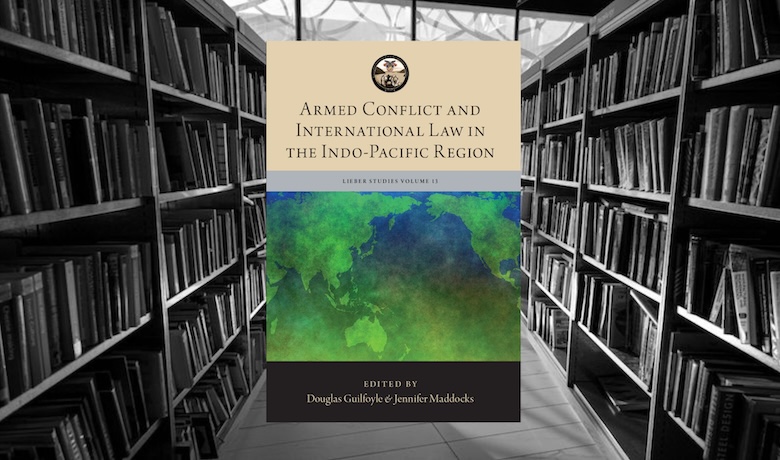
In recent years, the Indo-Pacific has emerged as a principal arena of strategic competition. The region has witnessed intensified military modernization and rivalry among major powers, often involving hybrid tactics, maritime grey zone operations, and influence activities in the information environment. States are expanding and integrating capabilities across the land, sea, air, cyber, and space domains. The result is a complex theatre of operations in which existing tensions, including those concerning Taiwan, could escalate into large-scale conflict marked by legal ambiguity on crucial operational questions. These questions are the focus of our recently published book, Armed Conflict and International Law in the Indo-Pacific Region, the thirteenth volume of the Lieber Institute’s Lieber Studies Series.
As military planners and legal advisers confront integrated operational environments, the volume examines how international law—particularly, but not exclusively, the law of armed conflict (LOAC)—may apply to future large-scale combat operations in the Indo-Pacific. It considers the legal frameworks governing such hostilities, as well as related questions including the targeting and protection of critical infrastructure such as submarine cables, the treatment of combatants and civilians in a potential conflict over Taiwan, the implications of neutrality for non-belligerent States, and the impact of emerging technologies shared through arrangements such as AUKUS (the security partnership announced in 2021 between the United States, the United Kingdom, and Australia).
As a preview, Articles of War will publish four posts adapted from chapters of the book. To introduce this series, we provide an overview of the volume’s broad themes before highlighting the posts that will follow.
Themes
Armed Conflict and International Law in the Indo-Pacific Region groups the work of our seventeen excellent contributing authors into four parts. Part I addresses overarching challenges in contemporary conflict. It begins with a chapter assessing the practical implications of large-scale combat operations in the Indo-Pacific, including risks such conflict may pose to the parties’ respect for LOAC. It then focuses on reducing the human cost of large-scale military operations, setting out key considerations for those preparing for and conducting them. Part I concludes with an assessment of neutrality law, which will be critical in any Indo-Pacific conflict in order to protect legitimate neutral commerce and support regional economic stability.
A further feature of any Indo-Pacific conflict is the likelihood it will take place across multiple operational domains: land; sea; air; space; cyber; and the information environment. Operations may combine kinetic force with non-kinetic tools such as cyber disruption, electromagnetic interference, and information operations. Even operations ostensibly conducted in a single traditional domain, such as the sea or air, are likely to rely on cyber and space capabilities for communications and intelligence, surveillance, and reconnaissance (ISR). Such integration may raise novel legal and coordination issues, including cross-domain targeting and the use of emerging technologies.
Part II therefore focuses on legal challenges in multi-domain operations. It contains six chapters addressing issues arising in the air, space, cyber, maritime, and information domains. Given the geography of the Indo-Pacific and the centrality of the sea to military operations in the region, two chapters address the maritime domain, examining the law applicable to auxiliary vessels in naval operations and the legal regime protecting submarine cables and pipelines during armed conflict. This Articles of War series will feature posts from two contributors to Part II, Angeline Lewis and Aurel Sari, who address issues arising in the air and information domains.
Part III turns to alliances, partnerships, and capability development. Longstanding defense agreements such as ANZUS, the Five Powers Arrangements, and the U.S. bilateral treaty network are key to any discussion of international law and armed conflict in the Indo-Pacific region. Professor Erika de Wet’s chapter introduces this part through a comparative survey of the alliances underpinning the region’s security architecture. She also contributes a post to this series, outlined below. Part III then examines the defense relationship between the United States and the Philippines and concludes with two chapters on AUKUS. These chapters address legal issues arising from AUKUS’s two main “pillars”: Australia’s acquisition of nuclear-powered submarines; and the development of advanced military capabilities and interoperability between the three nations.
The final part of the volume, Part IV, is a case study concerning potential conflict over Taiwan. It begins with two chapters addressing the foundational question of whether Taiwan is a State. This question is not merely academic. The conclusion reached has significant implications for Taiwan’s right to use force in self-defense, the right of other States to act in collective self-defense of Taiwan, and—if China is a belligerent—the status of combatants who fall into enemy hands. Professor Emily Crawford addresses questions related to detention in her chapter and in a post for this series. Part IV then concludes with a sobering analysis of U.S. constraints on the use of nuclear weapons in any conflict over Taiwan.
Taken together, the contributions illuminate how legal frameworks intersect with operational realities and strategic choices across a wide spectrum of issues that may arise in an Indo-Pacific conflict.
The Series
This Articles of War series features four posts, in addition to this introduction. The first, by Air Commodore Angeline Lewis, explores challenges related to the air domain in any Indo-Pacific conflict. Central to this analysis is the region’s geography, which includes several archipelagic States. How those States interpret rights of archipelagic sea-lane passage through their waters and airspace will significantly affect how parties to a conflict may conduct operations. Lewis highlights Indonesia’s wawasan nusantara doctrine, a unified vision of land and sea, which is not entirely consistent with the non-suspendable passage regime enshrined in the UN Convention on the Law of the Sea.
Professor Aurel Sari addresses the information domain, highlighting that LOAC itself is an area of strategic competition. Allegations of LOAC violations during warfare delegitimize opponents at low cost, spreading quickly and causing damage regardless of whether they are ultimately sustained. In any conflict in the Indo-Pacific region, China is likely to deploy LOAC narratives as an instrument of information warfare under its Three Warfares Doctrine. Sari uses the South China Sea as a case study to demonstrate Beijing’s willingness to sustain coordinated lawfare operations, arguing that States should treat LOAC compliance not only as a legal obligation but also as a component of their operational planning and strategic communication.
Professor Erika de Wet outlines the five mutual defense arrangements, concluded between 1951 and 1971, that still anchor the security architecture of the Indo-Pacific. While all five alliances demonstrate striking durability, they also raise unresolved questions of treaty interpretation. De Wet examines ambiguities surrounding the nature of the assistance obligations under the respective treaty frameworks, as well as their geographic scope. In addition, she highlights some of the challenges arising from the overlapping security arrangements that could come to the fore in the event of conflict in the region.
In the final post, Professor Emily Crawford addresses the thorny issue of detention in the context of a potential conflict over Taiwan. At the heart of this issue is conflict classification. If Taiwan is not a State, then any action by China to bring Taiwan under mainland control would amount to a non-international armed conflict, meaning detainees would not be entitled to prisoner-of-war protections. After setting out the implications of classification, Crawford considers whether the conflict could become international in character and what this would mean for detainees. She further highlights that, even in an international armed conflict, questions would remain concerning the status of detained members of Taiwan’s armed forces. If China conducts the detentions, these individuals are likely to be deemed nationals of the detaining power, leaving their entitlement to prisoner-of-war status in doubt.
Conclusion
Armed Conflict and International Law in the Indo-Pacific Region is intended not simply as a doctrinal survey of topical issues but as a contribution to legal thinking on the application of LOAC to any conflict in the Indo-Pacific. Its purpose is to ask how LOAC, and related bodies of international law, might shape and be shaped by the choices States may face in this region. The contributors seek to provide tools for legal advisers and policy makers considering legal questions likely to arise in complex operational environments, while also identifying points at which law may become a site of contest, persuasion, and legitimation.
It is in the Indo-Pacific that some of the most difficult and consequential legal questions of modern conflict may be tested. These include whether Taiwan is a State for the purposes of international law; how cyber and space operations fit within existing legal paradigms; whether and how neutrality law should evolve; how far mutual defense obligations extend in ambiguous scenarios; and the limits within which States may seek to reinterpret elements of the law to protect or advance strategic interests. These are not hypothetical issues. They will bear directly on the conduct of future operations in the Indo-Pacific and elsewhere, with potentially global ramifications.
We hope that the volume, and this Articles of War series, will help shed light on these issues by bringing together a range of perspectives on international law and its application in the Indo-Pacific region. Finally, we wish to express our gratitude to all the contributors to the volume as well as to the West Point Department of Law and Philosophy and its Lieber Institute for Law and Warfare for assistance in preparing the volume and for a superb workshop organized and hosted to support it at the Academy.
***
Jenny Maddocks is a Lecturer in International and Operational Law at the University of Reading.
Douglas Guilfoyle is Professor of Law and International Security at the University of New South Wales Canberra.
The views expressed are those of the authors, and do not necessarily reflect the official position of the United States Military Academy, Department of the Army, or Department of Defense.
Articles of War is a forum for professionals to share opinions and cultivate ideas. Articles of War does not screen articles to fit a particular editorial agenda, nor endorse or advocate material that is published. Authorship does not indicate affiliation with Articles of War, the Lieber Institute, or the United States Military Academy West Point.
Photo credit. Pexels, Oxford University Press
