

Modern Attack Balloons and the 1907 Hague Balloons Declaration
In the days leading up to the 1812 Battle of Borodino, Russia devised a plan to float a large shark-shaped hot air balloon over French forces to drop explosives. The balloon could not be made ready in time for the battle. When later ready, it collapsed as it left its hanger. The final version only flew at a height of 12-13 meters, well within the range of enemy fire.
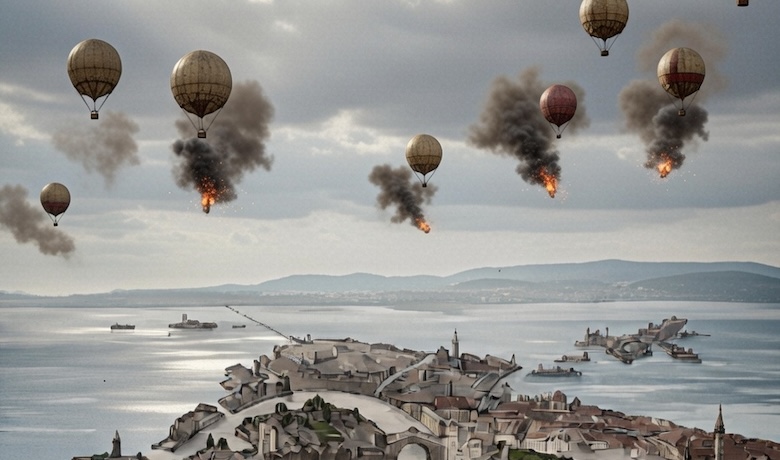
It wasn’t the last balloon fiasco. In 1849, Austria besieged the city of Venice which had gained independence a year earlier. The Austrians attempted to end the siege with an attack using paper balloons filled from suspended straw fires and carrying explosives. The balloons did minor damage to Venice, but some blew back over Austrian forces where they exploded to the cheers of the Venetians.
Owing in part to such ineffectiveness, these contraptions led States to adopt legal prohibitions on attack balloons during the two Hague Peace Conferences that bracketed the transition into the twentieth century.
Fast forward to the twenty-first century, however, and the concept of using non-maneuverable attack balloons appears to have suddenly caught wind. During its ongoing defensive war, Ukraine has sent balloons with GPS triggers, armed with explosives, and carrying drones to attack Russia. These innovative balloons are low-cost, they may be militarily effective, and they certainly represent a challenge for Russia. But because of a 120-year-old treaty, their wider adoption presents an interesting international law question for some States, like the United States.
1899 Hague Declaration on Discharging Projectiles and Explosives from Balloons
In 1899, State Parties gathered for the International Peace Conference at The Hague to discuss dispute resolution principles, revisions to the laws of war, and limitations on weapons. They ultimately agreed to three conventions: one on dispute settlement; another on maritime warfare; and the final on land warfare. They also agreed to three declarations restricting weapons: one on expanding bullets; one on the use of projectiles exclusively for carrying asphyxiating gases; and a five-year prohibition on “the launching of projectiles and explosives from balloons, or by other new methods of similar nature.” The prohibited weapons were generally viewed as having humanitarian concerns and no significant military utility.
According to the New York Times, a U.S. delegate, Captain Crozier, “recognized that the dirigibility and accuracy of travel of balloons were very uncertain” at the time. He was concerned “that explosives, instead of falling among the forces of the enemy, might drop among non-combatants[.]” This sentiment is reflected in the conference proceedings (here and here). Crozier’s official report explained,
[B]alloons, as they now exist, form such an uncertain means of injury that they cannot be used with any accuracy; that the persons or objects injured by throwing explosives from them may be entirely disconnected from any conflict which may be in process, and such that their injury or destruction would be of no practical advantage to the party making use of the machines.
However, Crozier also recognized that the technology would likely improve and proposed a five-year term limit for the rule.
Interestingly, A. Pearce Higgins, in his commentary to the Hague Peace Conferences, states that Crozier made a “strenuous attempt … to make the Declaration one of a permanent character[.]” This contrasts with Dr. M. Royce’s study of the conferences where he writes that the 1899 American delegation was “perhaps the most active in opposing [the] permanent prohibition of aerial bombardment[.]”
1907 Hague Declaration on Discharging Projectiles and Explosives from Balloons
By the time of the second Hague Peace Conference in 1907, technology had indeed advanced. Dirigibles (steerable airships) had arrived and airplanes were rapidly developing. They were now platforms for effective weapons and could not be readily discarded. Some States, like Great Britain and smaller nations feared aerial bombardment, while larger powers saw no difference between aerial bombardments and other means.
France was the leading air power at the time and opposed extension of the 1899 Declaration. Germany also had a significant fleet of airships and Russia was growing its program rapidly. Great Britain and the United States, on the other hand, had negligible military air programs.
With this split, France offered a proposal now reflected in Article 25 of the Hague Convention IV Regulations, The Law and Customs of War on Land. The 1899 language had stated, “The attack or bombardment of towns, villages, habitations or buildings which are not defended, is forbidden.” Updated Article 25 now reads, “The attack or bombardment, by any means whatsoever, of towns, villages, habitations or buildings which are not defended, is forbidden.” The change reflects the insistence of the air power advocates not to distinguish between means of delivery.
As for the Balloons Declaration itself, 27 of 44 States adopted an updated version, now the 1907 Hague Declaration XIV, addressing the use of balloons or “other methods of a similar nature.” It reads in part,
The Contracting Powers agree to prohibit, for a period extending to the close of the Third Peace Conference, the discharge of projectiles and explosives from balloons or by other new methods of a similar nature.
The present Declaration is only binding on the Contracting Powers in case of war between two or more of them.
It shall cease to be binding from the time when, in a war between the Contracting Powers, one of the belligerents is joined by a non-Contracting Power.
Note that Declaration XIV does not expire until a Third Hague Conference takes place. It did not take place as hoped, owing to the outbreak of the First World War. Nor did it ever take place after. The States that declined to sign the Declaration are significant and include Germany, Chile, Denmark, Spain, France, Guatemala, Italy, Japan, Mexico, Montenegro, Nicaragua, Paraguay, Romania, Russia, Serbia, Sweden, and Venezuela.
The Second World War
During the Second World War, France, Russia and the Axis powers were not State parties to the 1907 Balloons Declaration. Thus, by its terms, it did not apply to any other belligerent party, including the United States.
Still, the U.S. Army’s 1940 Field Manual on the Rules of Land Warfare included language from the 1907 Declaration. But it explained,
This rule may be said to be of comparatively slight value because it has been ratified by only two of the great powers, namely, the United States and Great Britain, and because its principal object is substantially accomplished by [the Hague Regulation] article 25 … prohibiting bombardment of undefended places. It is not regarded as imposing any restriction upon the use of modern military aircraft against armed forces or defended places.
At that time, the United States generally followed treaties even when an adversary was not a State party. This would not be the case for the 1907 Balloons Hague Declaration. To eliminate any ambiguity surrounding its inapplicability during the war, the U.S. War Department issued Circular Number 136 in May 1942, stating that the Declaration “is not binding and will not be observed.” By 1943, the U.S. Army’s Judge Advocate General’s School textbook on the law of land warfare characterized the War Department’s Circular as meaning that the United States had “expressly denounced” the Declaration.
While the United States did not employ attack balloons in the Second World War, other nations certainly did. When tethered barrage ballons blew away in a storm during the Battle of Britain, the British discovered that the cables attached to the balloons became caught in power lines, causing power outages in Denmark, Sweden, and Finland. This lesson generated Operation Outward which sent surplus weather balloons with wires attached into Germany to disrupt electrical power. The attacks caused havoc with German electrical lines. One 1942 attack caused over $4 million in damages and extended power outages in Leipzig. Over half the balloons were also sent with incendiaries in the hope of causing forest or farm fires. However, the balloons often landed in neutral countries like Sweden or Switzerland. One balloon caused a train collision in Sweden. Another caught an ill wind and knocked out power in Ipswich. Operation Outward ended in September 1944.
Balloon use was not confined to the European theater of war. In November 1944, Japan employed “Fu-Go” weaponized balloons against its North American enemies. These balloons carried incendiary and antipersonnel bombs designed to start fires and spread terror in the United States. The majority of the 9,000 Fu-Go “wind-ship weapons” never reached North America. Those that did came down randomly in locations as widespread as the Aleutian islands, Saskatchewan in Canada, northern Mexico, and 26 states including California, Kansas, Iowa, Nebraska, and Michigan. Fortunately for North American populations, the Fu-Go attacks took place in winter when conditions were unfavorable for massive fires.
The only lethal Fu-Go bomb killed a pregnant woman and five Sunday school students on a picnic and fishing trip in Oregon. Japan’s propaganda, however, claimed that major fires had started and that 500 Americans had been killed or injured. Japan’s information campaign was designed to inspire terror and divert their adversary’s military forces toward domestic air defense.
Because the Fu-Go bombs could not be directed at specific areas, let alone enemy combatants, these weapons have been classified as indiscriminate. The same conclusion could be drawn concerning the Allied balloons used in Operation Outward. In fact, their purpose was to attack indiscriminatly.
Ukraine’s Modern War Ballons
According to reports, Ukraine has sent balloons armed with explosives and attack drones, also known as aerostats, into Russia. Their ordinance appears to vary. Forbes identified bombs approximately 81-82mm in size. The 82mm variant is a mortar round classified as a “6.5-pound fragmentation/blast weapon.” In 2025, Ukraine used such aerostats to attack Russian oil refineries as well as other targets in Moscow and Ryazan. In December of last year, these balloons carried attack drones as far as Moscow.
The balloons are not only inexpensive. They can be dropped by airplanes, they can travel at extremely high altitudes, and they have ranges in the hundreds if not thousands of miles. Like bombs, drones launched from the balloons may travel almost vertically to their targets, making interception a nightmare. As the United States learned from incursions by Chinese spy balloons in 2023, these aerostats can be hard to detect as well. On the other hand, both Russia and Ukraine have added radar reflectors to their balloons making them cheap decoys to confuse defenders during attacks.
Based on pictures of the Ukrainian aerostats recovered in Russia, they appear to have GPS modules, Bluetooth controllers, and tracking devices. This technology theoretically enables Ukraine to release ordinance on command. The aerostats, however, do not appear to be maneuverable. The Russian MASH news agency claims, the ballons are “Weapons … intended for terror” and are “designed to create fear among the Russian population.” Of course, a weapon unable to strike military objectives and designed primarily to create terror in a civilian population would be unlawful.
While general law-of-war rules for attack and targeting apply to the conflict and the means and methods used, the specific prohibition on the discharge of projectiles and explosives from balloons does not because neither Russia nor Ukraine is a State party to the 1907 Declaration on Balloons.
Implications of the 1907 Balloon Declaration on State Parties’ Use of GPS Triggered Attack Balloons
But both the United States and China are parties to the 1907 Balloon Declaration. Would it apply to an armed conflict between them, assuming no other non-party State participated? Neither China nor the United States has formally withdrawn from the Declaration.
Nonetheless, the U.S. DoD Law of War Manual does not list the 1907 Balloon Declaration under “Law of War Treaties to Which the United States Is a Party,” but rather lists it among “Examples of Treaties or Documents of Mainly Historical Value.” It may also be said the treaty has been in a state of desuetude as its terms have never been operative. Conflicts since 1907 have involved non-signatories and attack balloons, until Ukraine demonstrated otherwise, have not been viewed as militarily effective weapon systems.
But treaties are not extinguished simply because their terms have not been invoked, even if for a century or more. The customary rule reflected in the Fourth Restatement of the Foreign Relations Law of the United States § 313 is that a treaty may be terminated in accordance with the provisions of the treaty or after consultation and consent by all State parties. This rule is also reflected in Article 54 of the Vienna Convention of the Law of Treaties.
The treatment of the 1907 Balloon Declaration by the People’s Republic of China (PRC) may be impossible to know until such a hypothetical conflict arises. The PRC examines the validity of pre-communist era treaties by determining whether the formal procedures to conclude it treated the parties equally and whether the content of a treaty undermines China’s sovereignty (see here, here, here, and here). In the case of the Balloons Declaration, following the Boxer Rebellion of 1899-1901, China would have been considered a weak State for such purposes in 1907.
If the PRC’s position is that it is not bound by the 1907 Balloon Declaration, then the United States would not be bound by it should a conflict arise. However, the PRC may maintain ambiguity on the treaty’s status to either restrict U.S. options relating to attack balloons or to delegitimize U.S. actions in the event it deploys such weapons for contingencies.
Concluding Thoughts
The United States has a straightforward path to eliminate any such question over the status and applicability of the 1907 Hague Declaration on Discharging Projectiles and Explosives from Balloons. Because the Declaration has a formal withdrawal procedure, the United States should follow it. Remaining a party to this 120-year-old treaty of almost no practical utility, while withdrawal would give the United States promising operational flexibility to leverage new, innovative delivery systems without the risk of being cast as a scofflaw.
The views expressed are those of the author and do not reflect the official guidance or position of the Department of the Air Force, United States Department of Defense (DoD), or the U.S. Government. The appearance of external hyperlinks does not constitute endorsement by the DoD of the linked websites, or the information products or services contained therein. The DoD does not exercise any editorial, security, or other control over the information you may find at these locations.
***
Col Ted Richard serves as the Staff Judge Advocate for Space Operations Command at Peterson Space Force Base in Colorado.
The views expressed are those of the author, and do not necessarily reflect the official position of the United States Military Academy, Department of the Army, or Department of Defense.
Articles of War is a forum for professionals to share opinions and cultivate ideas. Articles of War does not screen articles to fit a particular editorial agenda, nor endorse or advocate material that is published. Authorship does not indicate affiliation with Articles of War, the Lieber Institute, or the United States Military Academy West Point.
Photo credit: H. Rousseau, Bibliothèque Nationale de France, Grok AI
