

Identifying NIAC Series – The Geography of War and the Nature of IHL
Editors’ note: This post appears as an entry in a series examining Dr Nathan Derejko’s book, Identifying Non-International Armed Conflict published by Cambridge University Press. The series features alternating posts with our friends at Armed Groups and International Law. The series introduction can be found here.
It is the nature of a very good book that it can speak of things we are familiar with and yet trigger a further and deeper questioning. Nathan Derejko’s is one such book, offering a comprehensive and clear analysis of the classification of situations of non-international armed conflict (NIAC) under international humanitarian law (IHL) but not shying away from acknowledging that the law is at times unclear, incomplete, contested, or flawed. In this post, I focus on the geographical scope of NIAC, discussed in Chapter Five of the book.
The question of where IHL is applicable is an ineluctable consequence of its nature as lex specialis, not in relation to international human rights law (IHRL) in armed conflict (a much-debated question) but rather in relation to general international law. IHL (or, in its older history, the laws and customs of war) was created to govern only situations of armed conflict, constituted as a distinct form of violence by international law according to criteria analysed by Derejko in Chapter Two. As legal pluralism teaches us, law creates the object it seeks to regulate. If war is not permanent and omnipresent but rather a limited phenomenon, then its boundaries in space (and time) necessarily must be determined.
These boundaries will demarcate the territory of war within which IHL is applicable. We go from Charybdis to Scylla in attempting to bring clarity to the idea of war by invoking that of territory, for the latter is in equal parts central to international law and misconstrued by international lawyers (Michaels). More often than not, territory in international law is confused with land, a raw fact in the world to which some legal consequences are attached. Human geography and, in its wake, legal geography have offered a compelling reading of territory as a political technology combining elements of property, power, and geography (see: Elden, Sassen, Gottmann, Alliès, Braverman). The violence inherent in the notion of territory was captured by the provocative title of Yves Lacoste’s 1976 book, La géographie, ça sert d’abord à faire la guerre (“The point of geography is, first and foremost, to wage war.”). State and territory are mutually constituted concepts woven together in the idea of sovereignty and permeated by power and violence, whether in the form of war or otherwise. Considered in this way, war is not simply a contestation over control of an area, but in its essence a challenge to the necessary connection between State and territory. These are all very abstract musings, but they explain why it is so difficult to arrive at a simple formula to determine where IHL is applicable in situations of NIAC.
Drawing the Line: Applying the Law of NIAC to Territory
Let us imagine a NIAC between the territorial State and a non-State armed group, meeting all the material conditions required for the application of IHL, with hostilities exclusively taking place in the north of the country. One of the key commanders of the armed group has travelled to the south of the country, more than a thousand kilometres away, to visit his ailing mother. If he is found by the State military and directly targeted, is IHL applicable to this attack? What if the commander and his mother had crossed the border into a neighbouring State; does that affect the applicability of IHL? What if the commander has travelled abroad not to visit his ailing mother but to negotiate the purchase of weapons from a supportive third State located on a different continent? A somewhat similar scenario was debated in the context of the preparation of the International Committee of the Red Cross Interpretive Guidance on Direct Participation in Hostilities, and the fact pattern variations do indeed raise issues not just of location but also of function and continuity of status under IHL. Ultimately, they raise questions about the nature of armed conflict and the purpose of IHL. This suggests at the outset that it is difficult to disentangle the elements that constitute a NIAC, to analyse in isolation the material, temporal, and spatial dimensions of armed conflict.
Focusing on the territorial applicability of IHL, two approaches to the questions raised by the above scenario may initially appear geographically simple and legally elegant. The first is to hold that IHL is applicable to the entire national territory of the State in which the NIAC is taking place. Under this approach, the commander visiting his mother in a different part of the same country would be covered by IHL, but not if he is abroad for any reason. This is a position supported at least in part by the International Committee of the Red Cross (ICRC), reflecting the wording of Common Article 3 prohibiting a list of acts “in any place whatsoever.”
Derejko is, to my mind, rightly sceptical of this approach conflating the geographic ambit of war with the territory of the State because it disconnects the applicability of IHL from the concept of hostilities (p. 249). The International Criminal Tribunal for the former Yugoslavia and the International Criminal Tribunal for Rwanda devised variants of this approach, finding IHL applicable to territory under the control of a party to the conflict. Here again, what “control” of a territory implies is laden with normative assumptions that are hard to ground in IHL, even if we add a qualifier like “effective” or “overall” (see Provost, Rebel Courts). More generally, this is an instance in which the agendas of IHL and International Criminal Law (ICL) do not fully converge. While under ICL the widest definition of armed conflict ensures the possibility of accountability for war crimes, the result of applying IHL so extensively is mixed, because it both provides protection for victims of war and legitimises forms of violence that are otherwise impermissible under international law. As Derejko notes, this explains the variable State practice of both under- and over-qualification of situations as NIAC (p. 4). This first approach also fails to capture the significant phenomenon of NIACs that spill onto the territory of another State.
Shifting Focus from Territory to Hostilities
A second approach to IHL applicability in NIAC eschews connections to boundaries, whether of sovereignty or of control, in favour of a direct connection with the location of active hostilities. This allows IHL to extend to conflicts straddling international borders, deferring to jus ad bellum for any legal consequences of the use of force on the territory of another State. Would a direct attack against our commander visiting a third State to acquire weapons, whether done by missile strike or simply a shooting, be covered by IHL? This recalls the September 2025 Israeli strike on Doha against leaders of Hamas, argued to be part of the Gaza conflict. Whether or not this is a violation of Article 2(4) of the UN Charter is not determinative of whether the attack is governed by IHL. For actions within the territorial State, the narrower ambit of IHL under the second approach is offset by the complementary role played by IHRL (Derejko, p. 253).
The shortcomings of such a battlefield approach to the applicability of IHL are readily apparent. Although the current international armed conflict (IAC) between Ukraine and Russia shows that static lines of active hostilities are not the thing of the past we thought they were, the asymmetry of power present in nearly all NIACs makes that unusual in such conflicts. Indeed, for most insurgents, terrain is a central weapon and shield, with the result that the active battlefield is fluid, episodic, and as a consequence largely unascertainable. Besides, there are explicit norms of IHL applicable in NIAC that relate to actions that mostly take place away from the zone of active hostilities, including detention and prosecutions related to the conflict, suggesting that the battlefield approach cannot effectively guide the territorial applicability of IHL in NIAC.
Enter Derejko: A Functional Approach
Derejko lucidly details the failings of both the territorial and battlefield approaches, and proposes instead what he terms a functional approach. He borrows from Robert Kolb and Richard Hyde a distinction between applicability and application, corresponding respectively to the “activation” of IHL with respect to a given NIAC and, in turn, the operationalisation of specific rules in a given context (Derejko, p. 256-57). Distance and even international borders do not have any relevance. It is not easy to discern the extent to which there is any substance left to the question of territorial applicability under this functional approach, as Derejko claims that IHL will be applicable “wherever hostilities are occurring” (p. 257). Indeed, Kolb and Hyde concluded that IHL is “not truly spatially limited,” suggesting that it would apply on the Moon if ever an armed conflict spilled onto that extraterrestrial space.
This approach can connect spatiality to other elements of IHL to deny its applicability in some circumstances. Thus, drone strikes against terrorist suspects claimed to be connected to a NIAC thousands of kilometres away can be shown to lack a sufficient nexus to that NIAC, in part because of the distance involved. A fortiori, IHL is not applicable to attacks like the U.S. strikes against “drug boats” in the Caribbean that are not linked to any identifiable armed conflict. But what of the example of our commander visiting his mother or a foreign capital? The challenge is that the attack creates its own framework of validation under IHL in making hostilities occur wherever a party to the conflict wishes to strike. If IHL is applicable, the legality of such strikes will turn on IHL-specific standards like proportionality and precaution; if IHL is not applicable, it is highly unlikely that the strikes could be legal pursuant to IHRL. It is important to note that in principle the conclusion reached regarding the applicability of IHL to remote or extraterritorial strikes will apply equally to attacks by the armed forces of the State and the non-State armed group.
Conclusion
The lingering unease around the territorial applicability of IHL seems to reflect concerns linked to the necessity of violence and the containment of war, two issues that have spatial dimensions but that nevertheless remain distinct from the question tackled in Chapter Five of Derejko’s book. On the necessity of violence, the troubling aspect of a strike against the commander visiting his mother or a foreign capital is that there might reasonably be alternatives to the use of military force in order to achieve a legitimate objective. The ICRC, in Section IX.2 of its Interpretive Guidance on Direct Participation in Hostilities, has suggested a “principle of humanity” limiting lawful military force to that necessary to obtain the military advantage sought, echoing Jean Pictet’s statement that “[i]f we can put a soldier out of action by capturing him, we should not wound him; if we can obtain the same result by wounding him, we must not kill him.” While it remains doubtful that this is an accepted principle of IHL, its spirit certainly resonates more with respect to actions that are geographically disconnected from active hostilities, in places where a lesser degree of military force or a policing intervention seems plausible.
On the containment of war, the applicability of IHL to far-removed actions appears to grant unlimited powers to parties to a NIAC to extend the conflict wherever they wish, bringing with them the legitimating blanket of IHL. This of course spills over onto the domain of jus ad bellum, at least when military action crosses an international border. Indeed, Derejko’s explanation of his proposed functional approach to territorial applicability takes a surprising turn to discuss at length the three possible bases for the extraterritorial use of force under jus ad bellum: consent of the territorial State; authorisation by the UN Security Council pursuant to Chapter VII of the UN Charter; and self-defence (p. 268-81). The whole is interesting and ably presented but paradoxically concludes that “it is clear that the jus ad bellum does not affect the applicability of the jus in bello” (p. 281). Still, the analysis highlights the fact that the concerns that animate jus ad bellum are not entirely absent from IHL. Is it not in the DNA of IHL that it should aim to contain war? Jus ad bellum may play a role in doing so for State actions in IAC and extraterritorial NIAC, but this leaves a gap for NIAC localised within a State and for actions of non-State armed groups. If we return to the basic aspiration expressed in the St. Petersburg Declaration in 1868, that “the progress of civilization should have the effect of alleviating as much as possible the calamities of war,” then we should have much sympathy for any attempt to interpret IHL as a way to limit the geography of war.
***
René Provost is a Professor of Law at the McGill University, Faculty of Law where he teaches Public International Law, International Human Rights Law, International Humanitarian Law, International Environmental Law, Legal Anthropology, and various courses in legal theory.
The views expressed are those of the author, and do not necessarily reflect the official position of the United States Military Academy, Department of the Army, or Department of Defense.
Articles of War is a forum for professionals to share opinions and cultivate ideas. Articles of War does not screen articles to fit a particular editorial agenda, nor endorse or advocate material that is published. Authorship does not indicate affiliation with Articles of War, the Lieber Institute, or the United States Military Academy West Point.
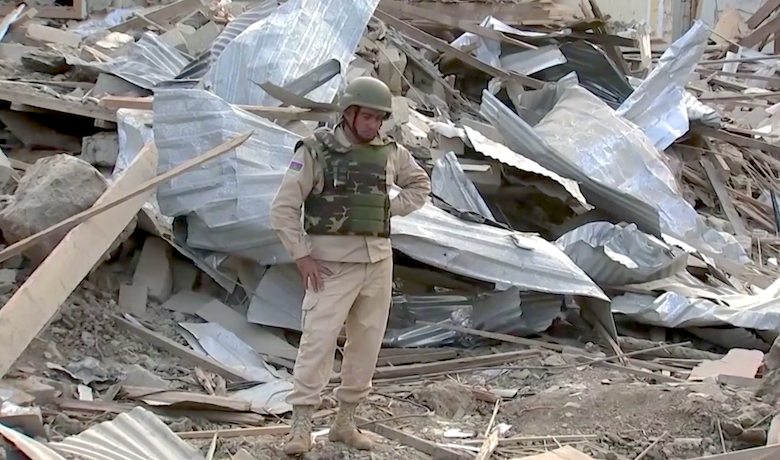
Photo credit: Voice of America via Wikimedia Commons
RELATED POSTS
Introduction: From Armed Violence to Armed Conflict
August 24, 2026
–
The Concept of Non-International Armed Conflict – Towards a Singular Definition of NIACs?
by Gloria Gaggioli
AGIL
August 24, 2026
–
Aggregating Criminal Violence: Challenges to NIAC-classification
August 25, 2026
–
Classifying Battlefield Actors in NIAC: Another View on an Old Conundrum
by Jelena Peijc
August 26, 2026
–
The IHL Dramatis Personae: Black & White or Shades of Grey?
by Katharine Fortin
AGIL
August 27, 2026
