

Laws of Yesterday’s Wars – Volume 5
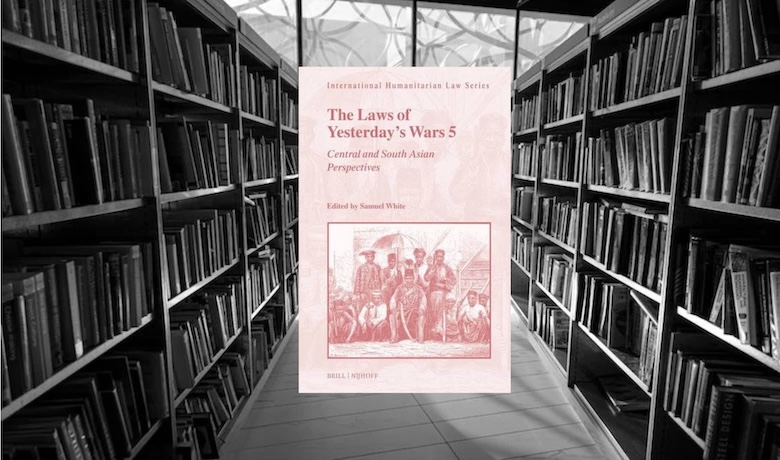
When Friedrich de Martens wrote in 1879 that international law ceased to operate in Asia and instead became “natural law,” he reflected a view that shaped generations of scholarship. International law was presented as something Europe created and exported. Asia, by contrast, appeared largely as the recipient of European legal ideas rather than a contributor to them. The history tells a different story.
Long before the adoption of the Hague Conventions or the Geneva Conventions, Asian societies had already developed sophisticated ways of regulating violence. It is something I have explored sporadically throughout the Laws of Yesterday’s Wars series, as well as singularly in a forthcoming work called Peace Beyond Westphalia. It came to the fore during my role at the National University of Singapore’s Centre for International Law and, once I started looking, I have found it everywhere. When discussing regional solutions to contemporary conflicts (such as the Thai-Cambodia border last year, all the way through to Konfrontasi) it will almost always be alongside the observation that non-interference is the ASEAN way.
But where does that come from? How are we to interpret the laws of war today with the laws of yesterday’s wars and their specific cultural, geographical, social and religious limbs? Volume 5 of the series sought to collate some of those answers, and this post highlights these contributions.
Framing the Volume
To write about “Asia” is to wrestle with a conceptual fiction. I therefore approached Volume 5 with the idea of “interpolity.” Interpolity law is a more useful term than “international law” in historical contexts. Interpolity “recognizes the legal character of relations among a range of political communities, including empires, micro-States, and corporate communities such as merchant diasporas, trading companies, and municipalities.”
We see that interpolity tension playing out today in the Indo-Pacific, just as it has for centuries. Recent research identifies interpolity zones as regions marked by “interpenetrating power and weak or uneven claims to territorial sovereignty.” The South China Seas are one such example. The Strait of Johor is another. It is no surprise that the legal concept of adat has flowed through it. Chapters in Volume 5 examine adat in contexts of the Malay peninsula, West Sumatra, and Central Asia. In an earlier volume, adat was examined in the context of Iban of Borneo.
Asian societies modified, re-interpreted, and amended adat through the cultural lenses they perceived it. This volume went beyond Southeast Asia though. It sought to canvas as wide a spectrum as possible, and rise to the challenge that Jean Pictet posited half a century ago to examine the “pure substance” that “is the heritage of all mankind.”
I deliberately instructed the chapter authors to avoid searching for Asian equivalents of the Geneva Conventions, or measuring historical practices against European models of international humanitarian law (IHL). That would misunderstand both history and law. Instead, the contributors were invited to examine societies on their own terms.
Highlights From Volume 5
Contributor Hägerdal looked to the Hindu-Buddhist basis of Balinese warfare, where diplomacy, ritual obligations and customary agreements regulated conflict, including the neutrality of villages and treatment of conquered populations. These restraints were admittedly applied inconsistently, particularly during campaigns beyond Bali, and beyond the polity in which the rules were established. Nathin and I sought to explore, in the same archipelago, the Minangkabau of West Sumatra, whose war proverbs continue to this day and shaped their interpretation of adat (providing protection for children, prisoners, the wounded, and religious personnel).
Fazli and Adzahar examined the pre-colonial Malay world, identifying prohibitions on unnecessary killing, looting and treachery. Theirs is a fascinating chapter in part for its deconstruction of what it means to be Malay and should be read alongside Lewis’s previous contribution. Sayapin turns to Central Asia, where adat met the rules of the steppe and communal reconciliation regulated disputes. His chapter demonstrates that restraint extended beyond the battlefield to rebuilding relationships after conflict, often through customary authority rather than formal legal institutions. It also demonstrates the dual legacies of Islam and Genghis Khan.
Charney explored the paradox of Buddhist kingship, especially a prohibition on killing with the creation of State-sanctioned violence. The answer lay partly in compassion towards prisoners and rigorous rules around killing. These restraints parallel the religious obligations identified in Malay and Minangkabau traditions, although their foundations and therefore methods of enforcement differed.
Mei Jansen examined Imperial China’s tianxia worldview, where Confucian virtue, the Mandate of Heaven and the moral authority of the Middle Kingdom shaped the legitimacy of military power. It is an interesting chapter, especially when linked to the lawfare notion of being owed allegiance. This concept flowed in due course across interpolity zones to their Mongol neighbours, and from there to Turkish and Cossack descendants. As with Buddhist kingship, restraint was closely connected to the ruler’s virtue rather than simply reciprocal obligations between political communities.
Seneviratne, Ratnayake, and Senaratne provided more direct examples from ancient Sri Lanka. Their examination of Dutugemunu highlights respect for defeated enemies, including the honouring of King Elara, while Parākramabāhu’s campaigns reveal both directions protecting civilians and instances of pillage, forced labour, and destruction. Like Hägerdal’s Balinese examples, they expose the persistent gap between recognised humanitarian norms and actual battlefield conduct. In modern parlance, this gap is framed as being between legal existence and enforcement.
Finally, Taak and Kaur examined Sikh traditions, where Dharam Yudh and the unity of creation connect righteous warfare with restraint and responsibility towards the natural environment. Their chapter links directly to earlier work (amplified here within Articles of War) within the series. Their discussion extends beyond the protection of human life to animals and ecosystems, offering an interesting comparison with Malay prohibitions on poisoning civilian water and food supplies. Both recognise limits on environmental harm, although their ethical foundations differ.
Concluding Thoughts on Volume 5
As I note in the conclusion of Volume 5, war is rarely “mere chaos.” Instead, communities channel the chaos and violence of war into “some form of order.” This volume looks to some of those forms, whether “expressed as oath, ritual, doctrine, story, taboo, proverb, or code.”
As with all volumes in the series, these were not identical legal systems. Nor can general rules be drawn from them. Unlike earlier volumes, the systems examined in Volume 5 occupied linked interpolity zones from which the foundations of restraint were drawn. They demonstrate that societies developed distinct understandings of permissible violence, protected persons, and the responsibilities of warriors long before Hague or Geneva. The effort to humanise warfare was never exclusively European, even if its modern legal expression became so.
Peace cannot be reduced to the mere absence of fighting. It requires institutions, relationships, and obligations capable of enduring beyond the cessation of hostilities. That distinction runs through this volume, from the mediation practices of Central Asia to the diplomatic traditions of the Malay world and the unresolved legal legacy of the Korean War.
Historical traditions cannot answer every contemporary question of IHL, nor should they be romanticised. But they challenge us to reconsider where we look for its foundations. Long before Hague or Geneva, societies across Asia had developed their own understandings of permissible violence, protected persons and the responsibilities of warriors. The modern law of war may have been codified principally in Europe, but the human endeavour to restrain warfare never belonged to Europe alone. It has been a shared journey, as Pictet predicted.
***
Dr Samuel White is currently the Scientia Senior Researcher in Military Law and War Studies at UNSW Canberra and a Global Fellow at the National University of Singapore’s Centre for International Law.
The views expressed are those of the authors, and do not necessarily reflect the official position of the United States Military Academy, Department of the Army, or Department of Defense.
Articles of War is a forum for professionals to share opinions and cultivate ideas. Articles of War does not screen articles to fit a particular editorial agenda, nor endorse or advocate material that is published. Authorship does not indicate affiliation with Articles of War, the Lieber Institute, or the United States Military Academy West Point.
Photo credit: Pexels, Brill Nijhoff
