

Lieber Studies Attribution of Non-State Actor Conduct Volume – Series Introduction
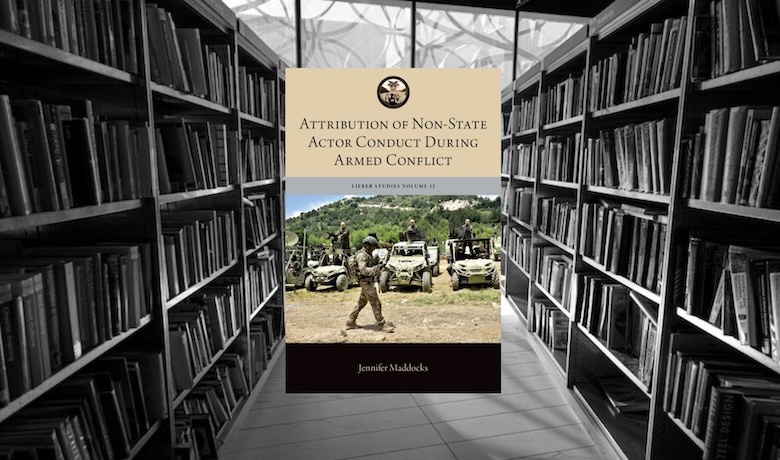
With this series we are proud to showcase the work of our former colleague Dr. Jennifer Maddocks. While an Assistant Professor with the United States Military Academy’s Department of Law and Philosophy, she completed work on her monograph, Attribution of Non-State Actor Conduct During Armed Conflict. It is the twelfth volume in the Lieber Institute for Law and Warfare series Lieber Studies, published with Oxford University Press.
State responsibility, and especially the question of attribution of conduct to States, has been a constant concern of international relations and international law. But the subject assumes heightened importance in the high-stakes context of war. As Dr. Maddocks explains, attribution is the starting point for and therefore at the heart of nearly every interaction between belligerents. Understanding the complex and often elusive legal regime that regulates attribution is therefore essential to ensuring lawful conduct of hostilities. On this basis alone, the work of Dr. Maddocks is worthy of attention.
But the timing of her focus on the conduct of non-State actors is particularly commendable as the international security environment sees frequent resort by States to private proxy actors and as victim States weigh their legal response options. The attribution issues she explores in unprecedented detail and the solutions she proposes offer vital clarity to the national security decision making circles she sets out to inform. Her volume is a superb contribution to the subject as well as our growing book series.
We begin with Dr. Maddocks, who offers a brief orientation to the volume’s origins, research, and conclusions. She first outlines the nature and extent of non-State actor involvement in armed conflict and the range of their connections to States. She then briefly tours the rules of State responsibility that are the focus of her work, including legal notions of: State organs; entities empowered by law to exercise governmental authority; effective control; absences or defaults of official authorities; insurrectional movements; and acknowledgments and adoptions of conduct. In closing, Dr. Maddocks surveys a gap of accountability which the preceding notions of State responsibility leave open, particularly in the context of armed conflict, and proposes an interpretive approach to narrow that gap.
Next, drawing from his deep reservoir of legal, operational, and scholarly experience, Brigadier-General (Ret’d) Ken Watkin KC addresses the question of when a State can be considered the “origin or cause of” the conduct of a non-State actor. BGen Watkin investigates how the volume’s accounts of events in Syria, Ukraine, and the Democratic Republic of Congo illustrate States’ efforts to mask covert and clandestine operations in “the legal shadows.” He commends especially her efforts to clarify responsibility under the murky legal notions of “effective control,” “overall control,” and “substantial involvement.”
Informed by her own significant contributions to the field, Professor Katharine Fortin highlights the volume’s coverage of Article 9 of the Articles on Responsibility of States for Internationally Wrongful Acts (ARSIWA). Noting the highly exceptional character of Article 9’s intended coverage, Professor Fortin explains how the volume’s approach to attribution to States of conduct by persons or groups that exercise governmental authority reflects an advance in thought and potential practice. She closes by posing several unresolved questions “for a cup of tea” with Dr. Maddocks. We sincerely hope they will transcribe that session for publication in a future co-authored Articles of War post!
Next, Professor Patrick Dumberry, whose work has carefully considered State responsibility for conduct by insurgent movements, covers the volume’s treatment of Article 10 of the ARSIWA. Professor Dumberry focuses on the fascinating question of what constitutes an “insurrectional movement” for purposes of attributing its conduct to a subsequently formed State. While he notes in one case an excessive broadening of Article 10’s coverage by the volume, he finds its conclusions convincing and a helpful practical tool for States navigating “the current chaotic state of international relations.”
Then, Professor Nicholas Tsagourias, a frequent and influential contributor to scholarship on State Responsibility, particularly in emerging domains of conflict such as cyberspace, addresses the volume’s assessment of customary international law status for Article 11 of ARSIWA. Where the volume disputes that the article’s rule on acknowledgment and adoption of non-State actors’ conduct by a State reflects binding custom, Professor Tsagourias musters for readers evidence to the contrary, citing deep roots in early international law and its invocation by various tribunals, each of which the volume acknowledges but accords less weight.
Finally, Professor Michael Schmitt and Dr. Klaudia Klonowska address attribution issues arising from use of artificial intelligence-enabled technologies in armed conflict. They address select attribution questions raised by the volume that relate to organized armed groups employing artificial intelligence in armed conflict. They also address attribution concerns involving private, commercial sector entities that design, develop, and bring to market artificial intelligence-enabled warfighting tools.
Before turning the series over to the contributors, we wish to thank each of them for their work and especially Dr. Maddocks whom we miss greatly but are proud to honor and support with this series. We encourage our readers to follow the series closely and hope it leads them to spend time with her impressive volume.
***
Colonel Josh Berry is the Deputy Head of the Department of Law and Philosophy, United States Military Academy at West Point and Co-Editor-in-Chief of Articles of War.
Liisi Adamson is the Managing Editor of Articles of War.
Sean Watts is a Professor in the Department of Law and Philosophy at the United States Military Academy, Co-Director of the Lieber Institute for Law and Warfare at West Point, and Co-Editor-in-Chief of Articles of War.
The views expressed are those of the authors, and do not necessarily reflect the official position of the United States Military Academy, Department of the Army, or Department of Defense.
Articles of War is a forum for professionals to share opinions and cultivate ideas. Articles of War does not screen articles to fit a particular editorial agenda, nor endorse or advocate material that is published.
Photo credit: Pexels, Oxford University Press
