

Lieber Studies Non-State Actor Attribution Volume Series – Blowing the Dust Off Article 9 of ARSIWA: Some Clarity and Some Questions
Editors’ note: This post appears as an entry in a series dedicated to Dr Jennifer Maddocks’ monograph, Attribution of Non-State Actor Conduct during Armed Conflict, appearing in the Lieber Studies book series with Oxford University Press.
Article 9 is a fascinating and peculiar article in the Articles of Responsibility of States for Internationally Wrongful Acts (ARSIWA). It deals with situations where the State is held responsible for conduct not because of what it does in terms of positive action, but essentially because of what it does not do. Drafted by the International Law Commission (ILC) to apply to situations of “agency of necessity” (see commentary, p. 49, para. 2), the Article covers situations where private actors have stepped in to carry out tasks that under usual circumstances would be carried out by the regular authorities of the State. Article 9 provides,
The conduct of a person or group of persons shall be considered an act of a State under international law if the person or group of persons is in fact exercising elements of the governmental authority in the absence or default of the official authorities and in circumstances such as to call for the exercise of those elements of authority.
Most analyses of the article break down this text into three components: exercise of elements of governmental authority; the absence or default of the official authorities; and the circumstances such as to call for the exercise of those elements of authority.
Given that Article 9 was only ever supposed to apply to highly exceptional circumstances, it is perhaps not surprising that the article generated very little attention from States during the drafting process. It may also explain why its commentaries contain so few examples of State practice and international jurisprudence, and why since its adoption there has been little, if any, judicial consideration of the rule. The meagre attention that the article has received from commentators means that questions remain regarding its customary status and its object and purpose (Maddocks, p. 237, 240).
Maddocks’s review of Article 9 in Chapter 8 of her book is the most detailed review of this article to date and certainly contributes to understanding the scope of the article and its possible application to different situations. After accepting the invitation to write this post, I found myself in the difficult position of finding that I agreed with most of what Maddocks has written. Rather than focusing on the points that I don’t agree with, which are few and far between, I will instead highlight some of Maddocks’s findings that I find particularly valuable and mention a few areas where I might need a bit more convincing or would be interested to hear her thoughts.
Does Article 9 Apply to the Acts of Armed Goups?
Maddocks’s analysis brings greater clarity to a scholarly debate that has been going on for some time regarding whether Article 9 is applicable to the acts of an organised armed group, confirming that it can. My own contribution to this debate can be found in Chapter 9 of my monograph The Accountability of Armed Groups under Human Rights Law (OUP 2017) and a later book chapter (here).
Doubt on this question has arisen because the idea that a State can be held responsible for the acts of an armed group fighting against it seems somewhat counterintuitive. It also sits uncomfortably with records showing that Special Rapporteur Robert Ago dismissed the idea that a State could ever be responsible for the acts of an armed group, except in the narrow circumstances prescribed by Article 10 (Fortin, p. 250). Equally, Special Rapporteur James Crawford, in his subsequent work on State responsibility, also dismissed the idea (Maddocks, p. 248).
While it may feel unorthodox to go against the views of two scholars who were so close to the drafting process, there is no getting around the fact that their views are hard to reconcile with the wording of the ILC’s commentary to Article 10 of the ARWISA, which explicitly states that the acts of unsuccessful insurrectional movements can be attributed to the State “in the special circumstances envisaged by Article 9” (see commentary, p. 50, para. 2; Maddocks, p. 248).
They also conflict with wording in the commentary to Article 5 of ARSIWA, which affirms that the article will not apply to situations in which an “entity or group seizes power in the absence of State organs but in situations where the exercise of governmental authority is called for.” In making this distinction, the Article 5 commentary confirms that Article 9 covers this situation (see commentary, p. 43, para. 7; Maddocks, p. 248).
Despite this wording in the commentary to Article 10 and 5, there is continuing disagreement among scholars as to whether Article 9 is applicable to the acts of what the ILC commentary calls “unsuccessful” insurrectional movements. This term refers to armed groups who either have not successfully become the new government whose acts (present and past) are covered by Article 10 or have not formed a new government out of a failed state, whose acts are covered by Article 4 (see commentary, p. 49, para. 2). In other words, the term “unsuccessful insurrectional movement” refers to armed groups who are still engaged in an armed struggle.
Given the reference in Article 9 to groups who are “in fact exercising elements of the governmental authority,” the discussion regarding Article 9’s application to armed groups has usually centred around armed groups that are controlling territory and exercising governance.
What is Relevant … the Act or the Actor?
Maddocks points out that the disagreement has mainly centred on the requirement in Article 9 that the elements of governmental authority are exercised in “circumstances such as to call for the exercise of those elements of authority.” In their consideration of what these words require, scholars are divided between those who take an act-based approach (into which I fall) and those who take an actor-based approach (Maddocks, p. 270).
Those scholars who, like me, take an act-based approach argue that the question of whether Article 9 applies should be resolved solely by an examination of the character of the act and whether it was objectively necessary for it to be performed. Under this approach, the character of the entity doing the act is not determinative; it is only the character of the act that counts (Fortin, p. 254).
Those who take an actor-based approach argue that the issue should be determined by the character of the actor, with particular account taken of the circumstances that led to its control over territory and its relationship with the State. Eatwell, for example, argues that if an armed non-State actor (NSA) caused the State’s default or absence, then its conduct should be excluded from the scope of Article 9 (Eatwell, pp. 116-166). Bílková makes a similar argument, indicating that Article 9 should only apply to armed groups that have not been implicated in having caused the State’s default in the first place, because such a group lacks a bona fide attitude (Bílková, p. 269).
Maddocks insightfully points out that there are problems with both approaches (Maddocks, p. 272). There are problems with the act-based approach because, as I acknowledge in my work on the topic, it leads to the counterintuitive conclusion that a State is responsible for the acts of an armed NSA against which it is fighting (Fortin, p. 385-86). There are conceptual problems with the actor-based approach because it does not seem to accord with the object and purpose of Article 9, which seems focused on acts and not actors (Fortin, p. 254; Maddocks, p. 272). A second problem with the actor-based approach is that during armed conflicts it would often be almost impossible to know which actor is to blame for a State’s default in governance (Fortin, p. 253; Maddocks, p. 273).
Trying to resolve the weaknesses of both these approaches, Maddocks puts forward what she calls “a multifaceted approach” to the “called for” criterion, which takes into account circumstances not only relevant to the act or the actor but to all the surrounding circumstances (Maddocks, p. 273-79). In my view, this is the greatest contribution of this chapter, and I agree with many of her conclusions.
As a result of her analysis, Maddocks puts forward some guidance relevant for any assessment of the “called for” analysis, which I list here because it’s helpful.
– It is the broader course of conduct that is relevant to determine whether the conduct was “called for” for the purposes of Article 9, and not the specific acts of the NSA that violate the State’s international legal obligations (Maddocks, p. 269, 274);
– To determine whether the conduct in question is attributable to a State, it is necessary to determine whether there is a nexus between those acts and the broader functions performed by the NSA (Maddocks, p. 275);
– The State’s attitude towards the conduct may be relevant, and the fact that the State instigates the conduct does not mean that it falls outside the article’s scope (Maddocks, p. 275);
– Article 9 will only rarely apply to the acts of armed opposition groups, and then it will only apply to governance-related acts and not acts related to the armed group’s armed struggle against the State (Maddocks, p. 275);
– In determining whether such conduct could satisfy the “called for” element, it can be helpful to objectively assess what gap the NSA sought to fill through its wider actions and whether this was a lacuna that needed to be filled, given the absence or default of the official authorities (Maddocks, p. 277).
Remaining Questions for a Cup of Tea
All of this is helpful and useful, though I do have some points on which I need a bit more convincing or on which I would like to hear Maddocks’s further thoughts either during this symposium or perhaps at some point over a cup of tea.
First, I am not 100% convinced that the wording of Article 9 or the drafting papers support the idea that the “called for” requirement needs the acts in question to be “essential to satisfy the needs of the population” as Maddocks writes in various places in the chapter (Maddocks, p. 267, 278). Such a high bar is not found in the wording of Article 9, which indicates that the acts should merely be “called for.” I do acknowledge there is probably only a small difference between something being “essential” and something being “called for,” but if the act needs to be “essential,” it suggests that something catastrophic will happen if it is not provided.
Yet, a lot of the examples given in the commentary suggest that the actual purpose of Article 9 was to recognise that private actors often step in to facilitate the continuance of daily life. In other words, the purpose of Article 9 was not only to apply to actions taken to ensure that people survive (i.e. delivery of emergency relief after a natural disaster) but also to apply to actions taken to ensure daily life can continue (i.e. administering property, performing legal acts, pronouncing judgments) (Fortin, p. 249; see ILC Report 1974, p. 285).
Second, I have some doubts about the argument that in an instance where a State tolerates or acquiesces in an armed group’s performance of public tasks, as occurred in Sri Lanka, the “called for” requirement can be said to be satisfied (Maddocks, p. 264). I am also not fully convinced that the object and purpose of Article 9 supports the idea that it should apply to acts that have been instigated or encouraged by the State (Maddocks, p. 256). My doubts on this come from the fact that, as Maddocks points out, the ILC commentary refers to NSAs acting “on their own initiative” and “without any actual authority to do so” (see commentary, p. 49, para 4).
While I understand that the tests in Article 8 and Article 5 may be too high to catch many acts done based on either a State’s instigation or instructions/encouragement (see Maddocks, p. 255-56), the exceptional character of Article 9 makes it unlikely that it will ever be able to act as a “safety net” in these circumstances. This is because the idea that there is some instigation or encouragement suggests that the NSA’s action no longer fits into the “agency of necessity” model, but more fits into delegated State power. Equally, if an NSA is exercising governmental functions in parallel to the government, like in Sri Lanka, this would seem to make it less likely, not more, that Article 9 would be held to apply to the NSA’s actions, without proof that the government was somehow incapacitated or unable (see Maddocks, p. 264; Fortin, p. 270).
Thinking through this problem, I do find myself wondering whether the notion of a State being absent or present in a particular locality might need more thought given the technological developments during the decades since the articles were drafted. At the time the articles were finalised, the drafters of Article 9 were obviously thinking about the regular authorities being physically absent due to a natural disaster or war. Will the fact that regular authorities can be digitally present when they are physically absent make it even less likely that Article 9 will ever be applied?
Third, I find myself having questions relating to Maddocks’s interesting analysis regarding how Article 9 would apply to situations of occupation (Maddocks, p. 261-63). Given that the commentary to Article 9 explicitly indicates that Article 9 can apply in situations of occupation, Maddocks’s more detailed examination of this question is valuable (see commentary, p. 49, para 1). In my view, she comes to the correct conclusion that it will not apply to situations of occupation. To understand why this is correct, it is important to go back to the reports of the Special Rapporteur discussing Article 9.
Here, it was made clear that Article 9 was designed to cover governance vacuums that might arise either just before a situation of occupation or just after an occupation. The examples that were given were situations where the local administrations fled before the invading German army and situations where occupying administrations fled before the liberating Allied forces (see ILC Report 1974, p. 285). In both these types of situations, the drafters noted that individuals or groups of individuals may fill the administrative void created by the fleeing government and take over government functions.
If Article 9 was intended to mainly apply to situations where there was an administrative void, it makes sense that it will probably not apply to situations of occupation. This is because generally, for a territory to be occupied, it needs to be “actually placed under the authority of the hostile army.” While agreeing with Maddocks’s analysis on this point, I found myself wondering whether there would ever be a situation where Article 9 would allow the conduct of individuals to be attributed to the (about to be/ just been) occupying State, rather than the occupied State? For example, if there would be an earthquake in a part of the occupied territory, such that the occupying power can no longer ensure public order and safety and private individuals or groups of individuals would step into that gap, would the responsibility be attributable to the occupying State, rather than the territorial State? What about a situation where the occupying power’s administrative capabilities are dissolving due to encroaching hostilities? Would the acts of private individuals stepping in to fill that administrative void be attributed to the occupying State or the territorial State? I’d be curious to hear Maddocks’s thoughts on this.
Conclusion
To conclude, there is no doubt in my mind that this is an excellent chapter that makes a real contribution to the understanding of Article 9 in an impressive book. I particularly appreciated the myriad of real-life examples with which Maddocks tested her analysis, especially those relating to civilian resistance actions that have not been discussed in this post but are very valuable. As more States turn to defence strategies relying on civilian involvement, these examples demonstrate that Article 9 may become increasingly relevant.
My only final question for Maddocks is the question I asked myself when studying Article 9 for the purpose of my monograph on armed groups and human rights law: what does a finding that an NSA’s actions can be attributed to the State as a violation of international law say about whether those NSAs are bound by international law? Maybe this one will have to wait for the cup of tea.
***
Katharine Fortin is Associate Professor at the Netherlands Institute of Human Rights, Utrecht University and a researcher at the Montaigne Centre for the Rule of Law and Administration of Justice.
The views expressed are those of the author, and do not necessarily reflect the official position of the United States Military Academy, Department of the Army, or Department of Defense.
Articles of War is a forum for professionals to share opinions and cultivate ideas. Articles of War does not screen articles to fit a particular editorial agenda, nor endorse or advocate material that is published. Authorship does not indicate affiliation with Articles of War, the Lieber Institute, or the United States Military Academy West Point.
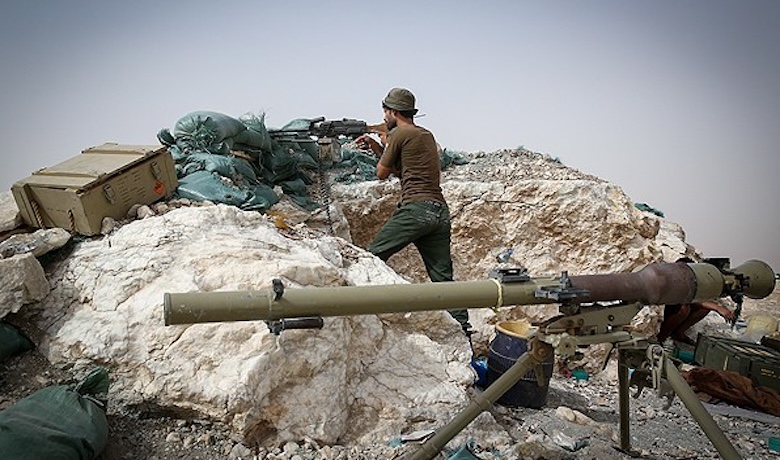
Photo credit: Mohammad Hossein Velayati, Fars News Agency via Wikimedia Commons
RELATED POSTS
by Joshua F. Berry, Liisi Adamson, Sean Watts
September 16, 2026
–
Attribution of Non-State Actor Conduct During Armed Conflict
September 16, 2026
–
Shadow Warfare, State Attribution and Substantial Involvement
by Ken Watkin
September 18, 2026
